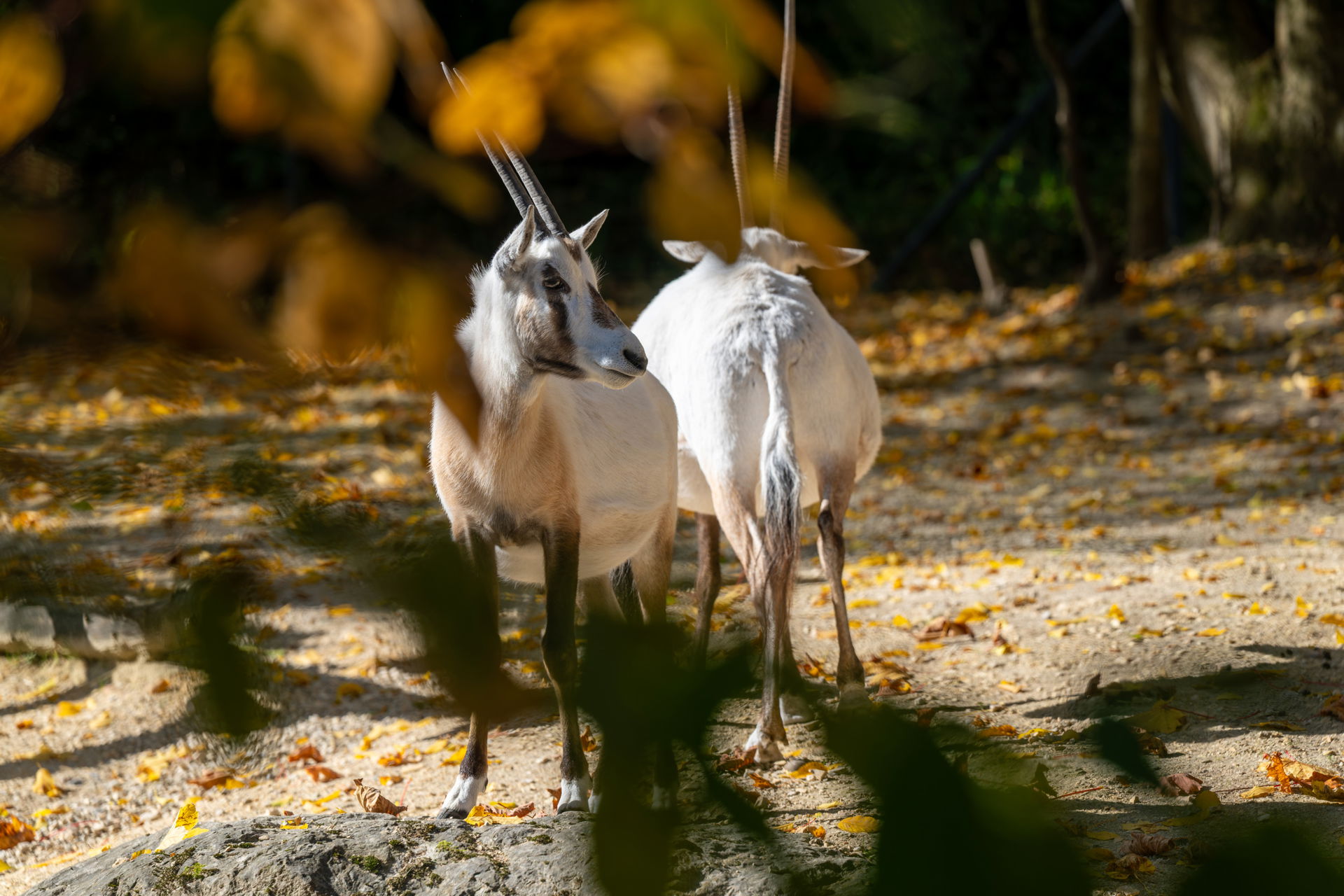
The Arabian oryx is perfectly adapted to life in arid regions. The light colour of its coat reflects the sun’s rays, thus protecting it from the heat. Without suffering any harm, the animals can raise their body temperature to as high as 46.5 degrees Celsius in intense heat and lower it to as low as 36 degrees during cool nights.
To minimise fluid loss, the oryx’s faeces are very dry and its urine is highly concentrated. When dew forms on the animals’ coats during the cool desert nights, they lick it off, thereby obtaining some of the drinking water they need.
The Arabian oryx was on the brink of extinction. In 1960, the population was estimated at around 200 animals. In 1972, the last animal was poached in Oman. Two years earlier, the US zoos in Phoenix and Los Angeles had launched a breeding programme. At the time, only nine animals were available. However, the breeding programme proved successful, and so in 1979, a number of animals were brought to Europe.
Berlin-Friedrichsfelde Wildlife Park (then in the GDR), Antwerp Zoo and Zoo Zurich were the first to receive Arabian oryx from the USA. Zoo Zurich received a total of six animals, which formed the basis of a successful breeding programme.
From 1982 onwards, the first animals born in zoos were able to be released into the wild. Arabian oryx bred at Zoo Zurich were sent to Jordan and, in 1993, to Saudi Arabia.
The population is now estimated at over 8,000 animals, of which around 850 are adults living in protected areas in the desert. This success in species conservation is also down to the work of forward-thinking zoos.
The Arabian oryx is a national symbol in Jordan, the United Arab Emirates and Qatar.
Taxonomy
Bovidae, Oryx (6 species)
Habitat
semi-deserts and deserts
Behaviour and ecology
diurnal, foraging in areas with fresh vegetation
Social structure
mixed-sex herds of up to 10 animals, rarely in herds of up to 100 animals; bucks are solitary for short periods