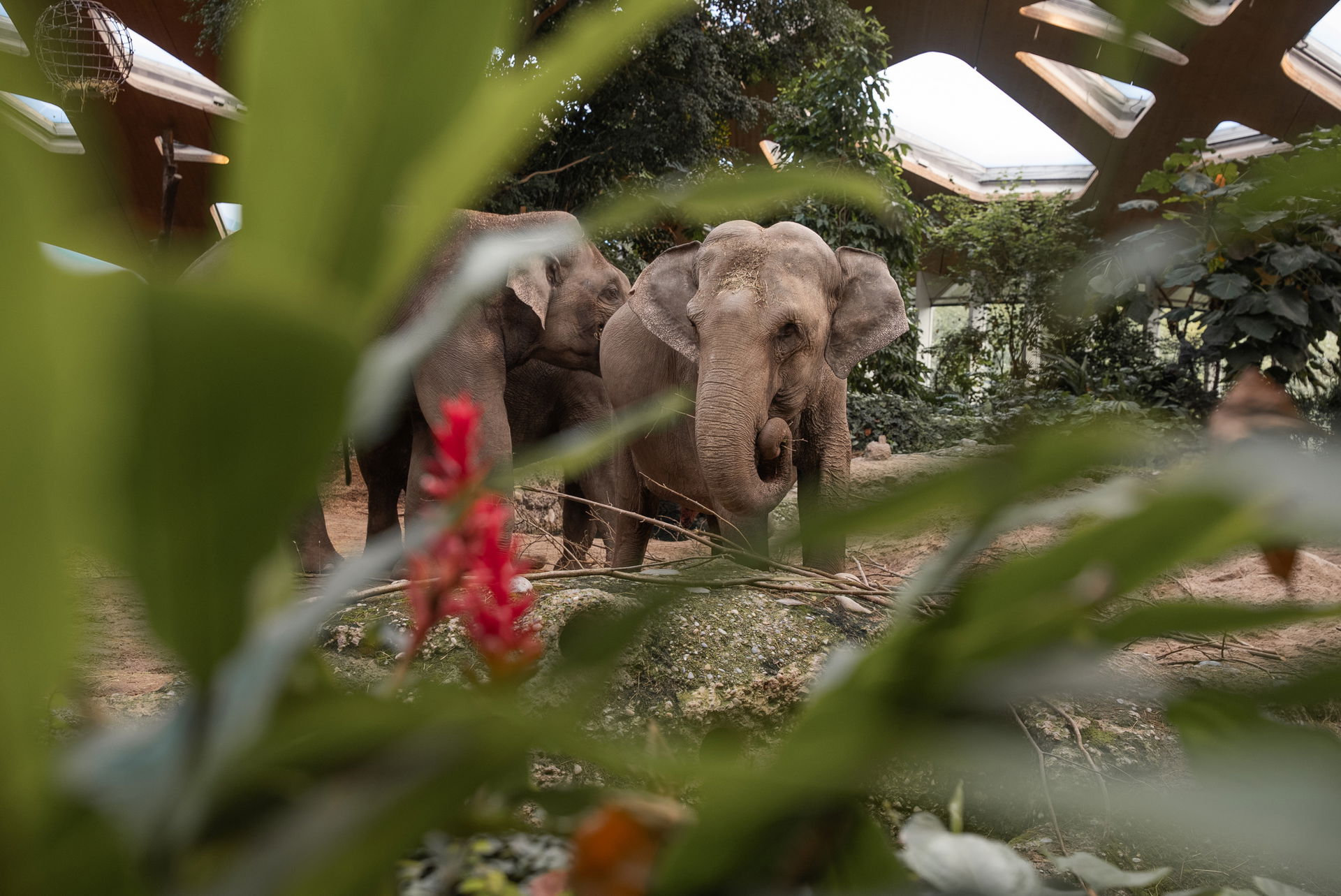
Asiatische Elefanten (Elephas maximus) im Kaeng Krachan Elefantenpark des Zoo Zürich

Asian elephant

Elephas maximus

The Asian elephant is the largest and heaviest land mammal in Asia. It lives in complex family groups led by experienced females.

EN

Red List
Endangered
Breeding programme

Elephants love water. They are good and persistent swimmers. To swim, elephants move all four legs at the same time. Their massive bodies provide them with buoyancy. Their face is usually above the water’s surface, whilst their mouth is in the water. To breathe, elephants use their trunk as a snorkel.

In the wild, the Andaman swimming elephants are particularly well known; the Andamans are an archipelago that belongs to India. There, it is not uncommon for elephants to leave one island and swim several kilometres across the Andaman Sea to another island.

Elephants engage in elaborate skin care routines that take a great deal of time. The animals bathe and wallow, massage their bodies and dust them with powder to get rid of pesky parasites in the folds of their skin.

Their large, well-perfused ears help regulate their body temperature. This is because elephants have difficulty regulating their body temperature naturally. For example, they do not have actual sweat glands and are therefore unable to sweat. When it is hot, they therefore seek shade, go into the water and/or fan their ears. This is because their large ears contain extensive blood vessels. By fanning their ears, the warm blood cools down slightly.

Taxonomy

Elephants (Elephantidae), genus Elephas

Habitat

Dry forest, rainforest, scrubland and grassland

Behaviour and ecology

active during the day, but in the wild mainly active at dusk and at night; tends to rest in the shade during the day

Social structure

Herds comprising related adult females and their young, with males in small groups or living as solitary individuals

Habitat at the zoo:

Kaeng Krachan Elephant Park

Our elephants

Indi, female, born in Burma in 1986

Chandra, female, born 13 May 2002 at Zoo Zurich

Panang, female, born 13 February 1989 at Zoo Zurich

Farha, female, born on 3 May 2005 at Zoo Zurich

Thai, male, born 26 November 2004, at Hamburg Zoo

Food per day

  • 150kg

    An elephant eats up to 150 kg a day; at the zoo, it mainly eats hay and branches.

  • 6kg

    Elephant's Cubes

  • 3kg

    Vegetables and fruit (carrots, beetroot, fodder beets, cauliflower, celery, fennel, leeks, apples)

  • 100g

    Livestock salt

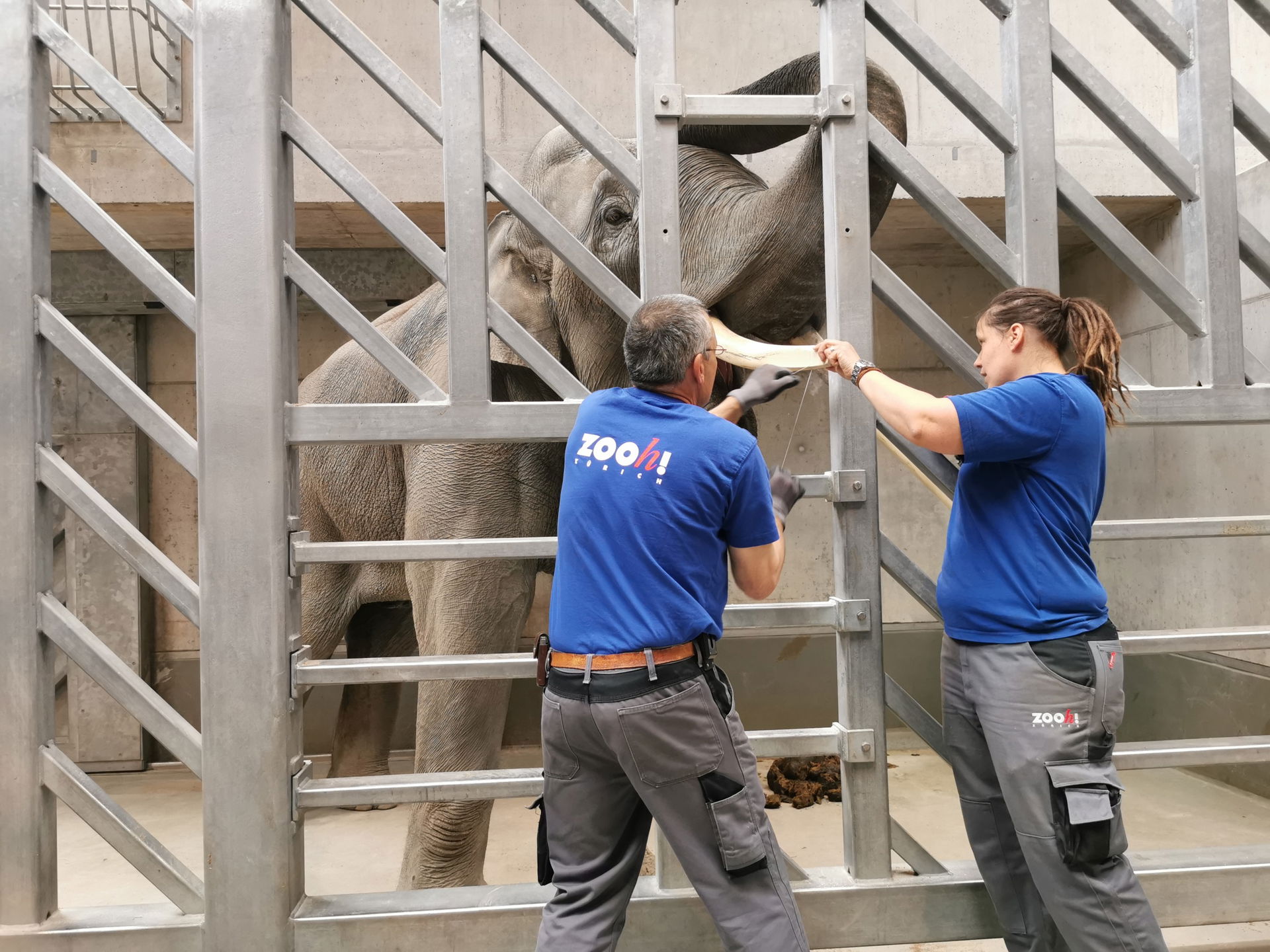
  • At Zoo Zurich, we keep elephants in a protected contact environment. Photo: Zoo Zurich, Sandro Schönbächler
    Protected contact

    We keep our elephants in what is known as protected contact. This means that elephants and humans are always separated by a barrier. This has many benefits for both animals and humans.

    However, it also means that the elephant must come to a specific spot in the exhibit of its own accord when the keepers or vets want to examine an elephant and, for example, take a closer look at a particular part of its body. This only works if the elephant is happy to cooperate.

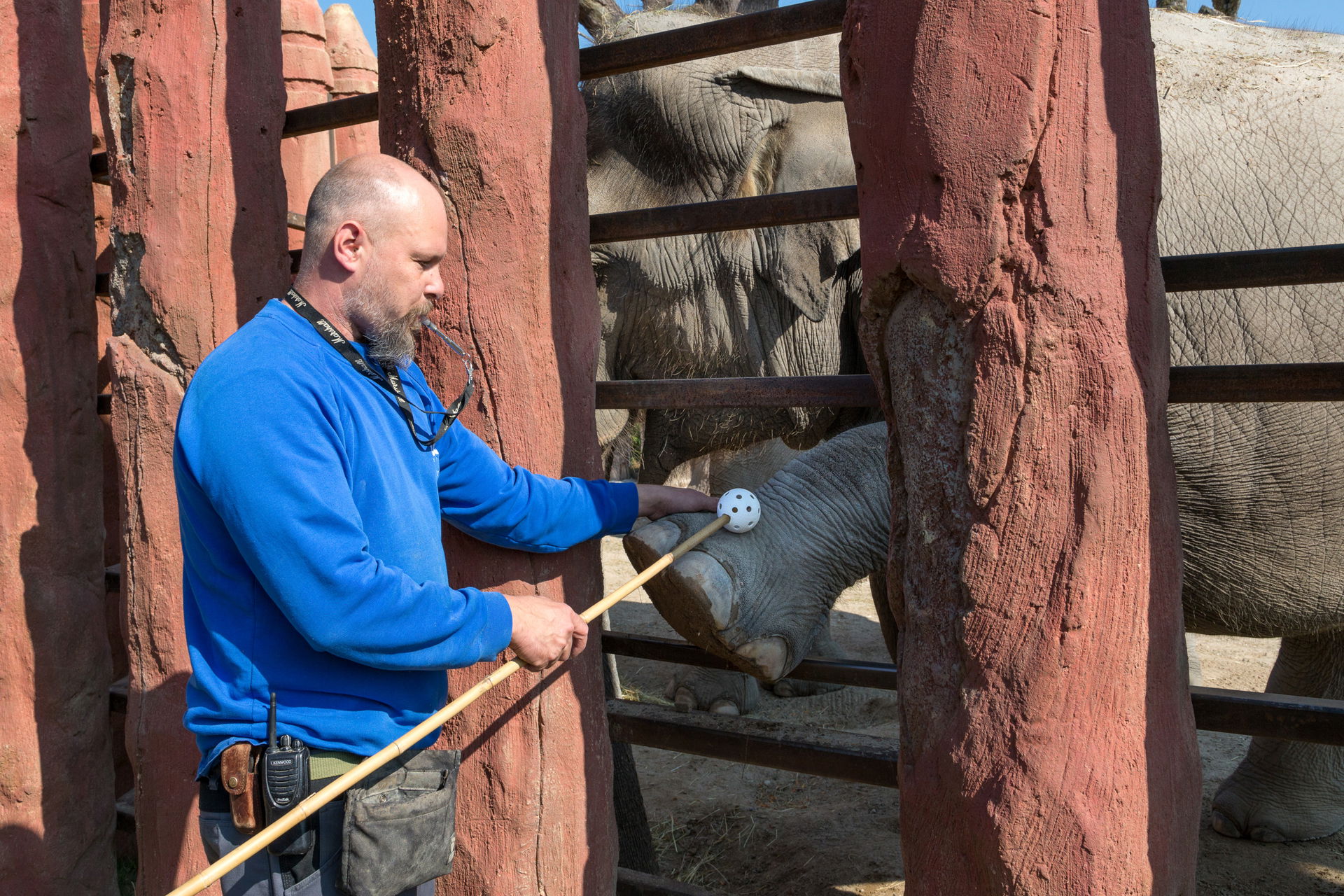
    We train our elephants using the principles of positive reinforcement. Photo: Zoo Zurich, Enzo Franchini

    Training using positive reinforcement

    For this to work, appropriate training is required. To this end, we use training based on positive reinforcement. The principle is simple: desired behaviour is positively reinforced, i.e. rewarded. If the elephant does the ‘right’ thing, it receives a reward. If it doesn’t do the right thing, nothing happens; there is no punishment.

    Put simply, the training works like this:

    1. The animal keeper prompts the elephant to do something.

    2. The elephant does as asked.

    3. The animal keeper signals (e.g. with a click or a whistle) that the elephant has done the right thing.

    4. The elephant receives an immediate reward, such as a treat.

    Another tool that is frequently used is the ‘target’, which is often a stick or similar object. The keeper uses it as a ‘guide’ to help the elephant understand more easily what it is supposed to do.

    The elephant first learns to touch the pole or follow it using different parts of its body. Later, the keepers can use the pole to guide the animal into the desired position. For example, so that they can trim its hooves or so that the vets can examine its ear.

    Positive reinforcement works with any species of animal. At Zurich Zoo, we therefore use this training method not only with the elephants, but also with other animals.

    Animal sound

    Elephants video playlist

    More exciting topics about elephants

    Back to overview