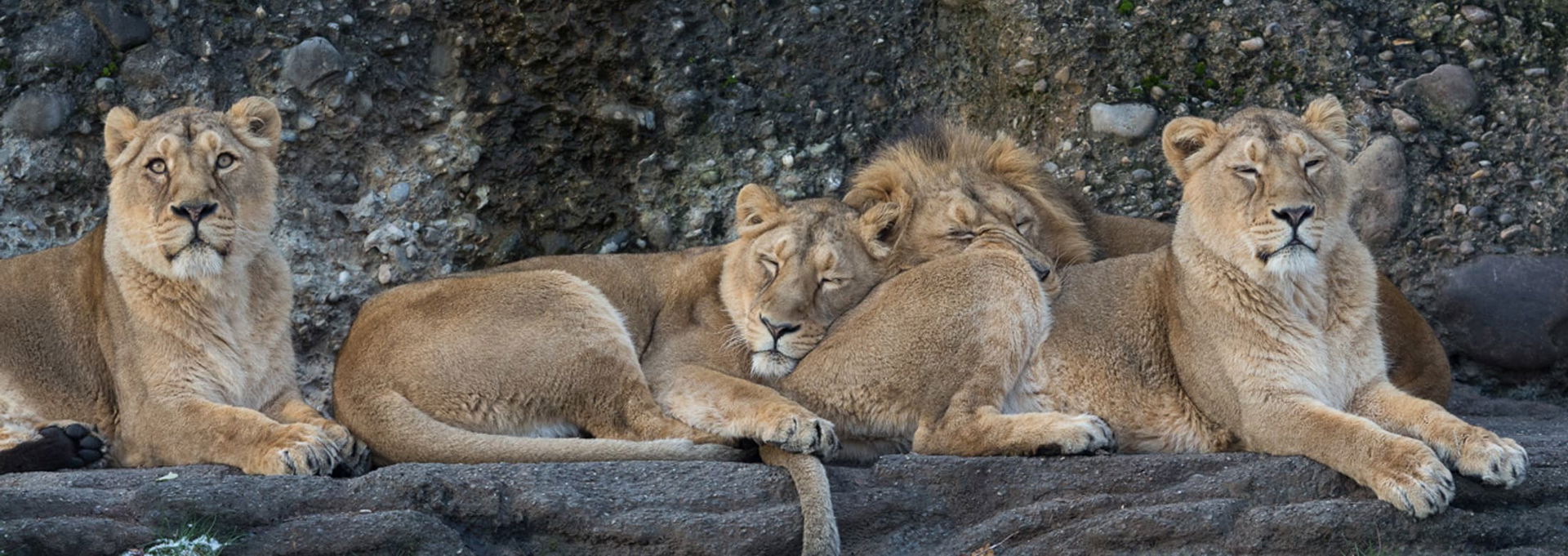
According to historical records, around 2,000 years ago, the Asiatic lion’s range stretched from south-eastern Europe – including Bulgaria and Greece – as far as India. At present, however, its habitat is confined to Gir National Park in the Indian state of Gujarat.
In 1913, the Asiatic lion was on the brink of extinction, with an estimated population of just 20 individuals. It was the then ruler of Gujarat, himself a passionate big-game hunter, who placed the remaining lion populations in the Gir Forest under his protection. In 1955, India introduced a national ban on hunting, and in 1965 a protected area covering 1,412 square kilometres was established in the Gir Forest.
The conservation measures led to an increase in the population, which has since grown to over 500 individuals. However, this growth resulted in overpopulation within the limited protected area, leading the lions to expand their habitat beyond the reserve’s boundaries. Human-wildlife conflicts occur repeatedly in these areas. To address this issue, Zoo Zurich supported a project over several years aimed at establishing a second protected area in India for the relocation of the lions.
In appearance, Asiatic lions differ from their African counterparts. They are smaller on average and have a distinctive, longitudinal skin fold on their belly, which is not present in African lions. Furthermore, male Asiatic lions have a less pronounced mane with shorter hair. The skull structures of the two subspecies also show slight but measurable differences, which are used, amongst other things, for taxonomic classification.
The Asiatic lion is a prime example of the success of species conservation measures. Its long-term survival depends on addressing existing challenges such as habitat constraints and the resulting overpopulation, as well as resolving human-wildlife conflicts.
Taxonomy
Felidae, Panthera (5 species)
Behaviour and ecology
diurnal, territorial
Social structure
in pairs, small family groups