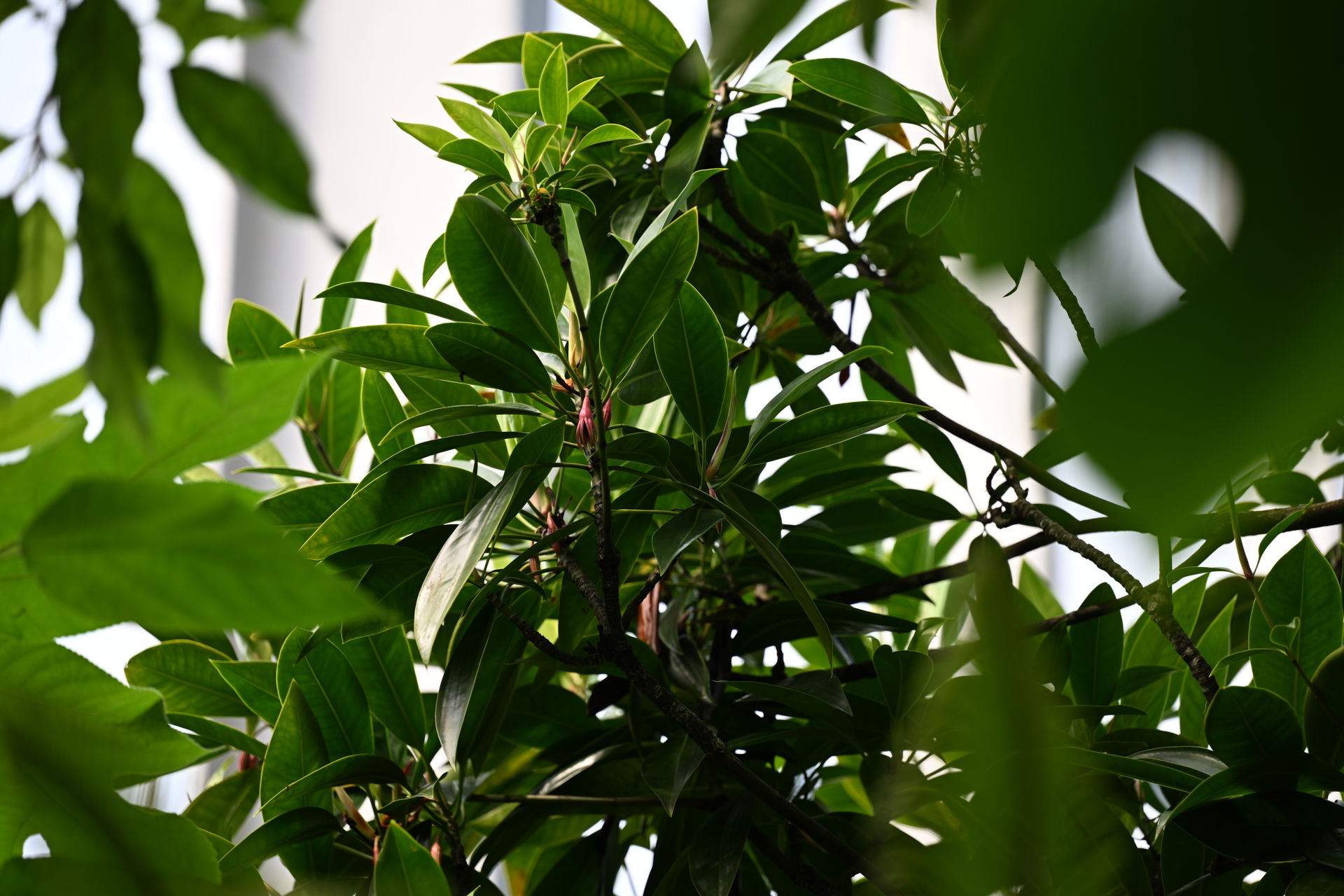
Mangrove forests grow along tropical coastlines that are subject to fluctuations in water levels caused by the tides. At high tide, only the tree crowns of the mangroves protrude above the water; at low tide, the forests are more or less dry. Mangrove forests thrive particularly well on muddy bottoms in lagoons or river estuaries.
Based on their tree species composition, mangrove forests are classified into western mangrove forests (West Africa, the east coast of South and Central America, and the Caribbean) and eastern mangrove forests (East Africa, Madagascar, South and Southeast Asia, and the South Pacific). Eastern mangrove forests are more species-rich. The eight tree species of the genus Rhizophora have the widest distribution.
Mangrove trees have developed a remarkable adaptation to their extreme living conditions through their root system. Lateral roots emerge from the trunk and grow downward in an arc. As they penetrate the mud, a multitude of nutrient roots form. The lateral roots, also known as stilt roots, help anchor the tree more securely in a habitat characterized by water currents and waves. However, the most important function of the stilt roots is oxygen uptake. The prop roots have small, air-permeable openings that are water-repellent and thus prevent water from entering. When the water level is high, the oxygen in the roots is consumed. This creates a negative pressure that is equalized again at low tide by drawing in air.
The fruit of mangrove trees contains only one seed. The seed begins to grow into a seedling while still attached to the parent tree. In the case of Rhizophora, these elongated seedlings can reach lengths of up to 40 centimeters. The young seedlings eventually fall from the tree and become lodged in the soft soil or are carried away by the tide. However, thanks to their rapid root growth, they are able to establish themselves quickly.
Mangroves must be resistant to high salt concentrations in seawater and soil water. However, scientists have not yet determined how salt levels are regulated within the plant.
Taxonomy
Rhizophoraceae, genus Bruguiera (approx. 6 species)
Distribution
tropical coastal regions around the world, including Madagascar
Use
Mangrove forests are important breeding grounds for fish and invertebrates. The wood from these trees is used for construction and as firewood. In particular, its resistance to the dreaded shipworm makes the wood very popular in shipbuilding.