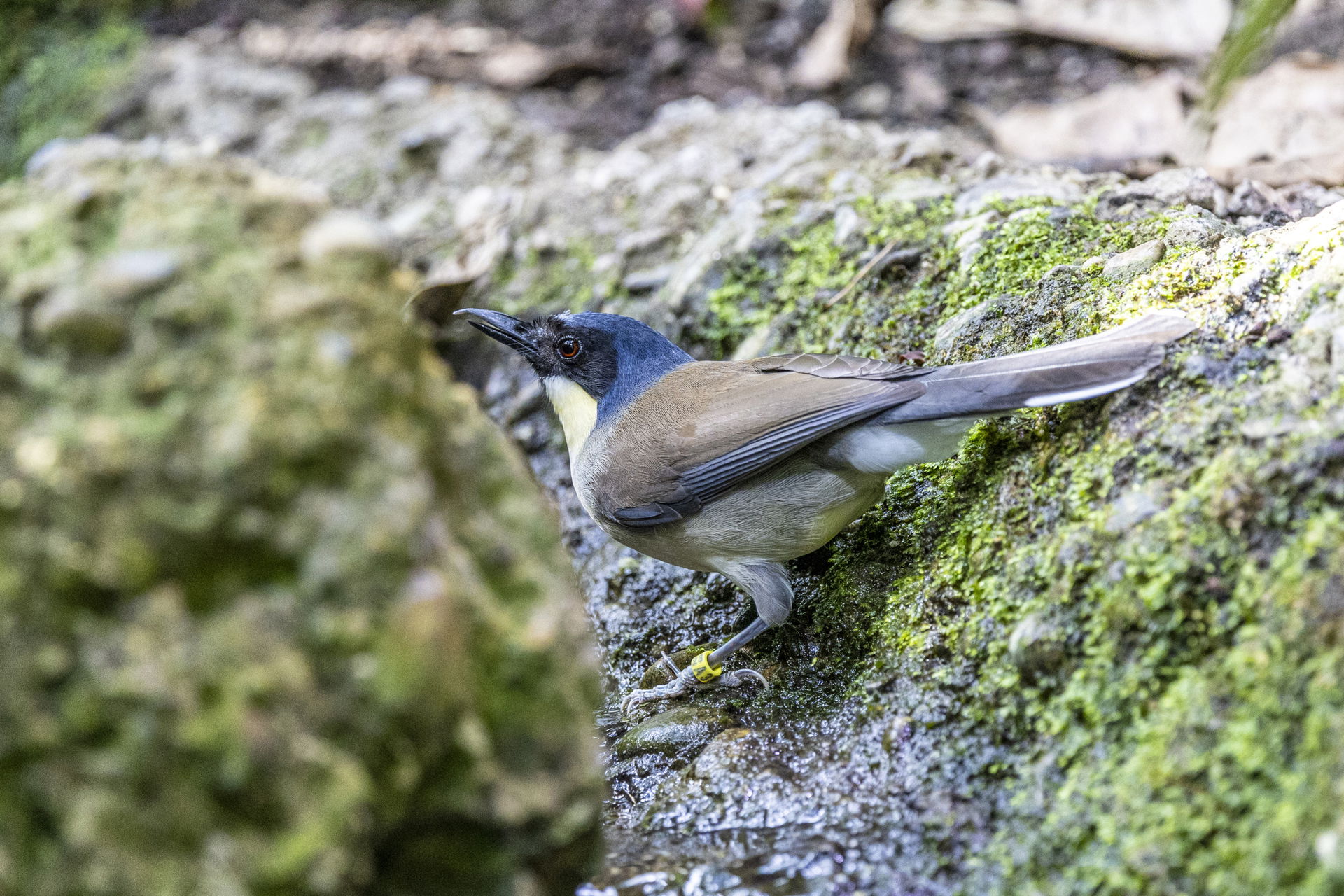
Blaukappenhäherling in der Forschungsstation im Zoo Zürich

Blue-crowned laughingthrush

Pterorhinus courtoisi

Their diverse repertoire of calls includes a sound that is strikingly similar to human laughter, which is why these birds are known as “laughingthrushes.”

CR

Red List
Critically Endangered
Breeding programme

The blue-crowned laughingthrush, as its name suggests, belongs to the laughingthrush family. These birds have a diverse repertoire of calls.
The blue-crowned laughingthrush is found exclusively in a small area in southeastern China (Jiangxi Province). Before it was rediscovered in 2000, it had not been observed in its natural habitat for a long time.
The birds inhabit forests, scrubland, and clumps of trees near human settlements. They usually live in pairs, family groups, or loose flocks of up to 40 individuals. They noisily forage on the ground, in shrubs, and in trees for insects, larvae, and other invertebrates. In doing so, they turn over layers of leaves, search tree bark for prey, and deftly climb through dense branches and vines. As insectivores, they help maintain the ecological balance of their habitat.
During the breeding season from April to July, the birds build bowl-shaped nests out of twigs and grasses, which are usually situated several meters high in trees. Not only the parents, but sometimes other group members as well—such as juveniles from earlier broods—participate in caring for the young birds and defending the brood.
The blue-crowned laughingthrush was once captured in large numbers for the pet trade. Today, the few remaining breeding areas are primarily threatened by habitat loss, road and residential construction, as well as disturbances caused by tourism and human activities.

Taxonomy

Leiothrichidae, genus Pterorhinus (23 species)

Habitat

evergreen, subtropical deciduous forest, coniferous forest, and adjacent scrubland

Behaviour and ecology

diurnal

Social structure

they live in pairs, in small family groups, or in larger groups; during the breeding season, they form monogamous pairs that breed in loose breeding colonies

Habitat at the zoo:

Research Station

Godparent

Support the animals of Zoo Zurich with your annual godparent sponsorship

Blue-crowned laughingthrush for CHF 150.–

Become a godparent

Godparent

Support the animals of Zoo Zurich with your annual godparent sponsorship

Blue-crowned laughingthrush for CHF 150.–

Become a godparent
Back to overview