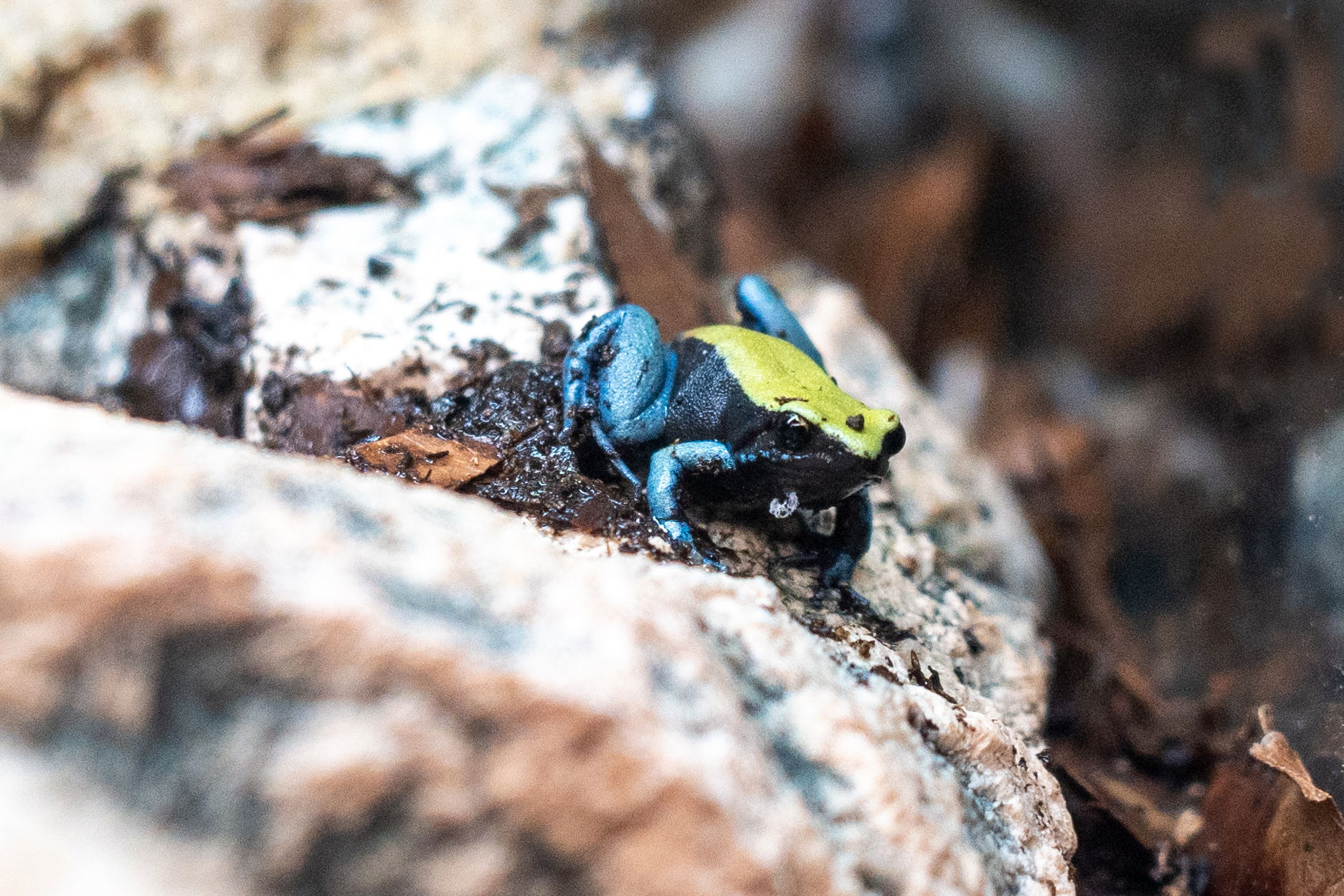
One of the reasons for its striking colouring is presumably to act as a warning signal to potential predators, indicating that the frog is poisonous.
The blue-legged mantella derives its toxicity from its diet, in particular from eating ants and termites that contain alkaloids. These substances enable the frog to produce toxic skin secretions. Although these are not fatal to humans, they are nonetheless unpleasantly irritating to the skin.
Blue-legged mantellas are diurnal and lead a solitary life, except during the mating season. At that time, the males emit distinctive calls to attract females.
The breeding season coincides with the rainy season from October to December, during which a female lays around 70 eggs per year. The fertilised eggs are laid on the ground. The larvae develop in marshes or in slow-flowing, temporary streams.
The blue-legged mantella is endemic to Isalo National Park in Madagascar. It faces threats to its population, primarily due to habitat loss caused by deforestation. It is also frequently kept illegally as a pet.
Taxonomy
Mantellidae, Mantella (16 species)
Habitat
damp gorges in Isalo National Park in Madagascar
Behaviour and ecology
diurnal