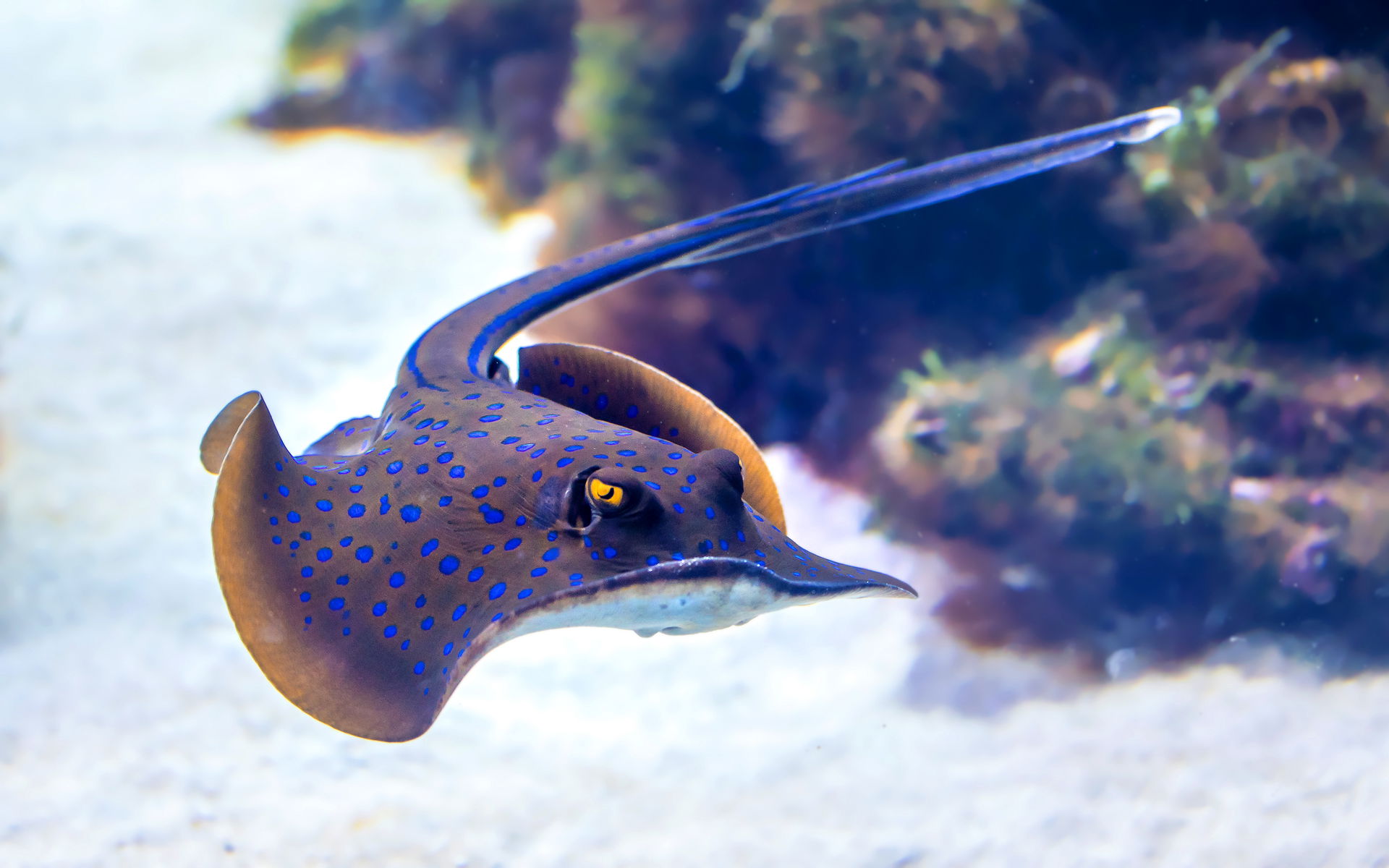
Bluespotted ribbontail ray

Taeniura lymma

The bluespotted ribbontail ray can alter the intensity of its characteristic blue spots, which helps it to blend in more effectively. It also lies on sandy bottoms and buries itself partially in the sand to make itself even harder to spot.

LC

Red List
Least Concern
Breeding programme

The bluespotted ribbontail ray has two venomous spines in its tail. It uses these for defence.

Although the bluespotted ribbontail ray is not aggressive towards humans, incidents can still occur. For example, if bathers accidentally step on it whilst on the sand, or if snorkellers get too close and it feels threatened by potential threats. Although a bluespotted ribbontail ray’s sting is painful, it is not fatal to humans under normal circumstances.

Taxonomy

Stingrays (Dasyatidae), spotted stingrays (Taeniura, 2 species)

Habitat

Coral reefs at depths of up to 40 metres

Behaviour and ecology

bury themselves in the sand to camouflage themselves; hunt at night

Diet

snails, crustaceans, worms

Taxonomy

Stingrays (Dasyatidae), spotted stingrays (Taeniura, 2 species)

Habitat

Coral reefs at depths of up to 40 metres

Behaviour and ecology

bury themselves in the sand to camouflage themselves; hunt at night

Diet

snails, crustaceans, worms

Godparent

Support the animals of Zoo Zurich with your annual godparent sponsorship

Bluespotted ribbontail ray for CHF 500.–

Become a godparent

Godparent

Support the animals of Zoo Zurich with your annual godparent sponsorship

Bluespotted ribbontail ray for CHF 500.–

Become a godparent
Back to overview