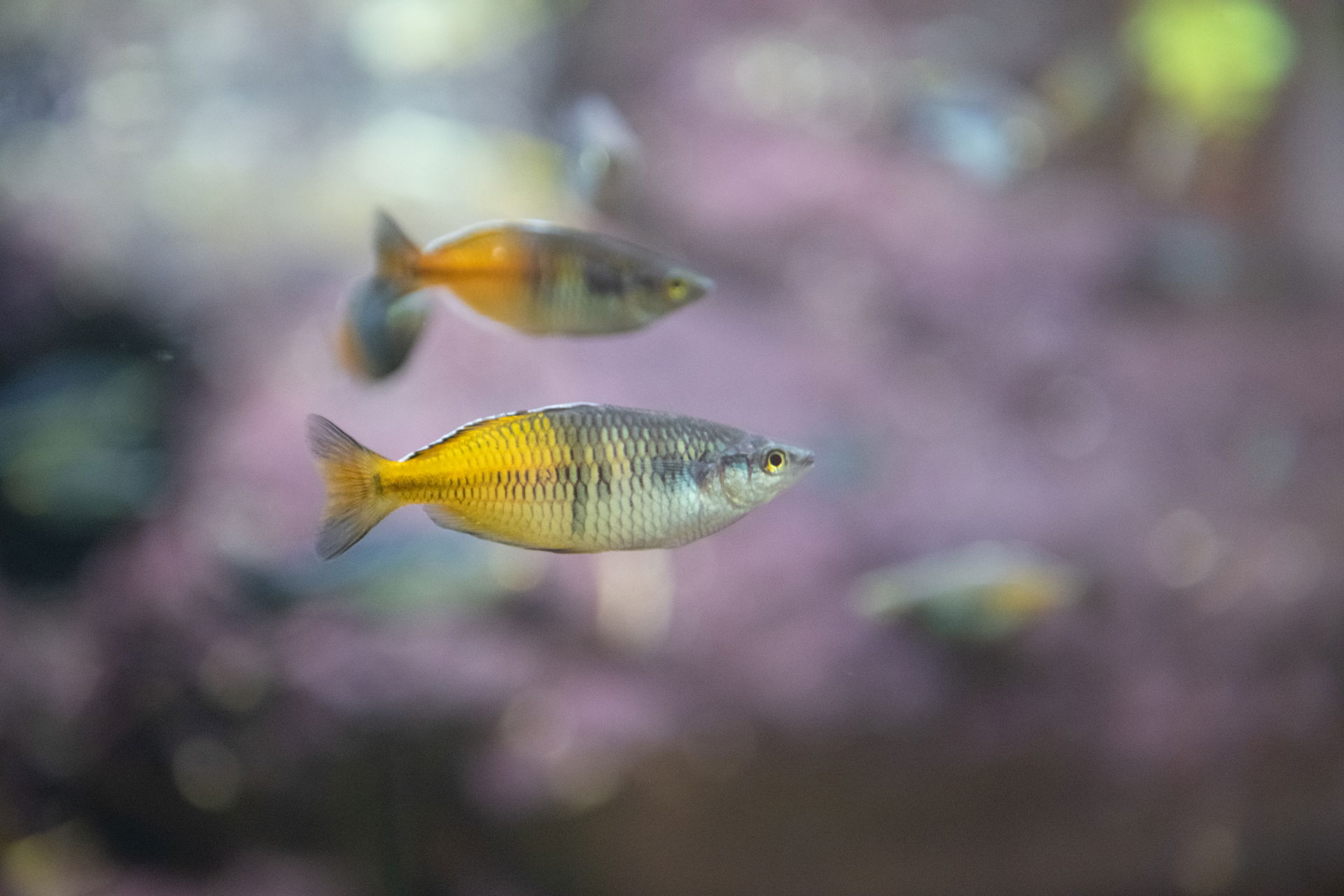
Harlekin-Regenbogenfische im Zoo Zürich

Boeseman’s rainbowfish

Melanotaenia boesemani

In the male Boeseman’s rainbowfish, the front half of the body is blue, whilst the rear half is a bright orange. The females are generally paler and less vividly coloured.

EN

Red List
Endangered
Breeding programme

The Boeseman’s rainbowfish belongs to the species-rich family of rainbowfish, of which around 100 species are known worldwide. This colourful freshwater fish species is endemic to just two lakes and the surrounding river systems in West Papua (Indonesia). 

A characteristic feature of the Boeseman’s rainbowfish is its striking two-tone colouring: the front half of the males’ bodies shimmers in a metallic grey-blue, whilst the rear half is a bright orange. Females, on the other hand, are less colourfully patterned. Furthermore, the females are slightly smaller than the males. 

The species is considered to be facing threats, primarily due to two factors. On the one hand, fluctuations in water levels within its limited habitats lead to changes in its habitat. On the other hand, over the years, numerous individuals – particularly the brightly coloured males – have been taken from wild populations for the international aquarium fish trade.

Most specimens now available on the market come from controlled breeding programmes, which has reduced the number taken from the wild. Currently, the greatest threats to the Boeseman’s rainbowfish come from introduced, invasive fish species such as Common carp and goldfish. In the sensitive ecosystems of the lakes, these species pose ecological competition or disrupt the balance of the food chains.

Taxonomy

Rainbowfish (Melanotaeniidae), genus Melanotaenia (around 90 species)

Habitat

densely vegetated water bodies offering hiding places (undergrowth, roots, reeds) in two lakes and their associated river systems in West Papua (Indonesia)

Behaviour and ecology

in droves

Diet

omnivorous (e.g. algae, plant seeds, insects and insect larvae)

Back to overview