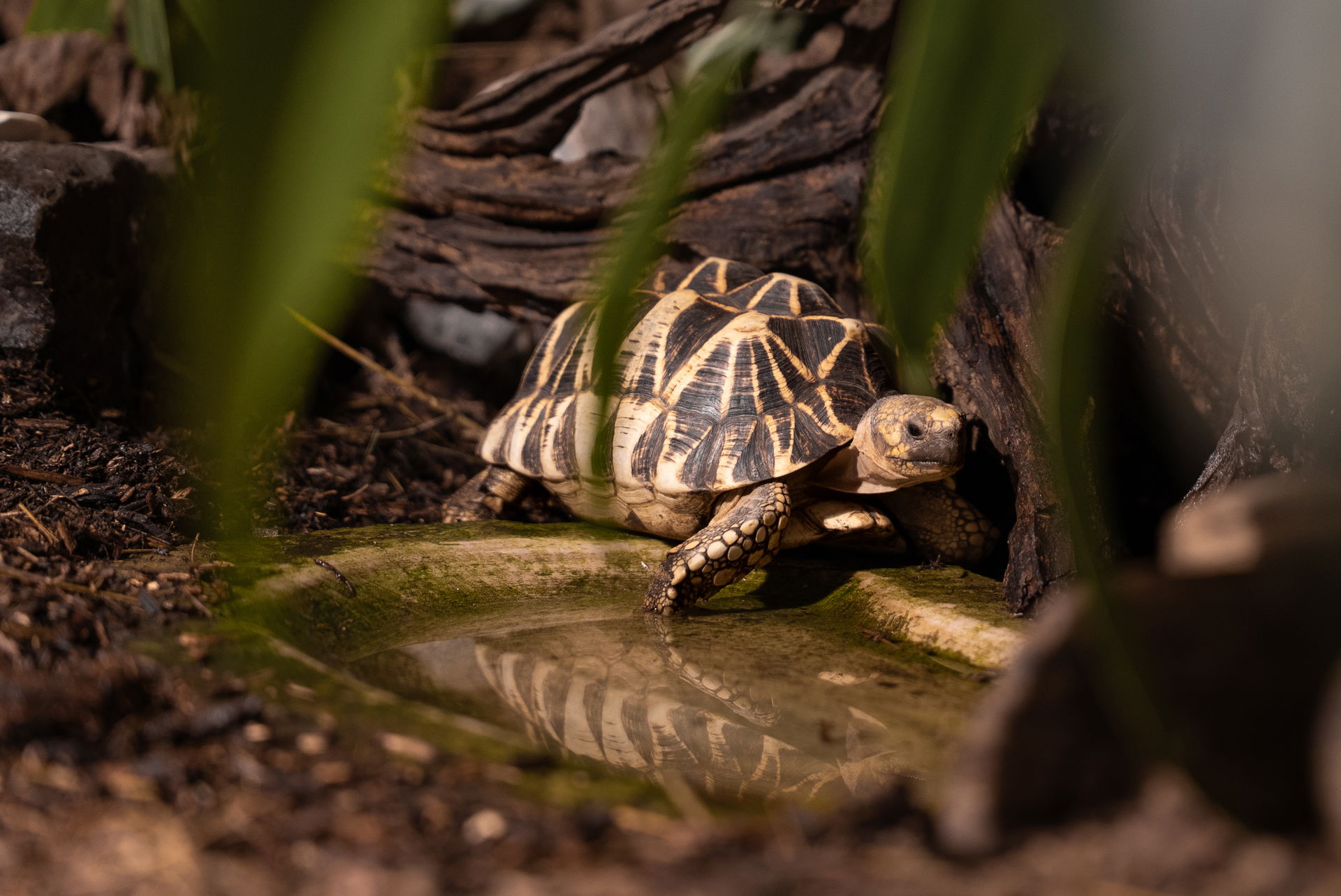
The Burmese star tortoise is known locally as “Kye Leik” (“star tortoise”). Its name refers to the striking, star-shaped pattern on its shell. The species is endemic to the dry zone of central Myanmar. There, it inhabits hilly scrublands, open deciduous forests, as well as pastures and agricultural lands with dense grass vegetation. It likely performs important ecological functions, such as seed dispersal and the grazing of plant biomass. However, very little is known overall about the lifestyle of this turtle species in its natural habitat.
Due to intensive hunting—initially for local food sources, and later primarily for the international pet trade and Asian medicinal markets—the population has declined drastically over the past few decades. In just over 50 years, the population declined by more than 90%. By around the year 2000, the species was considered virtually extinct in its natural habitat. In addition to overharvesting, habitat loss and fragmentation also contributed to this decline.
One of the last naturally occurring populations survived in Myaleik Taung—presumably due to the local belief in so-called “Nats” (supernatural guardian spirits). These “Nats” are said to inhabit forests and hills and to protect animals such as turtles. Harming or disturbing a turtle could enrage the “Nats” and bring about misfortune, illness, or even death.
It was only thanks to targeted conservation measures that the species was saved from complete extinction. In particular, successful captive breeding programs and reintroductions into strictly protected areas have led to the existence of wild populations once again today. Despite this progress, the Myanmar star tortoise remains critically endangered. Its “Species Recovery Score” of just 8% makes it clear that the species is only at the beginning of its recovery. Due to ongoing poaching, the species will likely continue to depend on protected habitats in the future.
Taxonomy
Family Testudinidae, genus Geochelone (approx. 2 species)
Habitat
dry, hilly scrublands, sparse deciduous forests, as well as pastures and farm fields with dense grass vegetation
Behaviour and ecology
terrestrial
Diet
mainly grass and other vegetation, but also fruits, mushrooms, snails, and insects