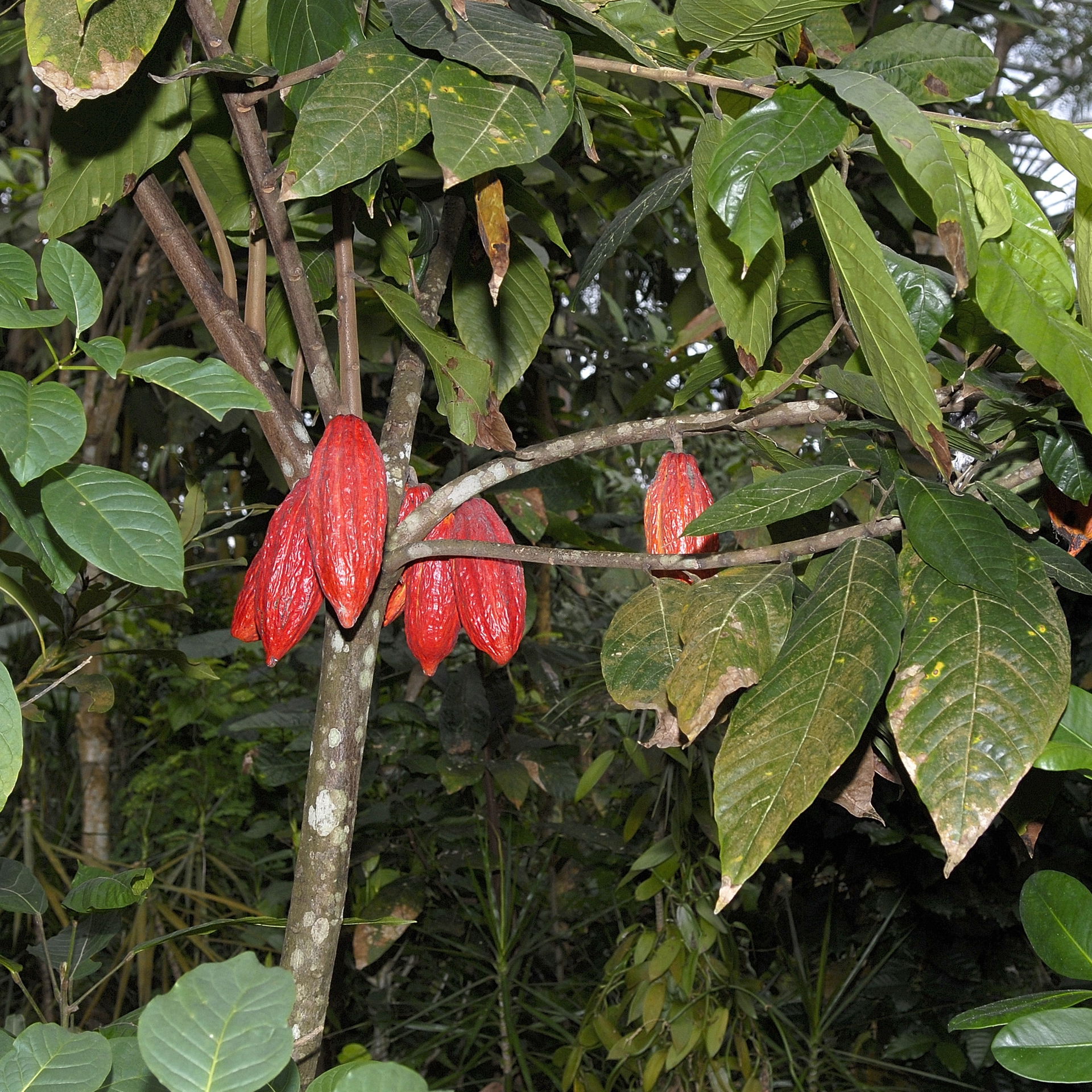
The cacao tree is native to Central America and northern South America. There are around 30 different species in total, which grow as small trees in the undergrowth of the rainforest. Cacao must therefore also be planted on plantations beneath large, shade-providing trees.
To extract the cocoa beans, the ripe seeds must be processed. Micro-organisms break down the sugary substances during a fermentation process. This releases heat, which is of fundamental importance for the subsequent quality of the cocoa bean. The seeds die off, and polyphenolic compounds form, which are responsible for the cocoa bean’s aroma. During this process, the seeds take on their characteristic chocolate-brown colour. After fermentation, the seeds are roasted at around 60 degrees Celsius. They then contain around 50 per cent fat, seven per cent starch and twelve per cent protein, as well as stimulants such as theobromine and caffeine. After roasting, the cocoa beans are cracked and the husk removed. The cocoa nibs are then ground, and the heat generated causes the cocoa butter to melt. This thick cocoa mass already bears a certain resemblance to the end product and is ready for use in the production of chocolate or cocoa powder. The fat extracted from the beans is sold as cocoa butter and is used in the production of chocolate. Cocoa powder is obtained from the press residues by drying and grinding.
Distribution
Central America and northern South America; now also cultivated in Africa and Asia
Number of related species
around 30 species
Use
cocoa butter (for chocolates and cosmetics) and cocoa powder