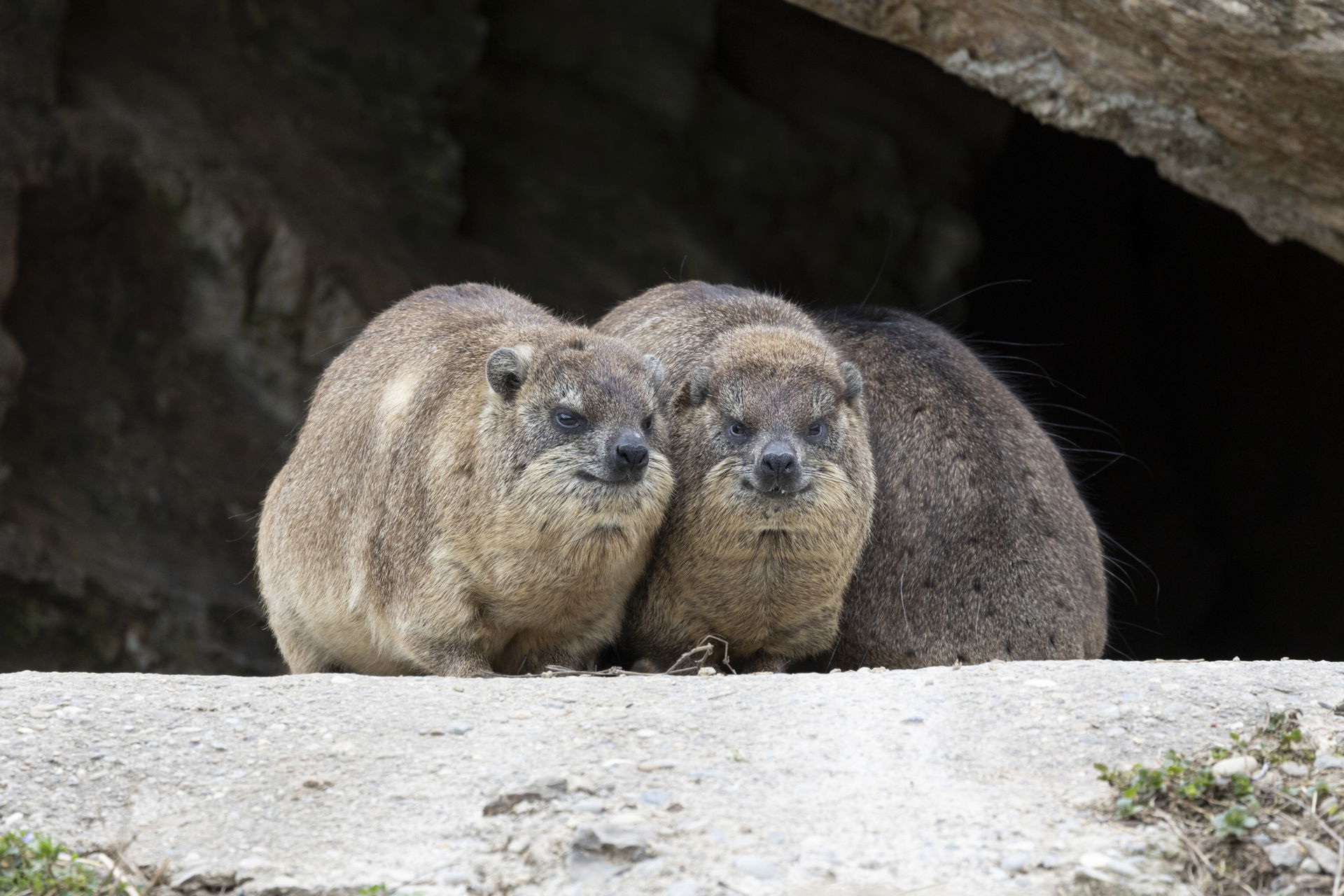
Kap-Klippschliefer im Semien Gebirge des Zoo Zürich

Cape hyrax

Procavia capensis

Cape hyraxes look very similar to marmots – but they are not closely related to them. The Cape hyrax’s closest relatives are, in fact, elephants, manatees and aardvarks.

LC

Red List
Least Concern
Breeding programme

Much like the elephant, the Cape hyrax is only able to regulate its body temperature to a limited extent. On cool nights, its body temperature drops by up to four degrees Celsius. To return to normal levels during the day, the Cape hyrax deliberately basks in the sun – or seeks out the shade if it gets too hot.

Cape hyraxes live in colonies in rocky areas, where they move nimbly. To help their feet grip slippery rocks more effectively, they produce sweat on the soles of their feet. The middle toe of the Cape hyrax’s hind foot is clawed. All the other toes have flat, hoof-like nails. Cape hyraxes are therefore unable to dig for themselves. They must seek out rock crevices and other existing hiding places for shelter.

The young are born fully developed and begin eating grass at an early age; this forms the main part of their diet during the rainy season. During the dry season, their diet consists mainly of leaves. Juveniles often climb onto their mother’s back, where they enjoy the cosy warmth and absorb her body scent through her dorsal gland.

Taxonomy

Procaviidae, Procavia (1 species)

Habitat

dry rocky landscapes with grass cover up to 4,300 metres above sea level

Behaviour and ecology

diurnal, use sunlight to warm their bodies

Social structure

in colonies of up to 50 animals

Young animals
1.1.2026
Taxonomy

Procaviidae, Procavia (1 species)

Habitat

dry rocky landscapes with grass cover up to 4,300 metres above sea level

Behaviour and ecology

diurnal, use sunlight to warm their bodies

Social structure

in colonies of up to 50 animals

Godparent

Support the animals of Zoo Zurich with your annual godparent sponsorship

Cape hyrax for CHF 300.–

Become a godparent

Godparent

Support the animals of Zoo Zurich with your annual godparent sponsorship

Cape hyrax for CHF 300.–

Become a godparent

Impressionen

Klippschliefer sehen zwar aus wie Murmeli, sind aber nicht mit ihnen verwandt. Foto: Zoo Zürich, Enzo Franchini

Im Zoo Zürich teilen sich die Klippschliefer den Lebensraum unter anderem mit Nubischen Steinböcken. Foto: Zoo Zürich, Fabio Süess

Man sieht es ihnen nicht an, aber Klippschliefer können trotz ihrer kurzen Beine prima springen. Foto: Zoo Zürich, Fabio Süess

Klippschliefer sind gut getarnt in ihrem felsigen Lebensraum. Foto: Zoo Zürich, Enzo Franchini

  • 50

    Klippschliefer-Kolonien können bis zu 50 Tiere zählen.

  • 4300

    Klippschliefer leben in Höhenlagen von bis zu 4300 m. ü. M.

  • 225

    Die Tragezeit der Klippschliefer beträgt rund 225 Tage.

  • Paargesang des Klippschliefers

    Back to overview