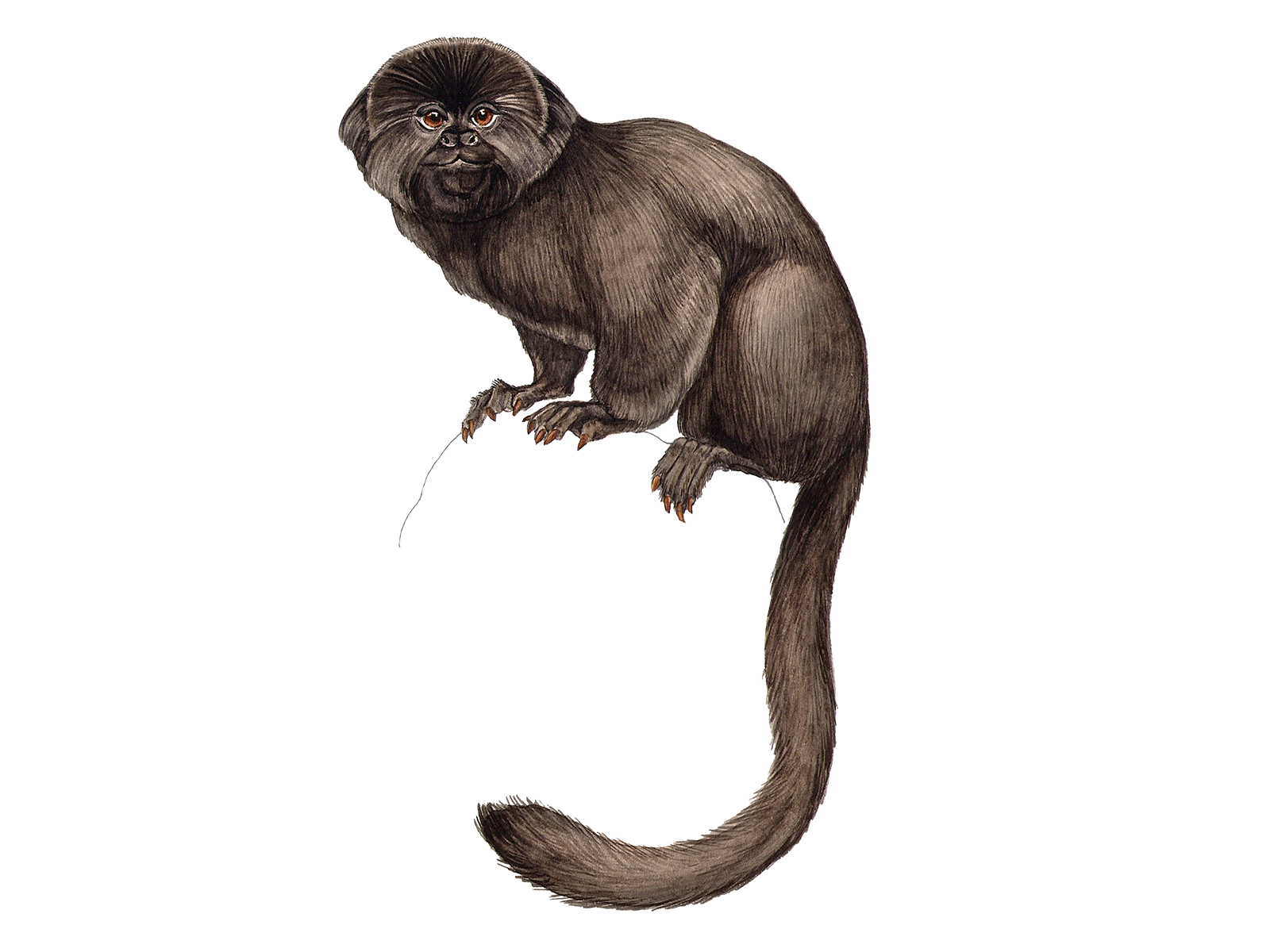
Cotton-top tamarins belong to the family of clawed monkeys. They are characterised by the claws on their hands, in contrast to the flat fingernails of other primates. Their backs and tails are brown to black in colour, whilst their bellies and legs are white.
The most striking feature, however, is the distinctive white hair on its head.
Cotton-top tamarins live in groups of between 2 and 15 animals. Within these groups, there is a strict hierarchical system in which a dominant pair takes the lead. It is worth noting that the dominant female leads the group.
The groups are territorial and require an area of around 8 hectares in their natural habitat to meet their food requirements. Male cotton-top tamarins often mark their territory with loud calls, whilst females mark branches with scent secretions from their genital glands.
Responsibility for the young lies solely with the dominant pair. The juveniles are mainly carried on the father’s back, whilst other members of the group also help to rear the young. The juveniles are mainly taken to the mother to be suckled.
As with other marmosets, the birth of multiple offspring is the norm amongst cotton-top tamarins. This contrasts with other primates, such as humans. The dominant female usually gives birth to fraternal twins twice a year. What is particularly fascinating is that the twins exchange stem cells during pregnancy, turning them into what are known as chimeras.
Taxonomy
Marmosets (Callitrichidae), genus Saguinus (24 species)
Habitat
forests and scrubland in north-western Colombia
Behaviour and ecology
diurnal tree-dwelling creatures, territorial
Social structure
groups of between 2 and 15 adult animals, including a dominant pair responsible for rearing the young