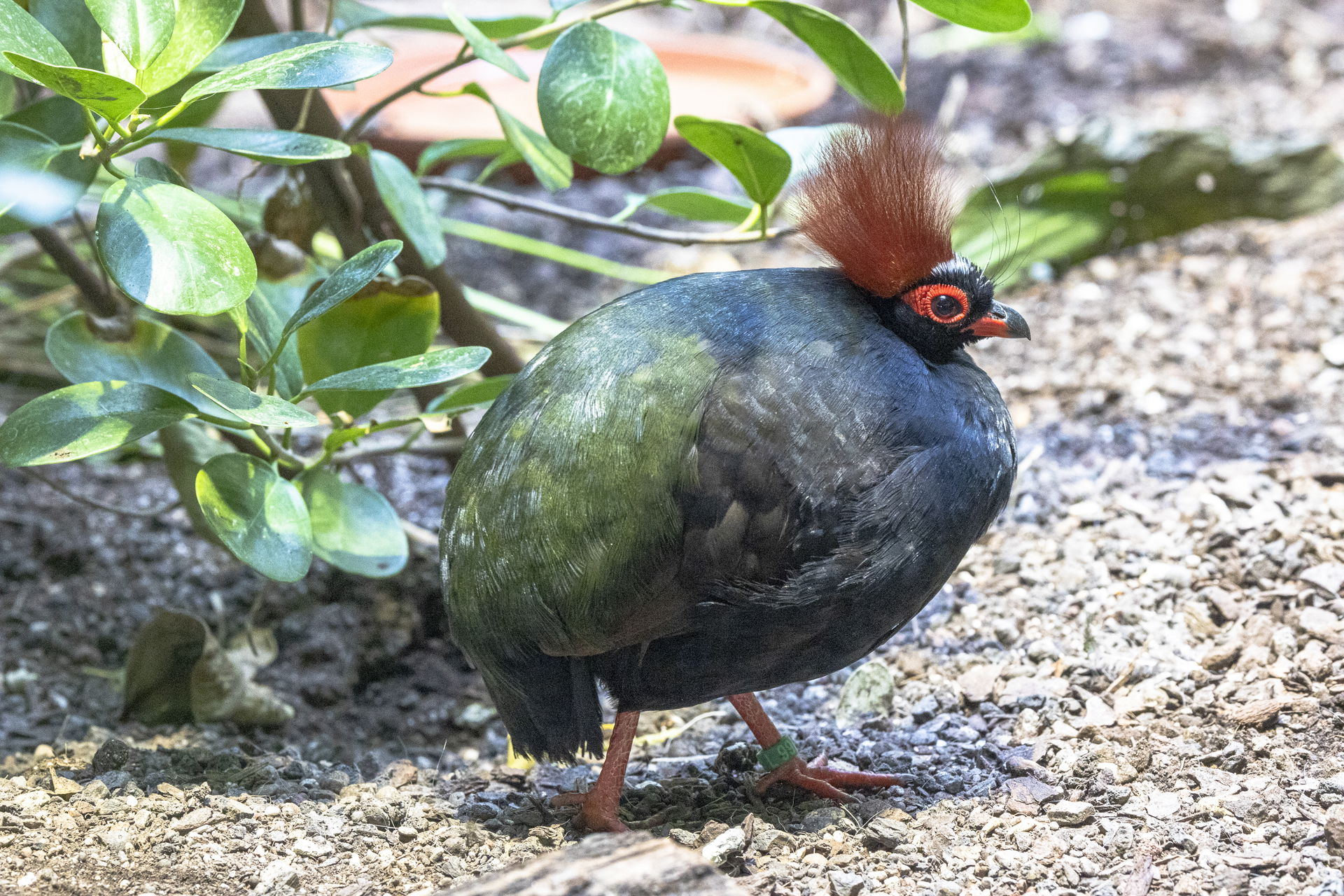
Crested partridges are ground-dwelling and are found in the dense, evergreen lowland forests of South-East Asia, including southern Myanmar, southern Thailand, Malaysia, Sumatra and Borneo. They usually live in small groups, where they spend the day scratching around on the ground in search of food, such as seeds, fruits, insects and other invertebrates.
Occasionally, crested partridges join wild boars that are breaking open large fruits. Crested partridges benefit from their wild boar diet, which includes food that has been exposed or left behind.
When danger threatens, they can reach safety very quickly by swaying from side to side. They are not particularly good at flying, however; if they do fly, it is only for short distances and not very high. At night, crested partridges seek shelter in trees.
The crested partridge exhibits clear sexual dimorphism: males have a metallic green-black plumage with a striking red head crest. Females are predominantly green in colour, with a grey head. They do not have a crest. Both sexes share the same red-rimmed eyes.
Crested partridges are monogamous and form lifelong pairs. Each pair builds a hemispherical ground nest, which is well camouflaged with leaves. The female lays 4 to 6 eggs, which she incubates for around 18 days, whilst the male keeps watch over the surroundings.
Unusually for gallinaceous birds, both parents later feed the chicks from beak to beak, rather than simply letting them forage on the ground. Although the young birds are precocial, they initially remain near the nest before becoming independent after about a month.
Due to the rapid destruction of its habitat through deforestation and conversion to agricultural land – particularly oil palm plantations – as well as forest fragmentation, the IUCN classifies the species as vulnerable.