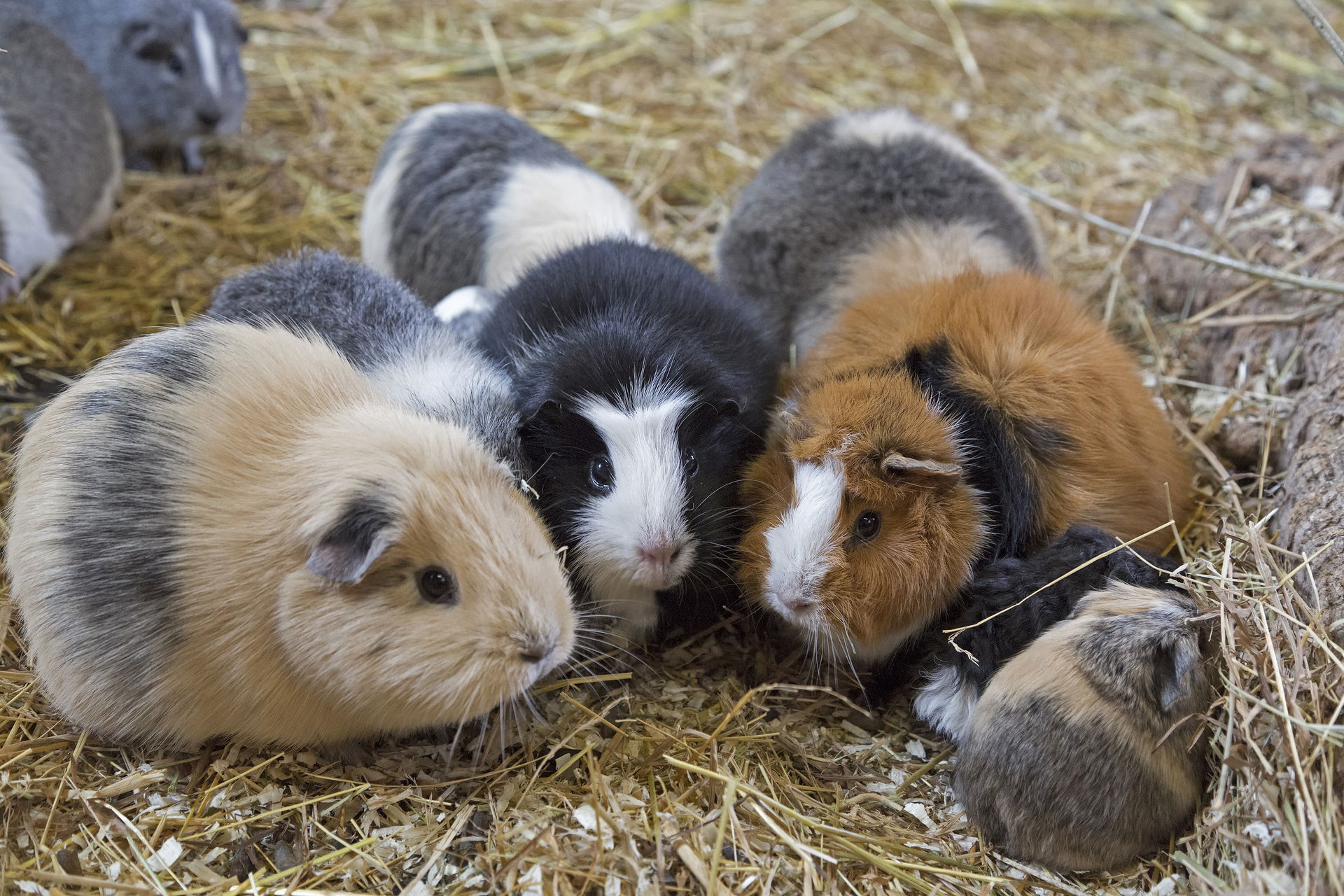
Today’s domestic guinea pigs are descended from wild guinea pigs native to the Andes region of South America (Bolivia, Ecuador, Peru). There, they were domesticated as livestock by indigenous cultures several thousand years ago and served as an important source of food.
Whilst wild guinea pigs usually have a uniform grey-brown, smooth coat, a slender build and a pronounced tendency to flee, domestic guinea pigs display a wide variety of coat colours, patterns and textures. Their bodies are also more compact, and the animals are generally calmer and less shy.
Both domestic and wild guinea pigs are active during the day and at dusk, and live in social groups which, in their natural habitat, consist of one adult male and several females. Several adult males in the same group will fight to the death.
They communicate using a variety of sounds, including whistles, hums and squeaks, as well as body language.
Guinea pigs are strictly herbivorous. They cannot produce vitamin C themselves, which is why they rely on obtaining it from their diet.
Taxonomy
Caviidae, Cavia (5 to 8 species)
Habitat
found in the wild in grassland up to 4,000 metres above sea level
Behaviour and ecology
active both day and night, ground-dwelling
Social structure
in groups