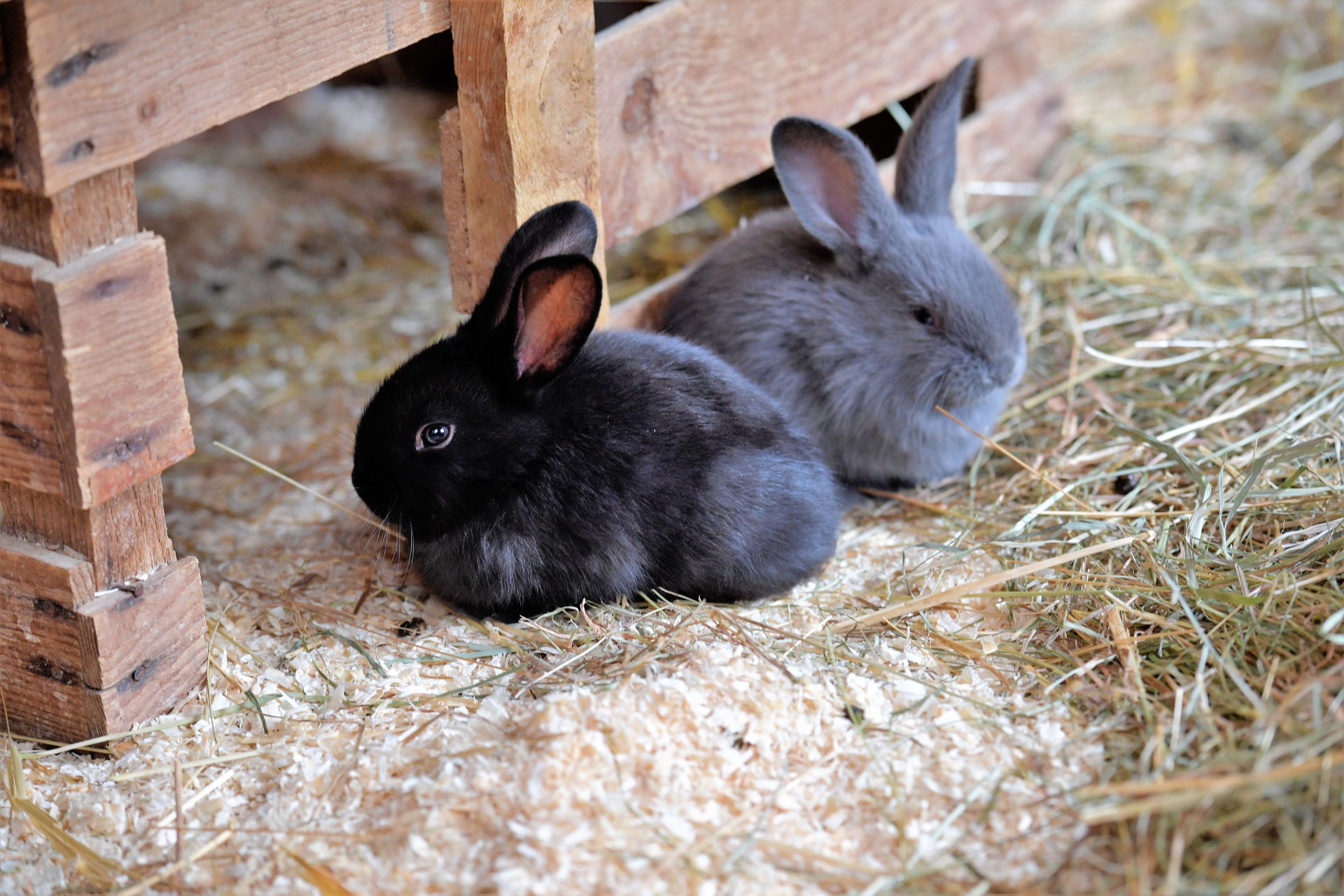
The domestic rabbit is a small, herbivorous mammal belonging to the hare family (Leporidae) and is the domesticated form of the wild rabbit. It is characterised by its long ears, strong hind legs and short, fluffy tail. Rabbits differ markedly from hares (Lepus europaeus) and mountain hares (Lepus timidus), which are larger and have longer ears.
In the wild, rabbits live in underground burrows with extensive networks of tunnels and chambers, which Domestic rabbits also instinctively use whenever they have the opportunity.
One striking characteristic is their high reproduction rate. After a gestation period of around one month, the female usually gives birth to five or six juveniles. At birth, these are hairless, blind and deaf, and develop very rapidly within a short space of time. After just a few weeks, they begin to follow a diet independently and soon reach sexual maturity.
Another interesting behaviour in rabbits is coprophagy: they re-ingest some of their own faeces in order to break down hard-to-digest plant matter more effectively and to utilise additional nutrients.
Swiss Tricolour Small-spotted Rabbit
Over the years, domestic rabbits have been bred into numerous breeds and colour varieties, some of which differ significantly in appearance from wild rabbits. The breed we keep at the zoo is called ‘Schweizer Dreifarben-Kleinscheckenkaninchen’.
Over 50 years ago, Anton Häberli from Winterthur began breeding this breed of rabbit. His vision was to breed a rabbit with the same markings as an English Piebald, but with a pure white coat featuring orange spots as well as black ones. To achieve this, he crossed English Spotted rabbits with Japanese rabbits, which are orange and black in colour.
A black-and-orange-spotted stripe runs down the spine, and on both sides, further orange and black spots are scattered as evenly as possible across a pure white coat. The ears, nose and the area around the eyes are also colourful.
Achieving the markings typical of this breed is one of the greatest challenges in rabbit breeding. If two rabbits with their typical colouring are crossed, 50 per cent of the juveniles will have the same colouring, whilst 25 per cent will be white and 25 per cent orange-black. This inheritance pattern is known as split inheritance.