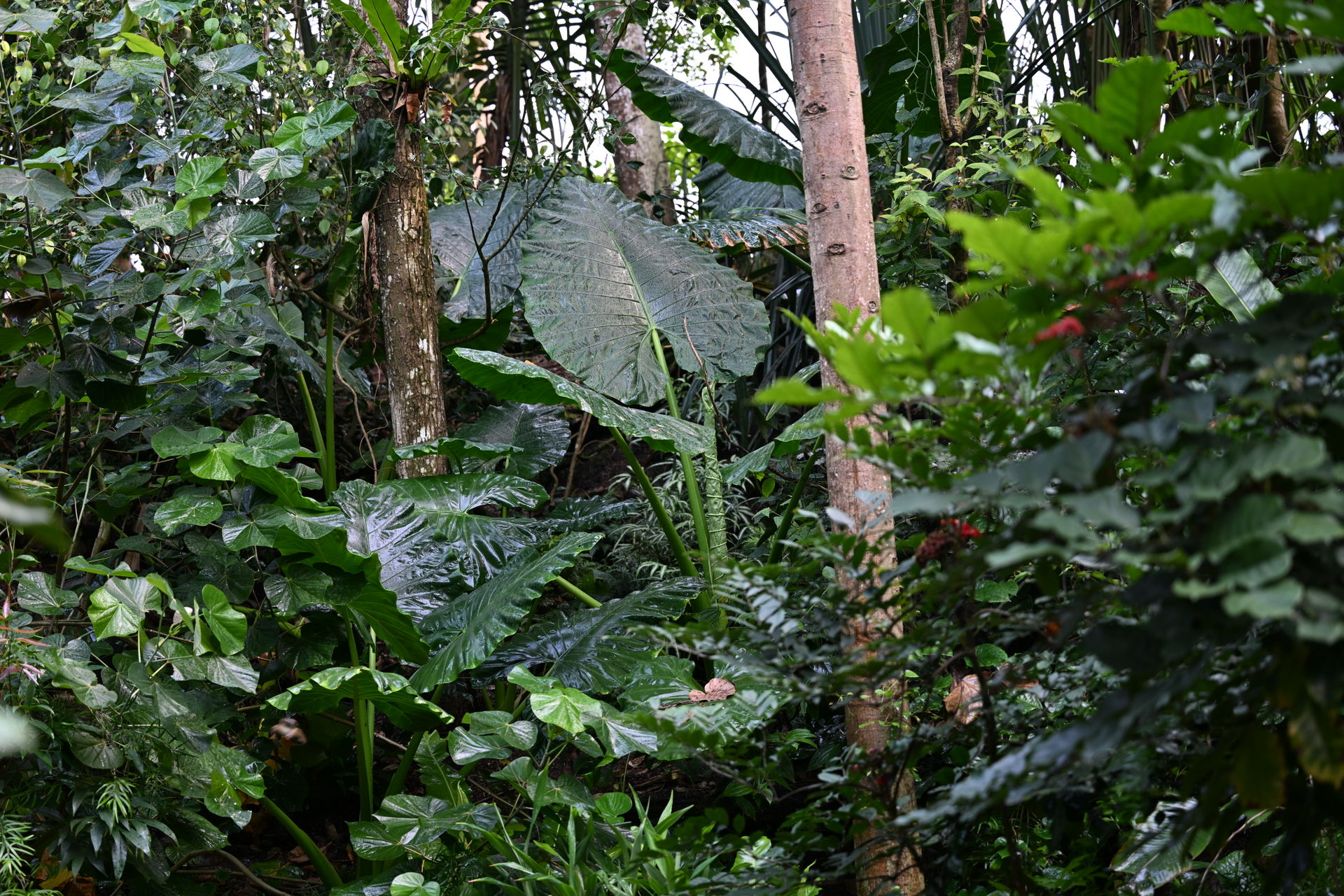
There is great diversity within the arum family. Many species form underground tubers. The arum family also includes climbing and epiphytic plants, and even species that float on water. The giant elephant ear on display at Zoo Zurich is closely related to the taro plant. Taro is one of the oldest cultivated plants. It has been grown in Asia for around 2,000 years. Around 1,000 local varieties are now known worldwide. The starchy tubers of the taro plant are eaten boiled or roasted, whilst the tubers of the elephant’s ear are used as pig feed. The leaves and starchy stems of the elephant’s ear and taro plants, which are detoxified by cooking, can be eaten as vegetables. The leaves grow up to 60 centimetres long and 35 centimetres wide. The taro plant is thought to have originated in South Asia (Sri Lanka and India). The elephant ear has a wide distribution from South-East Asia all the way to Polynesia. However, both plant species are now also native to Australia, the Americas, Africa and Madagascar. Taro and elephant ear thrive on dry land, but also grow in marshlands, river mouths and deltas.
Distribution
From South Asia to Polynesia
Number of related species
around 2,900 (family of the arum family)
Use
Food (leaves, stems, tubers), animal feed (tubers)