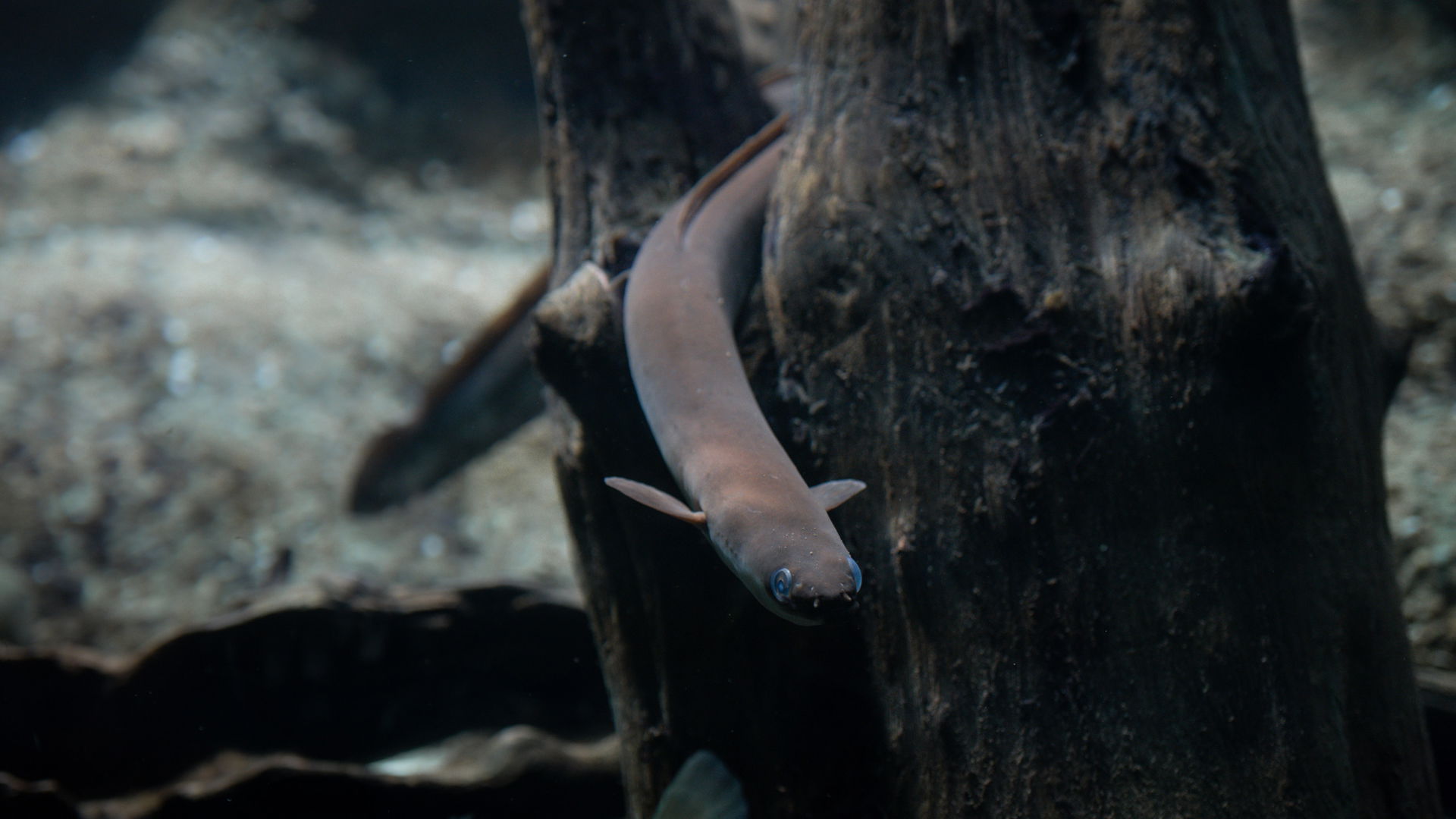
For a long time, the reproduction of eels was a mystery. Today we know that their life cycle begins in the Sargasso Sea, between Florida and the Caribbean, where the young hatch. However, the details of this process remain unknown to this day.
The tiny larvae are then passively carried to Europe by the Gulf Stream – a journey that takes two to three years. As soon as the larvae reach a coastline, they transform into transparent glass eels – miniature versions of their parents – and begin to make their way inland. In doing so, they cover remarkable distances, sometimes even travelling over land.
Where the habitat is suitable, the young eels settle down and begin to build up fat reserves over a period of years in preparation for their upcoming mating migration. During this phase, known as ‘yellow eels’, they can spend up to 20 years in rivers and lakes. In the past, they used to reach Switzerland at the age of four to six years. During this time, the eels need places to hide and also like to burrow into the ground.
When the time comes, they transform into silver eels – their flanks become bright and shiny, their backs darken and their eyes grow larger. They then set off on a mating journey of up to 6,000 kilometres back to their birthplace in the Sargasso Sea. They always follow the strongest current, which today proves to be their undoing: many eels end up in the turbines of hydroelectric power stations.
Wild eels no longer find their way into Switzerland naturally. All the eels found here are the result of human restocking.
Overfishing – particularly of glass eels – is also taking a huge toll on stocks, with the result that the species is now classified as critically endangered.
Taxonomy
Eels (Anguillidae), freshwater eels (Anguilla, 15 species)
Habitat
all bodies of water except for ice-cold, fast-flowing mountain streams
Behaviour and ecology
nocturnal, living mainly in freshwater and migrating back to the sea to spawn; a so-called catadromous fish species
Diet
hunt for worms, snails, insect larvae, crustaceans, fish and frogs in the dark