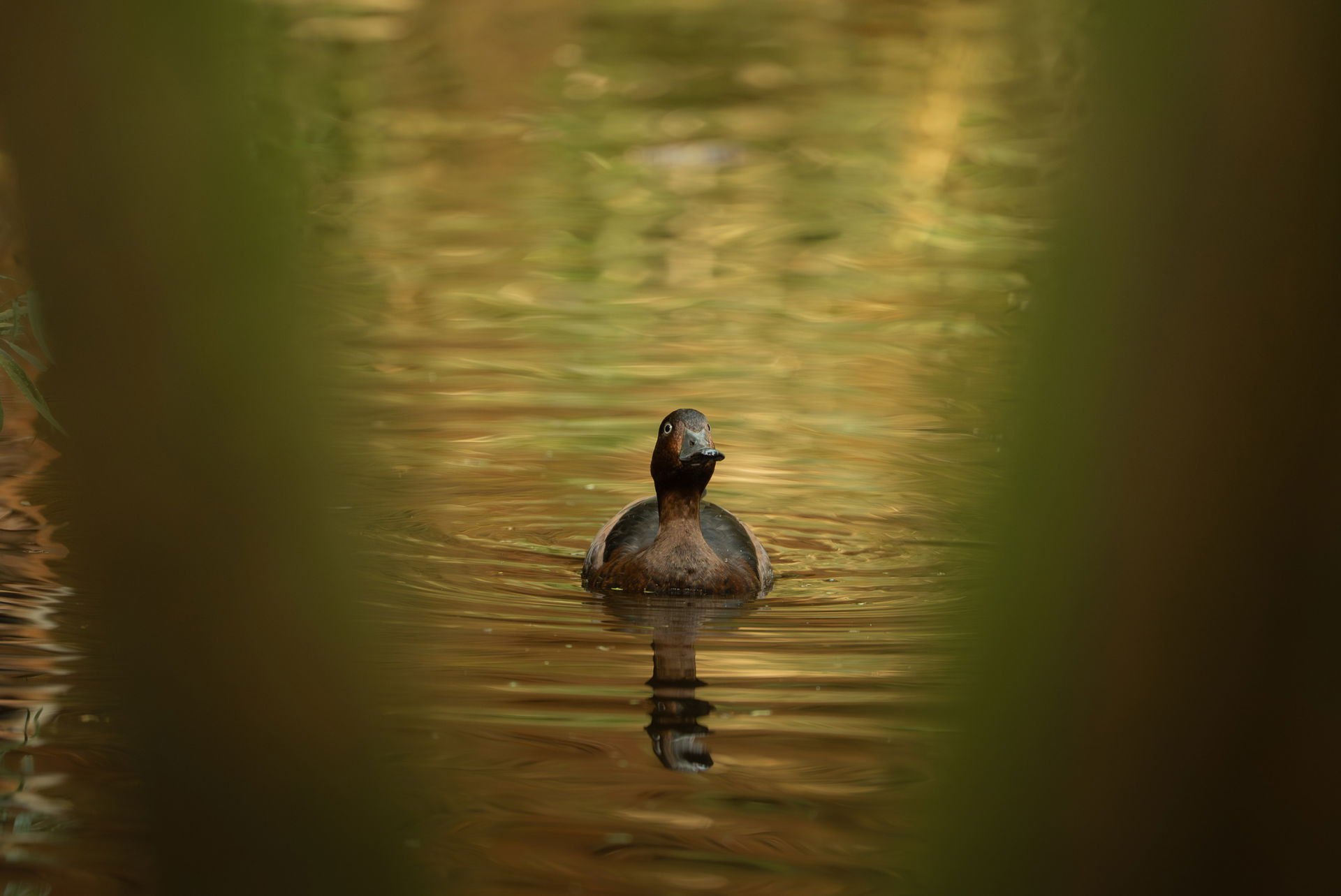
The ferruginous pochard is the smallest member of the diving duck family within the genus Aythya. A distinctive feature amongst diving ducks is that the sexes of the Ferruginous pochard are almost indistinguishable in appearance. Males and females have almost identical chestnut-brown plumage. However, a reliable distinguishing feature is the iris, which is white in males and brown in females.
As a diving duck, the ferruginous pochard is adapted to foraging underwater. Sensory receptors on its bill enable it to locate food such as aquatic plants, seeds and invertebrates, even in murky water. It prefers shallow waters with dense vegetation along the banks and underwater, which provide both a diet and cover.
The species is predominantly migratory. It winters mainly in the Mediterranean region, extending as far as areas of East and West Africa and West Asia (including Iraq, Iran and Pakistan). For breeding, the birds return from mid- to late August to their more northerly and easterly ranges, which extend from Eastern Europe through the Mediterranean region and far into Central Asia. In Western and Southern Europe, the birds may also behave as resident birds and spend the winter there. In Central Europe, the species has become rare, but is once again showing isolated breeding occurrences in some localities.
The courtship season begins at the end of March, when the birds gradually start returning to their breeding grounds. Compared with other duck species, it is relatively unobtrusive. Characteristic behaviours include ‘nodding’ whilst swimming, in which the head and neck move in a nodding motion, and the so-called ‘bent neck’, where the neck is sharply bent. The vocalisations remain quiet and are usually only audible at close range.
The nest is built well hidden amongst dense vegetation close to the water, for example in a marsh or in the silted-up area just above the shallow water. However, as the name suggests, they do not breed in moors.
Due to the ongoing loss of wetlands, the draining of marshes, intensive farming and water pollution, the Ferruginous pochard is considered to be vulnerable in many parts of its range. In Switzerland, the species is even classified as endangered.