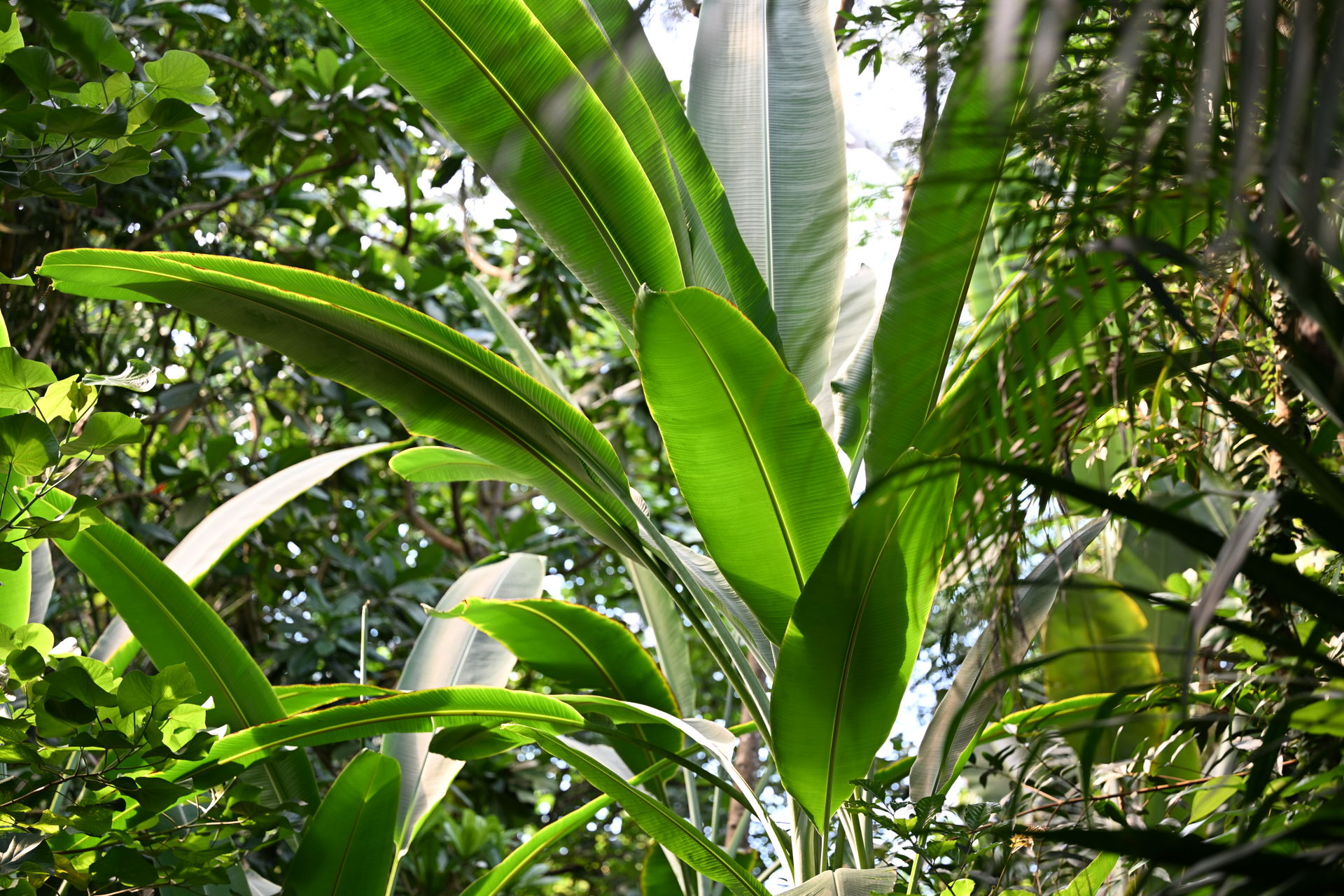
The distribution of wild banana plants includes over 40 different species, which are found from Africa through East Asia and northern Australia to the South Pacific. The wild ancestors of all commercially important banana species produce inedible fruits containing seeds. It was only through breeding that the many edible banana varieties were developed. Sweet bananas (or dessert bananas) are eaten raw. Starch can be extracted from plantains. They are used to make crisps, purée, alcoholic drinks and vinegar. In the tropics, plantains are often eaten boiled, baked or fried. Banana plants are perennials with a short underground stem. The densely growing leaves form what are known as pseudostems. In certain species, these non-woody pseudostems can reach a height of up to 13 metres, whilst smaller species grow to only one metre. Banana leaves can reach a length of up to six metres! Under the influence of the wind, the leaves tear at the sides and appear ‘pinnate’. In the centre of the pseudostem, a stem grows upwards, bearing a hermaphroditic inflorescence at its upper end. The female flowers are located at the base of the inflorescence, whilst the male flowers are at the tip. The female flowers remain open for just one day and are pollinated by bats and birds. An inflorescence of the wild forms usually produces between 10 and 16 individual fruits. The fruits of the wild species contain up to 100 hard-shelled seeds, whilst in the cultivated forms the ovules are stunted.
Distribution
Wild varieties in Africa, East Asia, Australia and the South Pacific; cultivated varieties worldwide (tropical and subtropical regions)
Number of related species
over 40
Use
Fruit and cooking bananas as food; Fibre bananas for fibre production; ornamental plants for gardens and parks