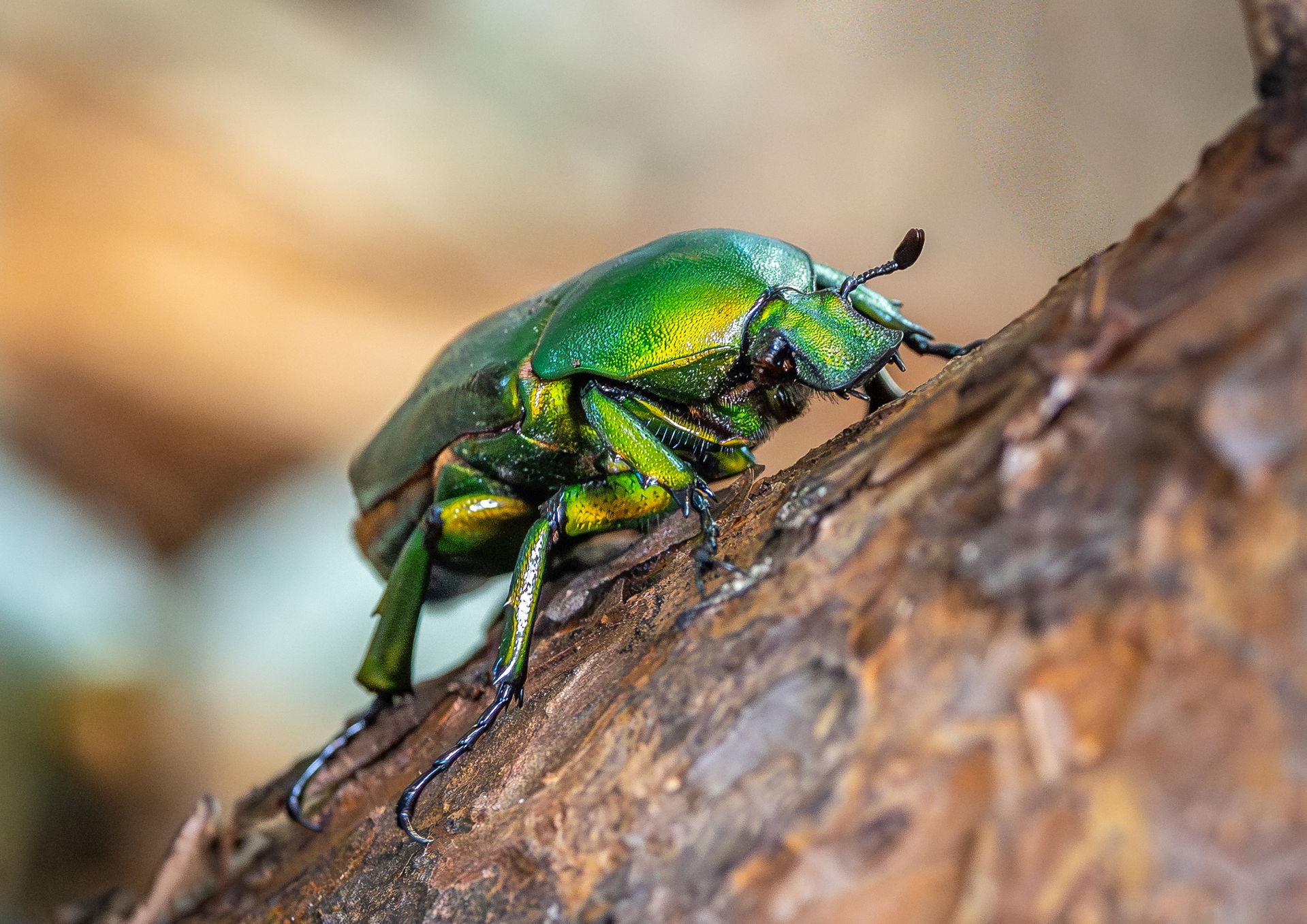
The flower beetle belongs to the subfamily Cetoniinae, within which some 3,000 species are known worldwide.
The flower beetles at Zoo Zurich are hybrids, which means they are crosses between two species: Dicronorhina micans and Dicronorhina johnstonii. The latter species is native to Cameroon, but there are no reliable data available on its current wild population.
Amongst breeders, there was recently only one known specimen of D. johnstonii. In order to preserve at least some of the genetic material of this species, the remaining female was crossed with males of the species D. micans. The hybrid micans x johnstonii, as we keep it at the zoo, is therefore a captive-bred specimen that lives exclusively in terrariums.
The genus Dicronorhina comprises a total of four species, all of which are native to Africa. They are characterised by their striking, metallic-green colouring. The species can only be distinguished by minor details.
Flower beetles spend most of their life cycle in the larval stage, during which they play a key ecological role: they break down organic material such as dead wood and leaves, thereby helping to return nutrients to the soil.
After a development period of around eight to nine months, the insect pupates, and after some time the adult beetle emerges. It typically lives for three to four months and is primarily concerned with reproduction.
Adult males may engage in fights in which they lock their horns. However, these fights do not usually result in injury and serve as a test of strength.
After mating, the female burrows into the ground to lay her eggs. After about 14 days, the larvae hatch, and the life cycle begins again.