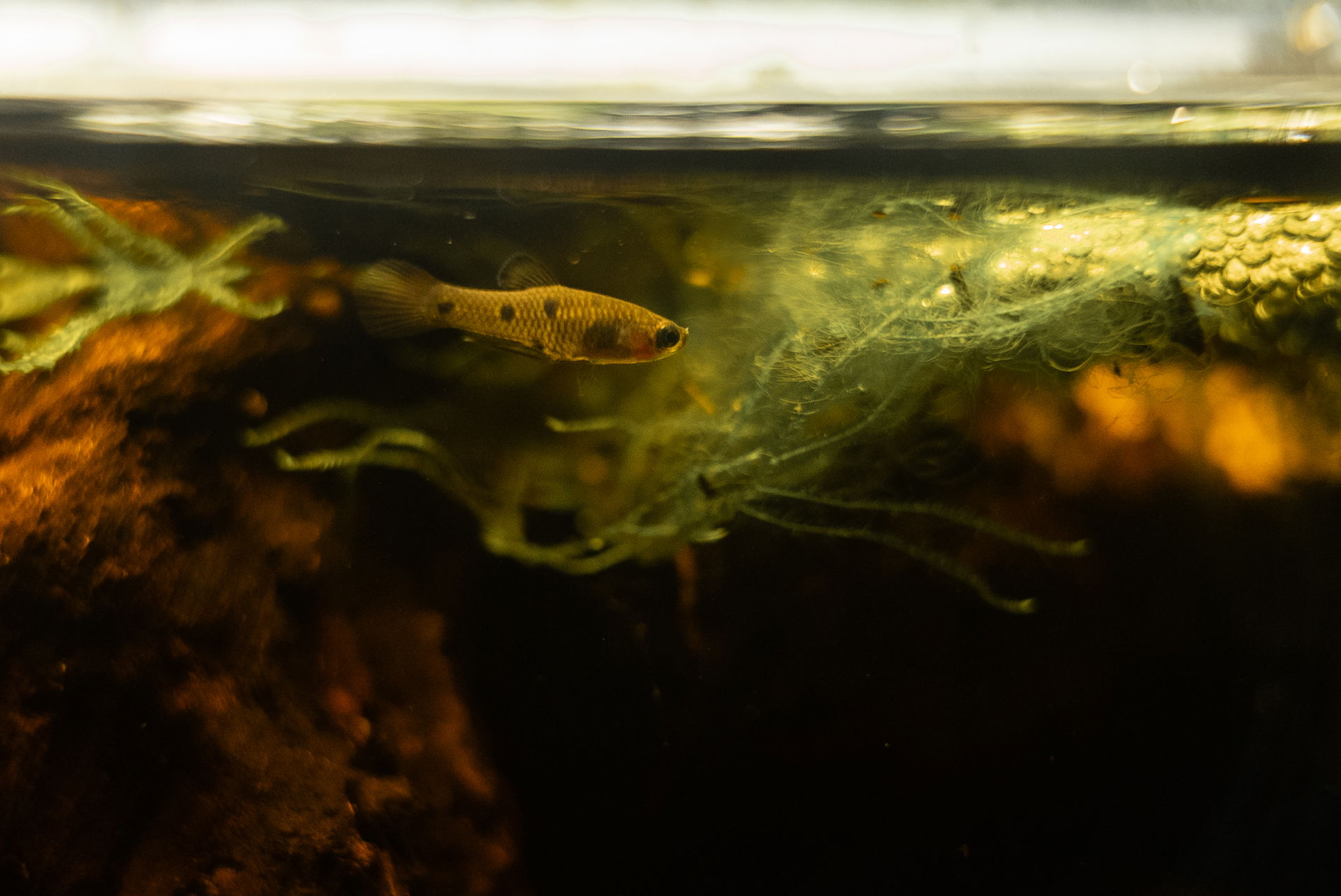
The fourspotted toothcarp is a small freshwater fish species that reaches a body length of about three to four centimeters. Males are generally slightly smaller than females. The sexes can also be distinguished by the males’ anal fin, which is modified into a gonopodium used for internal fertilization.
Characteristic of the species are the dark, round to oval spots along the sides of the body. Most individuals have four of these spots—hence the German name “Vierpunktkärpfling” (four-spot carp) and the scientific name P. quadripunctatus. Occasionally, however, individuals with only one or as many as five spots are found.
In its natural range, which extends primarily across the Río Sixaola watershed in Costa Rica and parts of western Panama, the species inhabits shallow, slow-moving waters with dense aquatic and riparian vegetation. There, it feeds primarily on micro-organisms, algae, and detritus, particularly dead microorganisms in the substrate.
According to the IUCN, the fourspotted toothcarp is classified as critically endangered. The main threats are closely linked to human interference in its habitat. Widespread deforestation and the conversion of land into plantations lead to increased nutrient input, pesticide contamination, and sedimentation in the waters. Added to this is inadequate wastewater infrastructure—for example, in the city of Sixaola in Costa Rica—which leads to additional pollution of natural habitats. These factors impair habitat quality and cause increased mortality rates within the populations.
Taxonomy
Poeciliidae, genus Phallichthys (over 3,000 species)
Habitat
slow-moving rivers and still bodies of water with a depth of about 10 to 50 cm
Behaviour and ecology
in small groups among aquatic plants
Diet
zooplankton, single-celled algae, and sludge