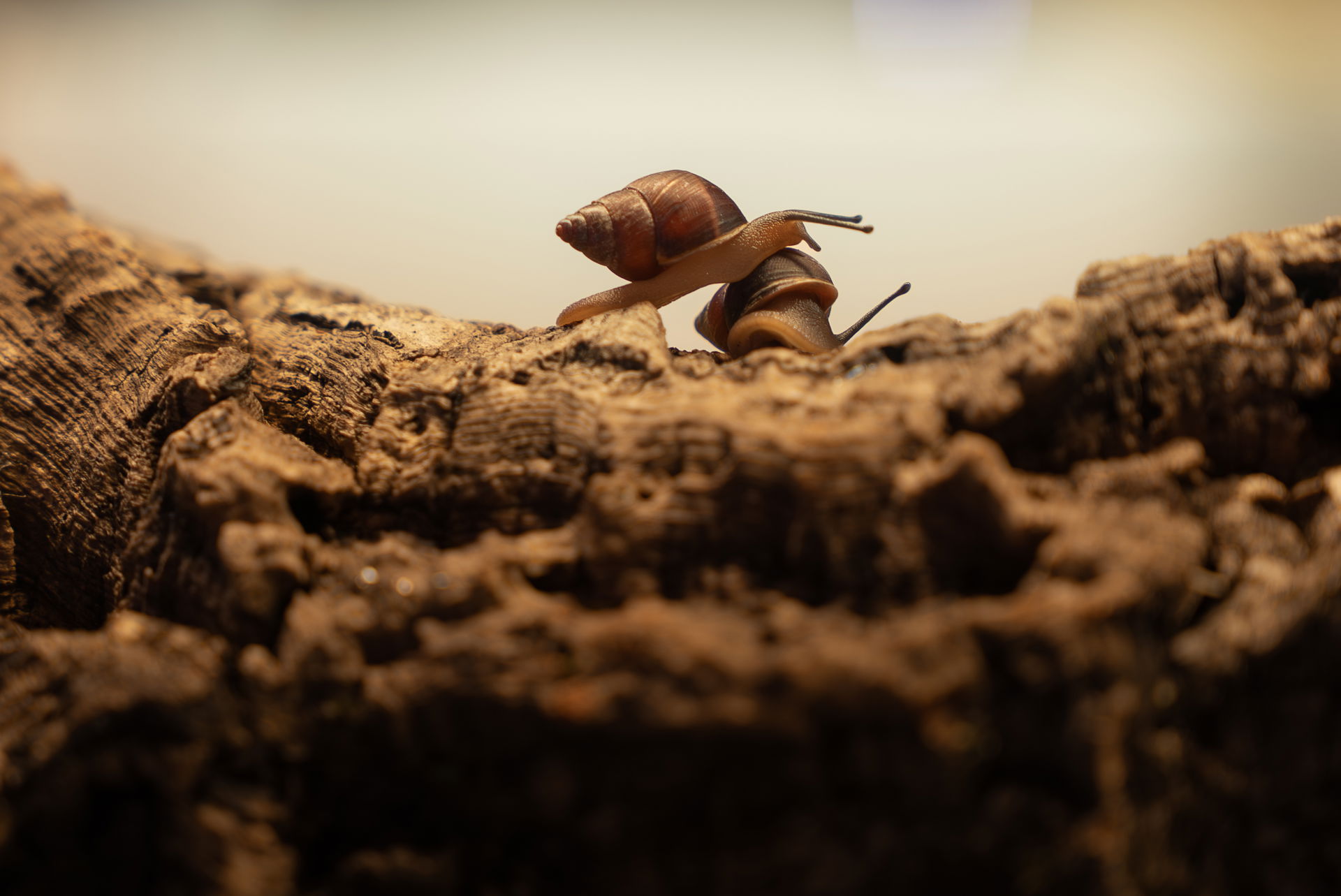
The Frégate island enid snail is an endangered terrestrial lung snail. It is found exclusively on the small island of Frégate in the Seychelles. Its entire habitat covers just around 2 km² – an extreme example of what are known as endemic species, i.e. species with a very limited distribution that are found nowhere else.
The snail lives there mainly in damp woods, under dead wood and leaves, where it is protected from drying out. To prevent itself from drying out, it also produces large quantities of slime.
It feeds on plant matter, which it can scrape off using its radula – a ‘rasping organ’ studded with thousands of tiny teeth.
Following the introduction of rats in the 1990s and the use of poisons to control them, the population of the Frégate island enid snail plummeted by 87 per cent within a few years. Since then, the population has recovered significantly.
Like all land lung snails, the Frégate island enid snail is an air-breathing mollusc. Instead of gills, land lung snails have what is known as a pulmonary cavity – a well-perfused outpouching of the mantle cavity. Air is taken in and expelled through a small opening in this protrusion. The oxygen is then transported into the snail’s blood via the fine network of blood vessels.
Most land snails are hermaphrodites, which means that each individual possesses both male and female reproductive organs. Nevertheless, they still need a partner for reproduction: during mating, the individual acting as the ‘male’ transfers a sperm packet into the other’s genital opening.
Egg cells are then produced in the so-called hermaphroditic gland and fertilised with the sperm obtained. A few days later, the snail lays its eggs in a small hole it has dug itself in the ground or under leaves. As both partners possess both male and female functions, they can also fertilise each other, meaning that both lay eggs after mating.
Taxonomy
Cerastidae, genus Pachnodus (approx. 12 species)
Habitat
forest and scrubland at altitudes of 1 to 100 metres above sea level on Frégate Island, some of which is also found within coconut plantations
Behaviour and ecology
terrestrial, solitary
Diet
plant material, in particular leaves