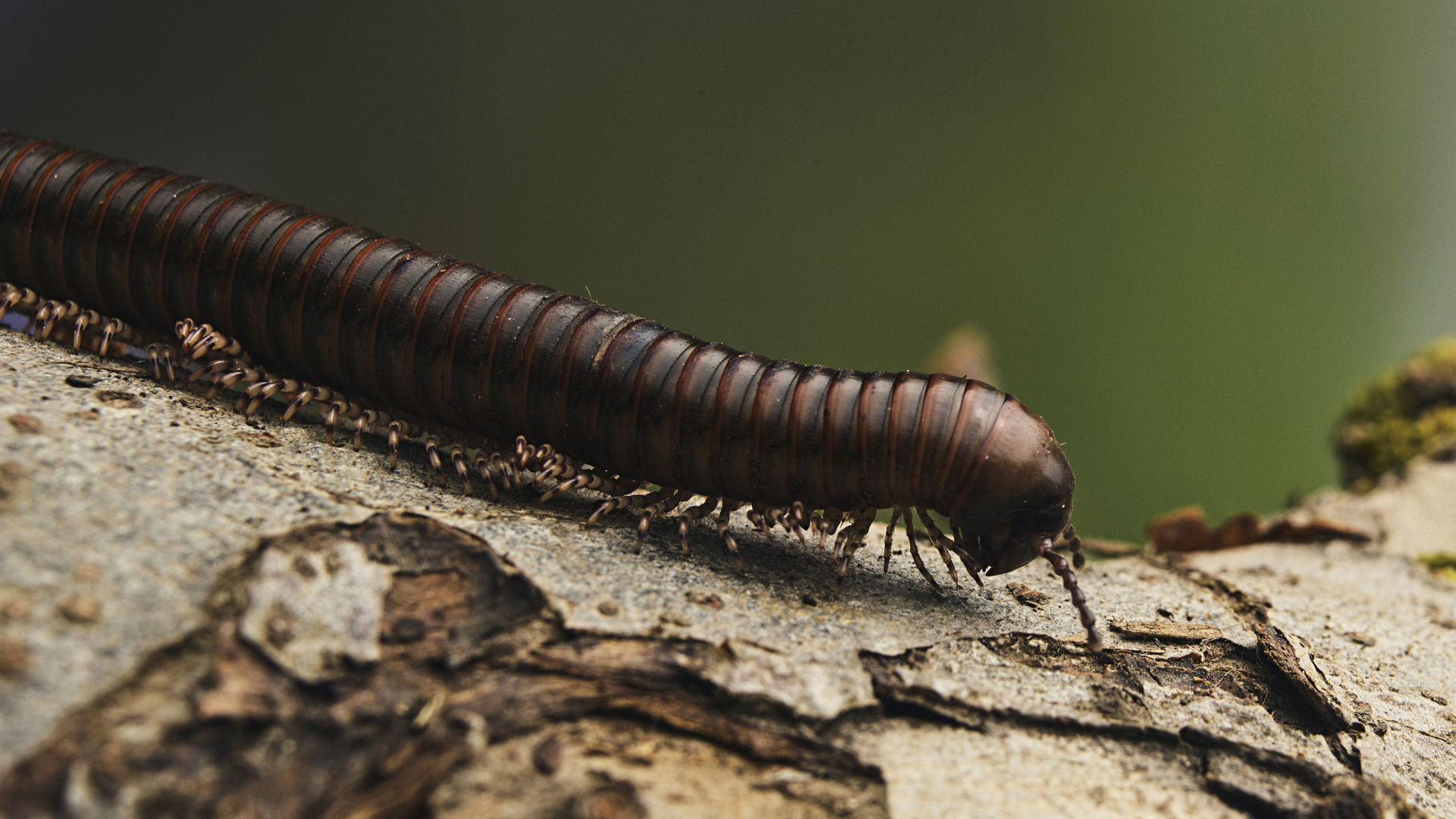
With a maximum length of up to 18 cm, the giant African olive millipede is one of the medium-sized species of millipede. Its body is brownish-green in colour and consists of around 70 identically structured segments extending from the head to the abdomen.
Contrary to the name ‘millipede’, this species actually has fewer than 300 legs. However, this is not particularly surprising. In fact, of the approximately 12,000 described species of millipede to date, only one has been found to have more than 1,000 legs.
Compared with other millipedes, the giant African olive millipede has relatively long legs. Although it is primarily a ground-dwelling species, these long legs also give it a remarkable ability to climb.
It is difficult to distinguish between the sexes based on external characteristics. However, the male can be identified by the absence of legs on the seventh segment, as this is where the reproductive organs are located.
As a defence mechanism, the giant African olive millipede curls up into a spiral shape and secretes a chemical defence substance. This substance is generally harmless to humans. However, it can cause irritation if it comes into contact with mucous membranes and may temporarily discolour the skin.
From an ecological perspective, this species plays an important role in the decomposition of organic matter, as its diet consists, amongst other things, of decaying plant material.
Taxonomy
Spirostreptidae, Telodeinopus (4 species)
Habitat
tropical rainforests and humid savannahs in Central and West Africa
Behaviour and ecology
active both day and night, usually under leaves or in the upper soil layers
Diet
fresh and decaying plant material