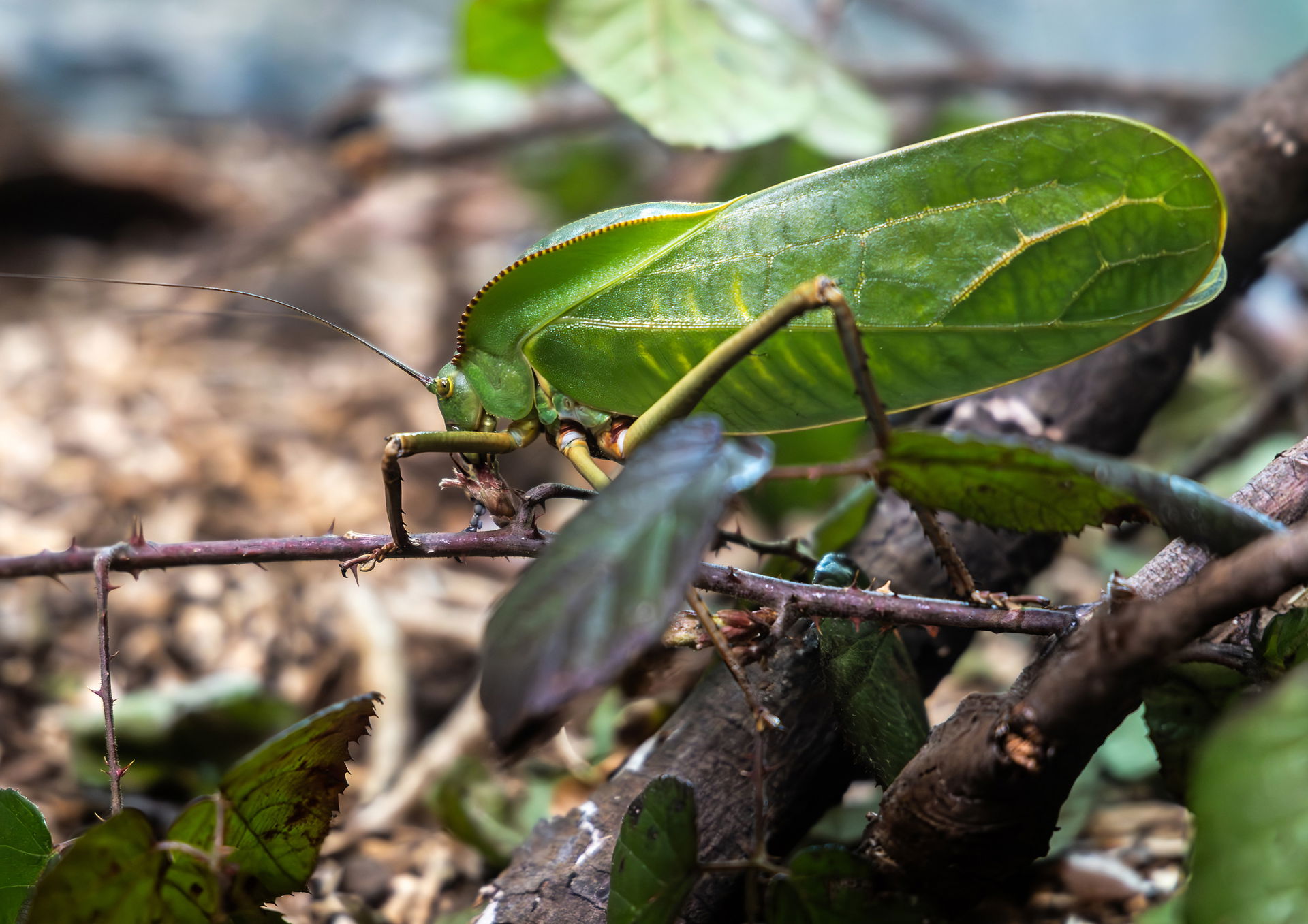
Female giant hooded katydids can reach a length of up to 13 centimetres, whilst the males remain slightly smaller. Their wingspan can be an impressive 25 centimetres. Nevertheless, they are not good flyers. They usually move about by crawling – and even that is rather rare, as they are perfectly camouflaged.
Although giant hooded katydids do not have ears on their heads, as we are familiar with in mammals, they do nevertheless possess hearing organs similar to those of humans. However, their eardrums are not located on their heads, but on their front legs. These enable them to detect sounds from a distance – a crucial ability for identifying potential predators at an early stage.
In females, a sort of stinger can be seen at the rear end of the body. This is not dangerous, as it is the ovipositor, the egg-laying tube. The females use it to lay their eggs directly into the ground.
After about two to three months, the nymphs (juveniles) hatch and display a remarkable behaviour: until they moult into adults, they can fling their faecal pellets metres away using their hind legs. In this way, they prevent predators from tracking them down by their scent, despite their camouflage.
Taxonomy
Tettigoniidae, genus Siliquofera (1 species)
Habitat
rainforests of Papua New Guinea, Indonesia and northern Australia
Behaviour and ecology
active at night and at dusk