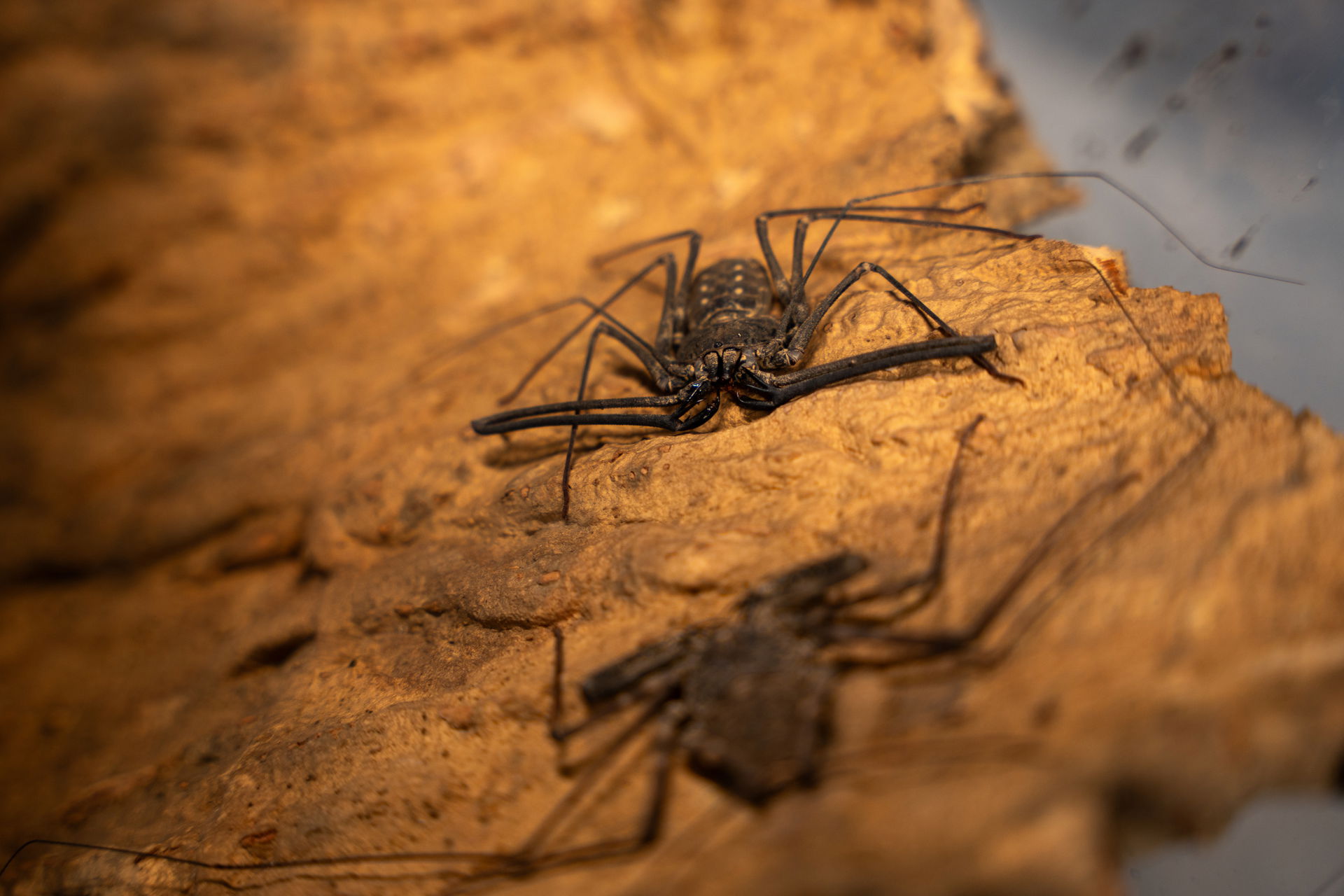
The front pair of legs is particularly striking. These legs are elongated into whips, which serve as tactile and olfactory organs and help the spider to perceive its surroundings. Due to their delicate structure, injuries to the legs are not uncommon. However, whip spiders are able to fully regenerate damaged limbs – during the next moult, they grow back to their original length.
A distinctive feature of the order of giant tailless whip spiders (Amblypygi) is the ability of both sexes to continue moulting even after reaching sexual maturity. This is an exception amongst arachnids and is accompanied by continuous growth in the animals’ size.
Like all arachnids, giant tailless whip spiders have pedipalps – modified appendages near the head that perform various functions. Whilst in scorpions they are modified into pincers and in many true spiders they function as sensory organs, in Giant tailless whip spiders they have evolved into specialised catching arms. These are studded with spines and enable the animals to seize their prey. Giant tailless whip spiders do not have spinnerets and are therefore unable to weave webs for hunting. They are therefore reliant on their hunting arms.
Harry Potter fans are likely to be very familiar with the Giant tailless whip spider: in the fourth film, ‘Mad-Eye Moody’ demonstrates the three Unforgivable Curses on a Giant tailless whip spider. However, contrary to what is stated in the film, this species is completely harmless to humans: the Giant tailless whip spider has no venom glands.
Taxonomy
Phrynichidae, genus Damon (10 species)
Habitat
forests and savannahs in West Africa
Behaviour and ecology
nocturnal, living in trees and caves