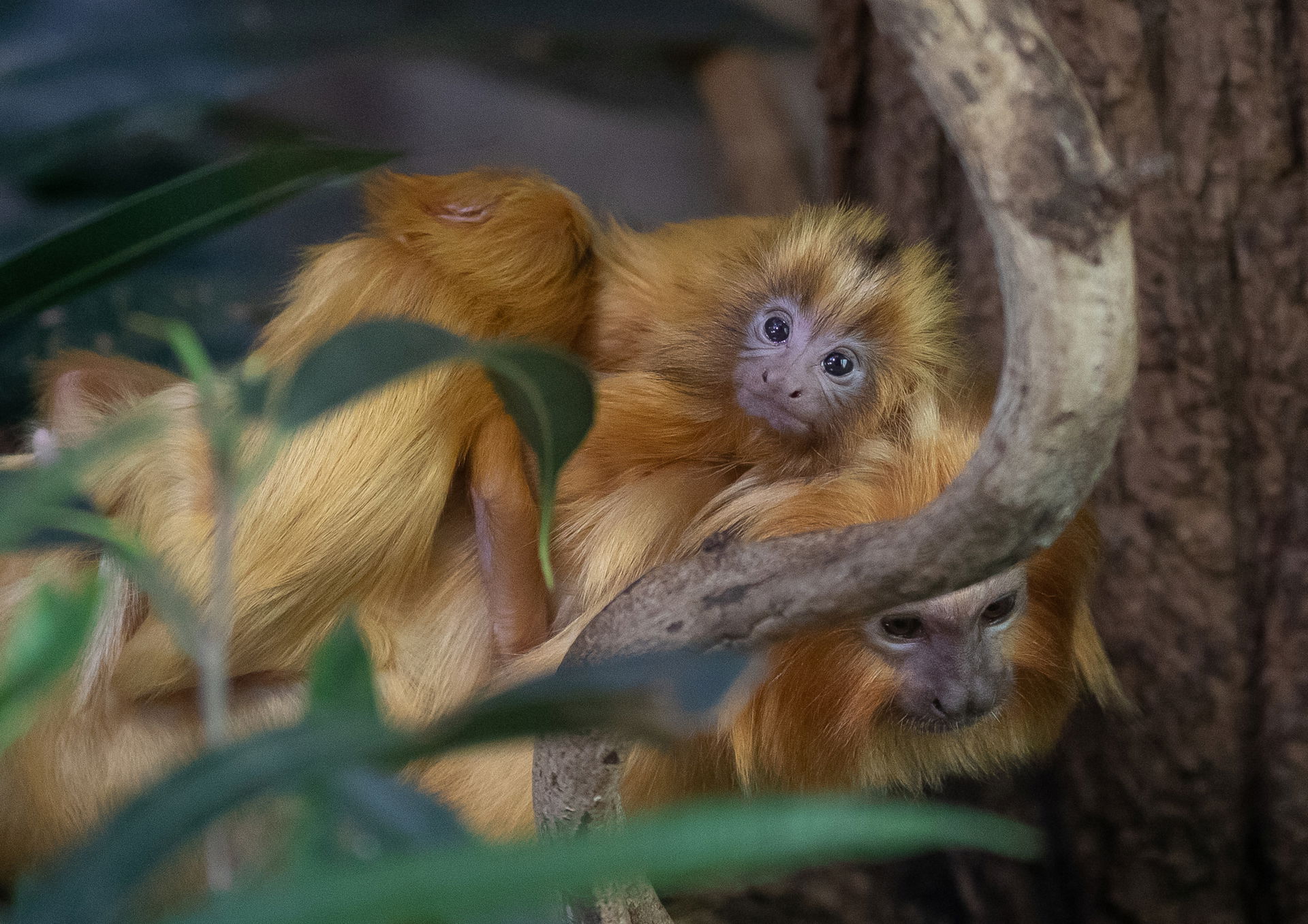
All four species of lion tamarin are critically endangered. Their original range comprises the rainforests along Brazil’s Atlantic coast. Ninety-eight per cent of these forests have now been destroyed, and what remains is fragmented into small patches of woodland.
The zoos’ coordinated conservation breeding programmes have saved the golden lion tamarin and the golden-headed lion tamarin from extinction.
The Poço-das-Antas reserve, covering an area of around 50 square kilometres, was established in 1974 for the reintroduction of zoo-bred golden lion tamarins. Between 1984 and 2000, a total of 146 zoo-bred lion tamarins were released into the wild. Currently, there are once again over 1,000 animals living there and in other forest areas in the Silva Jardim region. Poço-das-Antas is a success story and proof that zoos make an important contribution to the conservation of endangered species.
With the exception of their big toe, marmosets have sharp claws on their hands and feet. Using these claws and their teeth, the little monkeys can scratch at and break open tree bark. This enables them to get at tree sap and insect larvae.
Marmosets are very social animals. Mutual grooming, as well as physical contact whilst sitting together and sleeping, are important behaviours for maintaining and strengthening bonds within the group. Marmosets communicate using whistling sounds that are reminiscent of birdsong.
As a rule, in groups comprising several adult animals, only the dominant female with the highest rank reproduces. In some species of marmosets, there may be several potential fathers; however, it is usually only the highest-ranking male.
Rearing the young is the fathers’ responsibility. Often, all the males in a group help out at the same time, regardless of who the father is. The males carry the juveniles around and play with them. The female takes the juveniles to feed them. As a rule, marmosets give birth to fraternal twins.
Taxonomy
Callitrichidae, genus Leontopithecus (4 species)
Habitat
rainforest in the lowlands up to 300 metres above sea level.
Behaviour and ecology
They live in trees, sleep in tree hollows or in thickets, and fiercely defend their territory.
Social structure
family groups, including those with juveniles that are now adults; only the dominant pair engage in reproduction