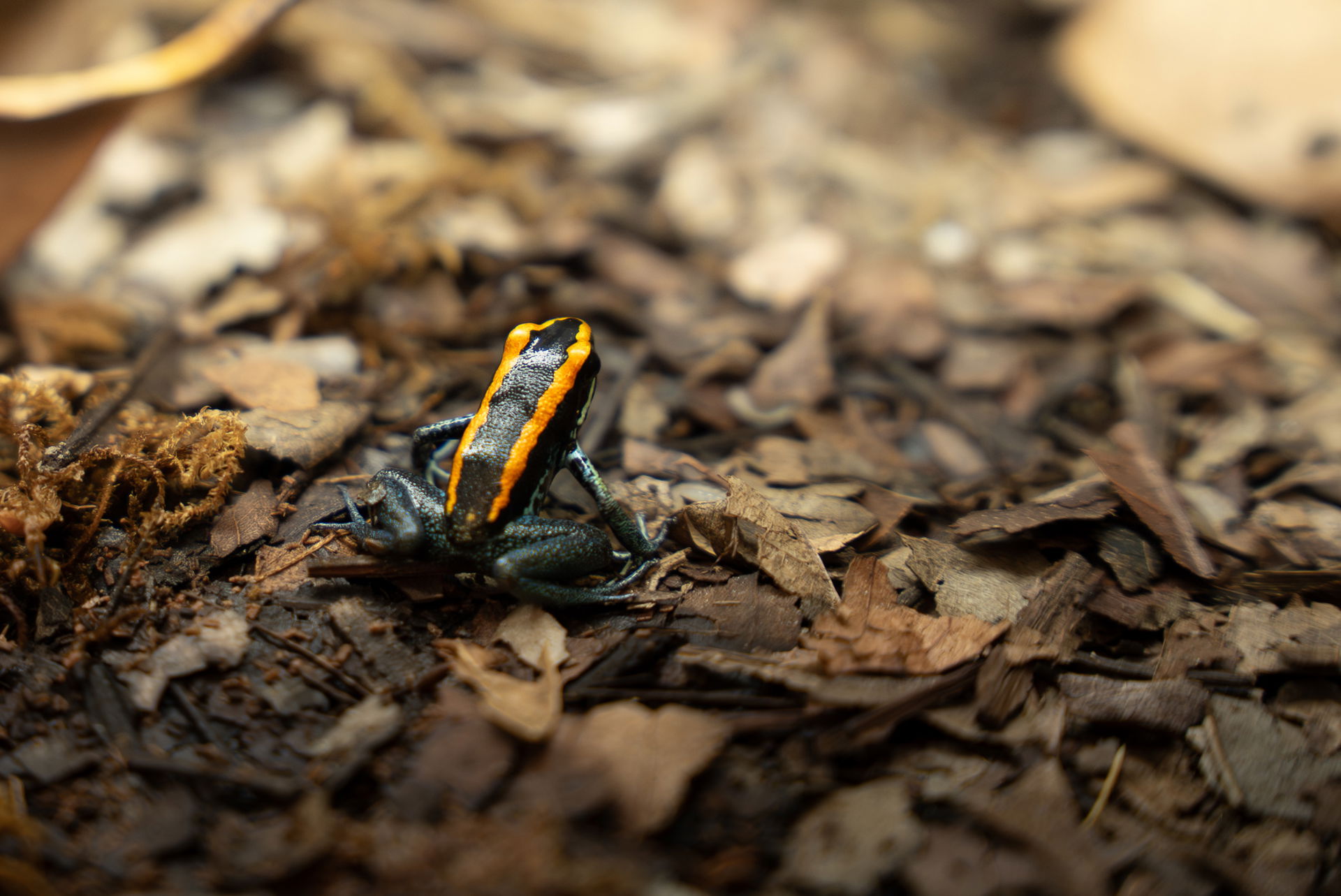
The golfodulcean poison frog is endemic to the moist lowland rainforests along streams in south-western Costa Rica. It spends almost all its time on the ground and near shallow water, and rarely climbs higher than one metre into the vegetation.
The species is diurnal and territorial. Rival males settle their disputes mainly through vocalisations, as well as through displays of dominance and brief chases.
Owing to their skin venom, adult animals have few natural predators to fear. The golfodulcean poison frog obtains the toxic alkaloids – traces of batrachotoxins – exclusively from its diet. In captivity, the animals lose almost all of their toxicity, as the relevant prey species are absent.
The golfodulcean poison frog displays distinctive brood-care behaviour. The male sits in front of his brood chamber and attracts females with a species-specific trill lasting several seconds. The female eventually lays between 10 and 25 eggs, usually on a leaf or in a damp cavity. There, the male fertilises the eggs and then guards them and keeps them moist on a regular basis.
The tadpoles hatch after about 18 days. The male carries them one by one on his back to calm stretches of water. The metamorphosis into a small frog is complete after about 2 to 3 months.
The range of the golfodulcean poison frog is small and fragmented. It is increasingly under threat from various factors, such as deforestation and water pollution. Furthermore, the species is affected by the international trade in animals.
Taxonomy
Tree-climbing frogs (Dendrobatidae), leaf-climbing frogs (Phyllobates, 5 species)
Habitat
humid lowland rainforests along streams at altitudes of 20 to 550 metres above sea level
Behaviour and ecology
diurnal, ground-dwelling (climbing no more than 1 m up into the vegetation); males are territorial
Diet
Ants, beetles, small invertebrates