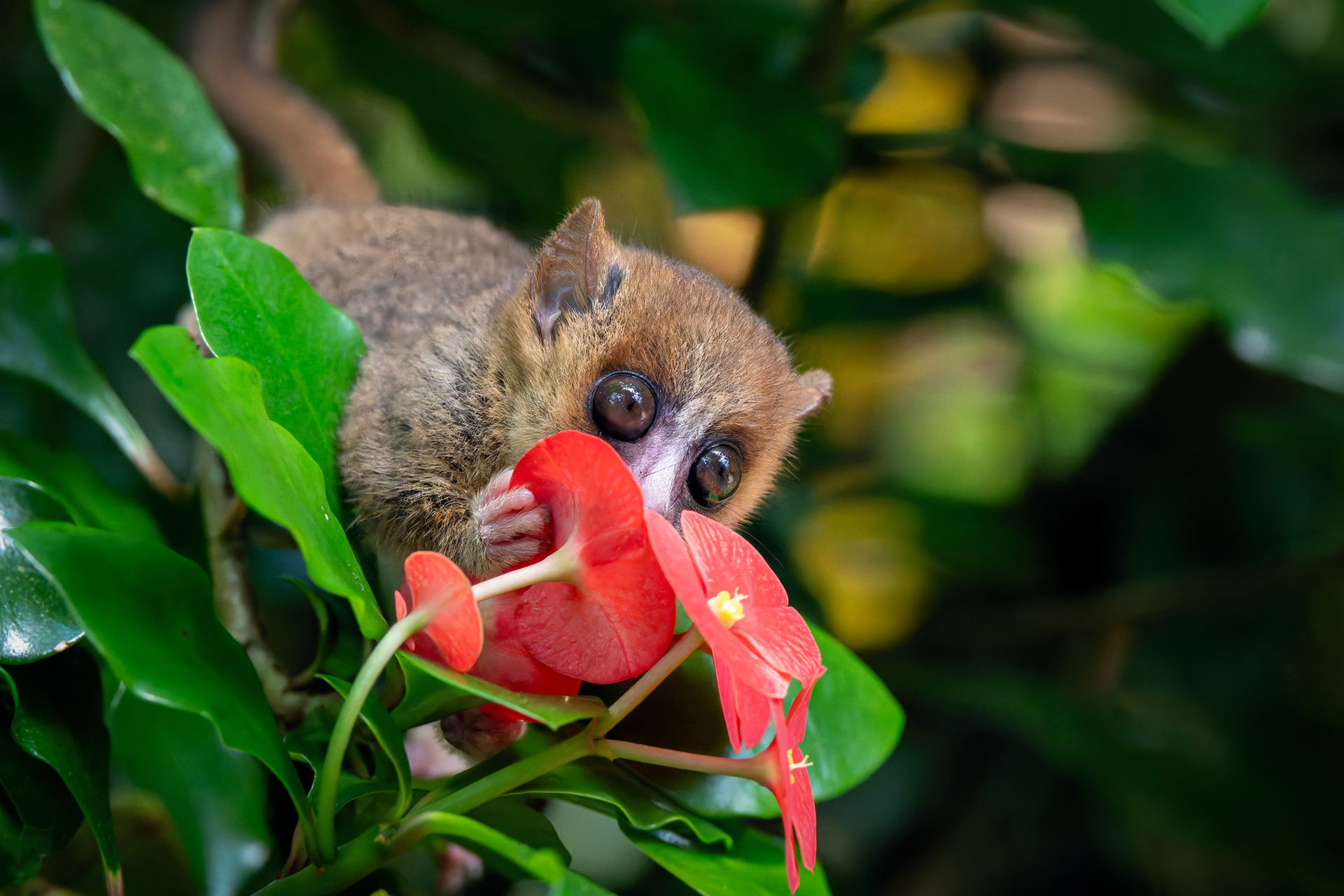
Goodman-Mausmaki (Microcebus lehilahytsara) im Masoala Regenwald des Zoo Zürich

Goodman’s mouse lemur

Microcebus lehilahytsara

The Goodman’s mouse lemur was first scientifically described in 2005 and, to date, is known only from the Andasibe-Mantadia National Park and its surrounding area in Madagascar.

NT

Red List
Near Threatened
Breeding programme

Goodman’s mouse lemurs are very small, measuring just 8 centimetres in head-body length. Depending on the season, they weigh between 30 and 55 grams.

During the southern winter, from May to August, the animals draw on the body fat stored in their tails. The females sometimes go into a short hibernation.

Goodman’s mouse lemurs live in the lowland and mountain rainforests of Madagascar, but are also frequently found in areas of degraded forest. In some regions of Madagascar, a population density of over 250 tail-less lemurs per square kilometre has been recorded!

Goodman’s mouse lemur Tremarins are nocturnal and can therefore usually only be seen in the Masoala Rainforest during guided tours at dusk or at night. They search the undergrowth and low-lying trees for fruit, flowers, shoots, insects and frogs. During the day, mouse lemurs sleep in tree hollows or in disused birds’ nests.

Due to its small size, the mouse lemur has many predators. It forms part of the diet of owls, falcons, mongooses, civets and Madagascar dog-headed boas.

Zoo Zurich is one of only a very few zoos in the world to be home to around 90 animals, the majority of which were born in Zoo Zurich’s Masoala Rainforest.

Taxonomy

Cheirogaleidae, genus Microcebus (25 species)

Habitat

rainforest

Behaviour and ecology

tree-dwelling, rarely move on the ground; nocturnal, sleep in tree hollows or birds’ nests; undergo hibernation in the wild during the Madagascan dry season

Social structure

solitary whilst foraging, but sleep in groups

Habitat at the zoo:

Masoala Rainforest

Godparent

Support the animals of Zoo Zurich with your annual godparent sponsorship

Goodman’s mouse lemur for CHF 300.–

Become a godparent

Godparent

Support the animals of Zoo Zurich with your annual godparent sponsorship

Goodman’s mouse lemur for CHF 300.–

Become a godparent

Mausmaki-Zählung

Back to overview