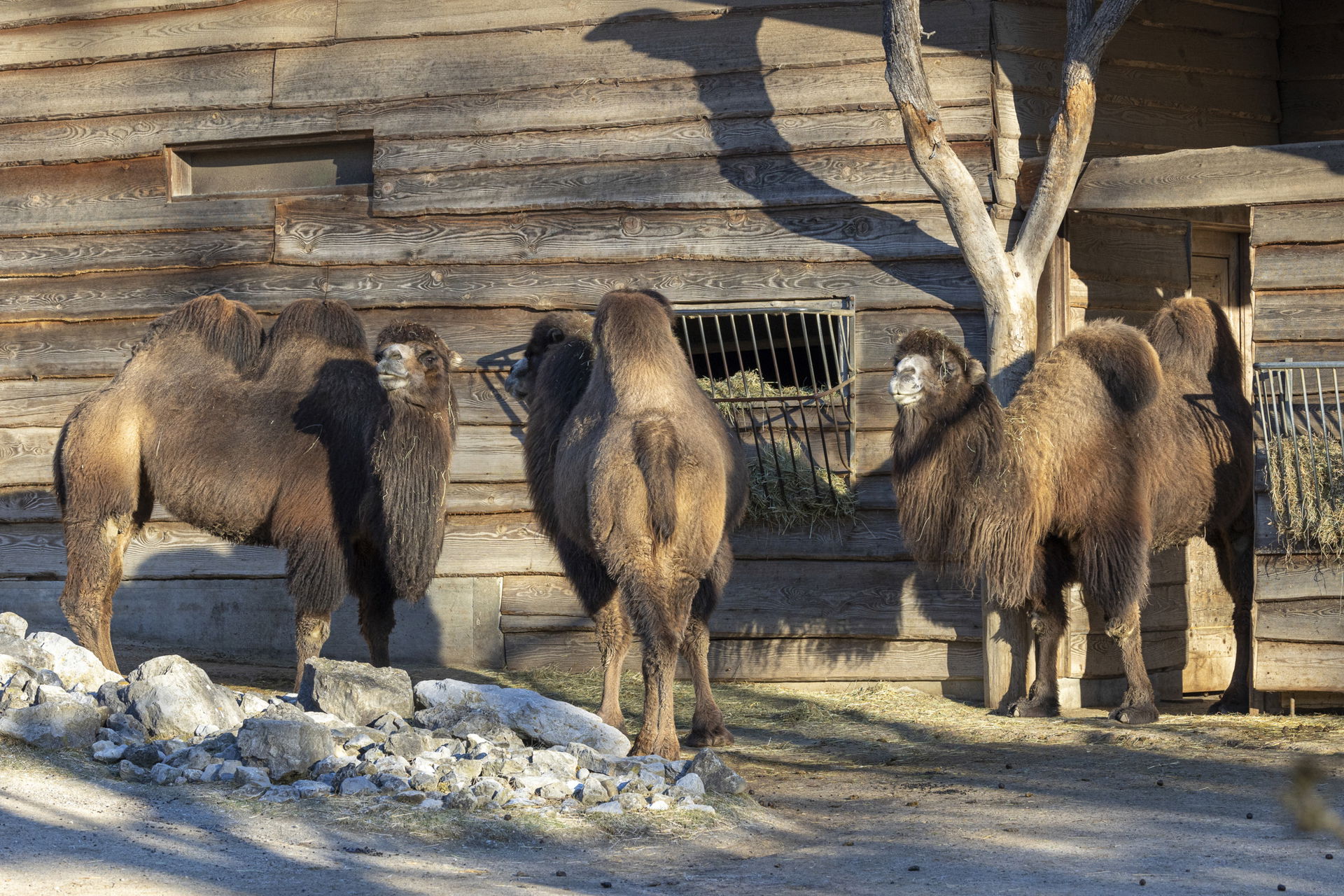
Hauskamele/Trampeltiere (Camelus ferus f. bactrianus) im Zoo Zürich

Bactrian camel

Camelus ferus f. bactriana

The Bactrian camel has two humps, whilst the dromedary has only one. The humps do not serve as water reservoirs, but as stores of fat reserves.

NE

Red List
Not Evaluated

The two-humped Bactrian camel, together with the two-humped wild camel and the one-humped dromedary, belongs to the group of large camels. Bactrian camel and dromedaries are regarded as domestic animals.

Wild camels differ in appearance from Bactrian camel in that their humps are relatively small, narrow and widely spaced. In Mongolia and China, there are now no more than 900 wild camels living in the wild. They are able to survive in extremely arid and cold regions and are the only mammals that can drink nothing but salt water.

All species of camel are even-toed ungulates. Instead of hooves, their toes are covered with nails. The toenails rest on an elastic, calloused pad.

The humps of dromedaries contain fat reserves. When the animals are on the move for long periods without eating, they draw energy from this reserve. However, water is also released when fat is burnt.

Taxonomy

Camelidae, genus Camelus (2 species)

Habitat

domestic animal, grazing in semi-arid regions and steppes

Behaviour and ecology

diurnal

Social structure

small harem groups, and, on rare occasions, solitary individuals

Taxonomy

Camelidae, genus Camelus (2 species)

Habitat

domestic animal, grazing in semi-arid regions and steppes

Behaviour and ecology

diurnal

Social structure

small harem groups, and, on rare occasions, solitary individuals

Tierstimme

Back to overview