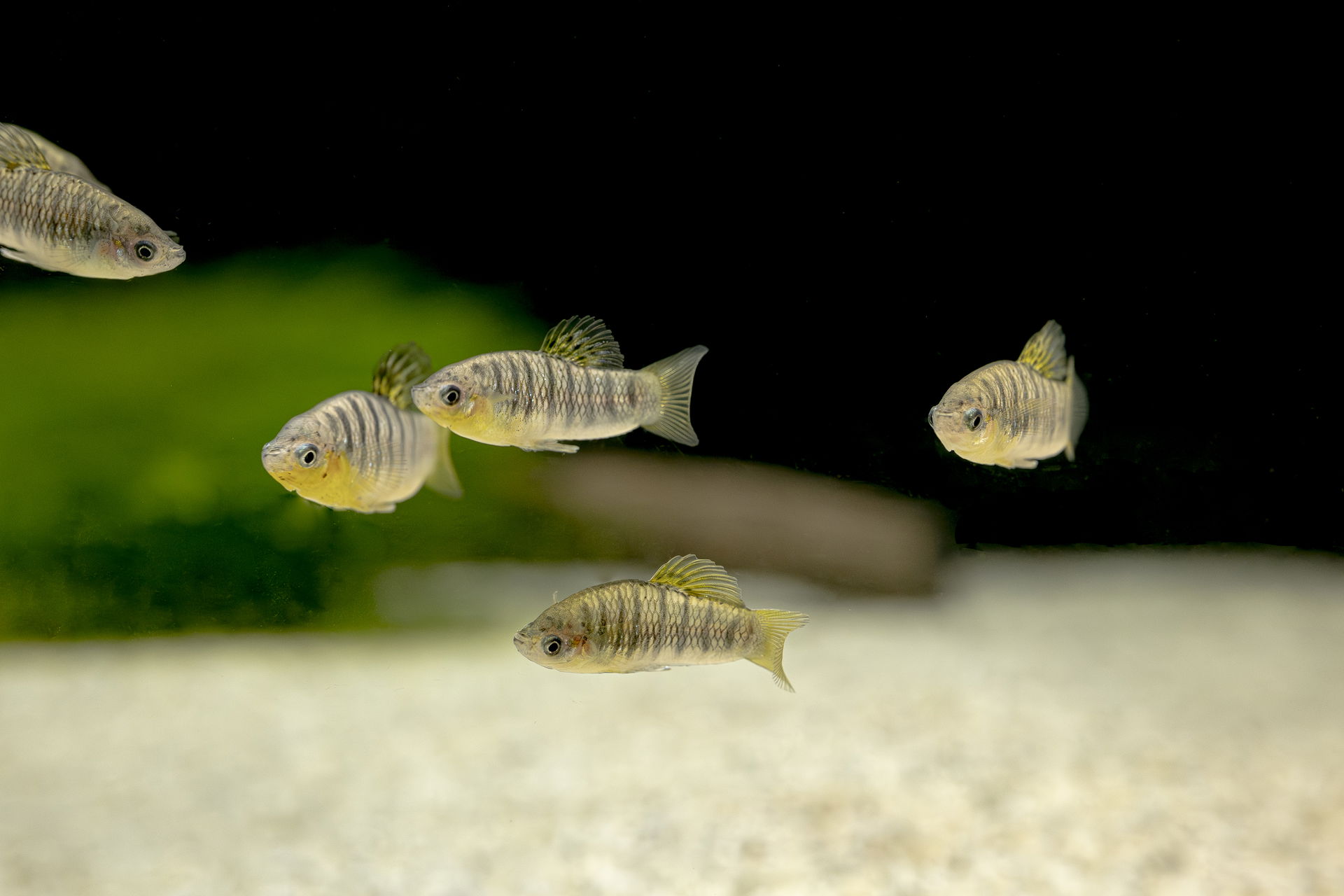
Buckelkärpfling (Poecilia nigrofasciata) in der Forschungsstation des Zoo Zürich

Humpback limia

Poecilia nigrofasciata

Male humpback limias have a specialised reproductive organ known as the gonopodium. They use this modified anal fin to transfer sperm to the females.

CR

Red List
Critically Endangered

The humpback limia is endemic to the island of Hispaniola (Greater Antilles). It is also known as the black-banded snapper.

The name ‘Humpback limia’ refers to the prominent hump on the back that adult males develop.

This species belongs to the live-bearing cyprinids. It is characterised by its distinctive reproduction behaviour: the males possess a copulatory fin, the gonopodium. This consists of modified rays of the anal fin. The male uses it to fertilise the eggs inside the female’s body.

The females give birth to between 10 and 60 fry every 28 days. They are about eight millimetres long.

As soon as the young fish are born, they are left to fend for themselves. They reach sexual maturity after five months.

Taxonomy

Poeciliidae, genus Poecilia (70 species)

Habitat

Haiti’s watercourses and Lake Miragoâne

Behaviour and ecology

in large swarms

Diet

omnivore

Taxonomy

Poeciliidae, genus Poecilia (70 species)

Habitat

Haiti’s watercourses and Lake Miragoâne

Behaviour and ecology

in large swarms

Diet

omnivore

Back to overview