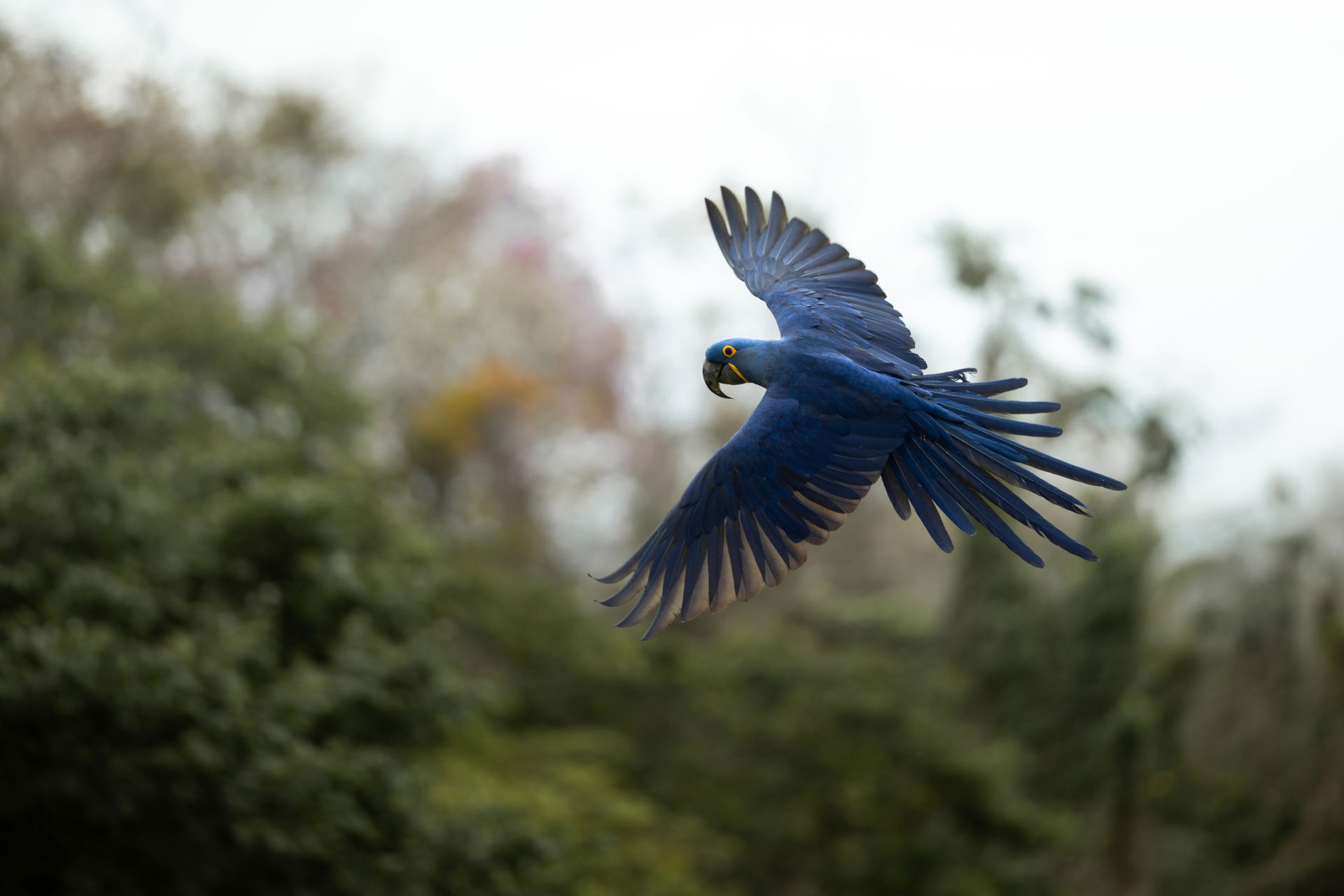
The hyacinth macaw is a species of parrot native to Central and Eastern South America. With a body length of about one meter, it surpasses all other parrot species and is considered the largest flight-capable parrot species in the world.
This species prefers open, swampy forests and savannas, where it can be found in groups of up to 20 individuals. Hyacinth macaws are considered very sociable birds with highly developed social communication. Their diet consists mainly of palm seeds and fruits, which they can easily crack open with their powerful beaks. As a result, the species plays an important role in the dispersal of these plants. As they carry the fruits to their nesting sites, the birds separate the pulp from the seeds, allowing the intact seeds to fall to the ground, which can contribute to the germination of new plants. Ecologically, the hyacinth macaw thus plays a significant role as a seed disperser for palms and thereby contributes to the preservation of the vegetation structure of its habitat.
The species' conservation status has changed over the years. Until 2000, the hyacinth macaw was considered critically endangered. In 2014, the IUCN downgraded the species to “Endangered” because recent surveys showed that the population decline was proceeding more slowly than originally assumed. The main causes of the decline are habitat loss due to deforestation and large-scale wildfires, as well as illegal wildlife trade, which is fueled by the bird’s strikingly bright blue plumage.
Taxonomy
family Psittacidae, genus Anodorhynchus (2 surviving species)
Habitat
open, swampy forests and savannas
Social structure
They live in groups, form monogamous pairs, and usually form lifelong bonds with their partners.
Diet
seeds of palm trees, fruits