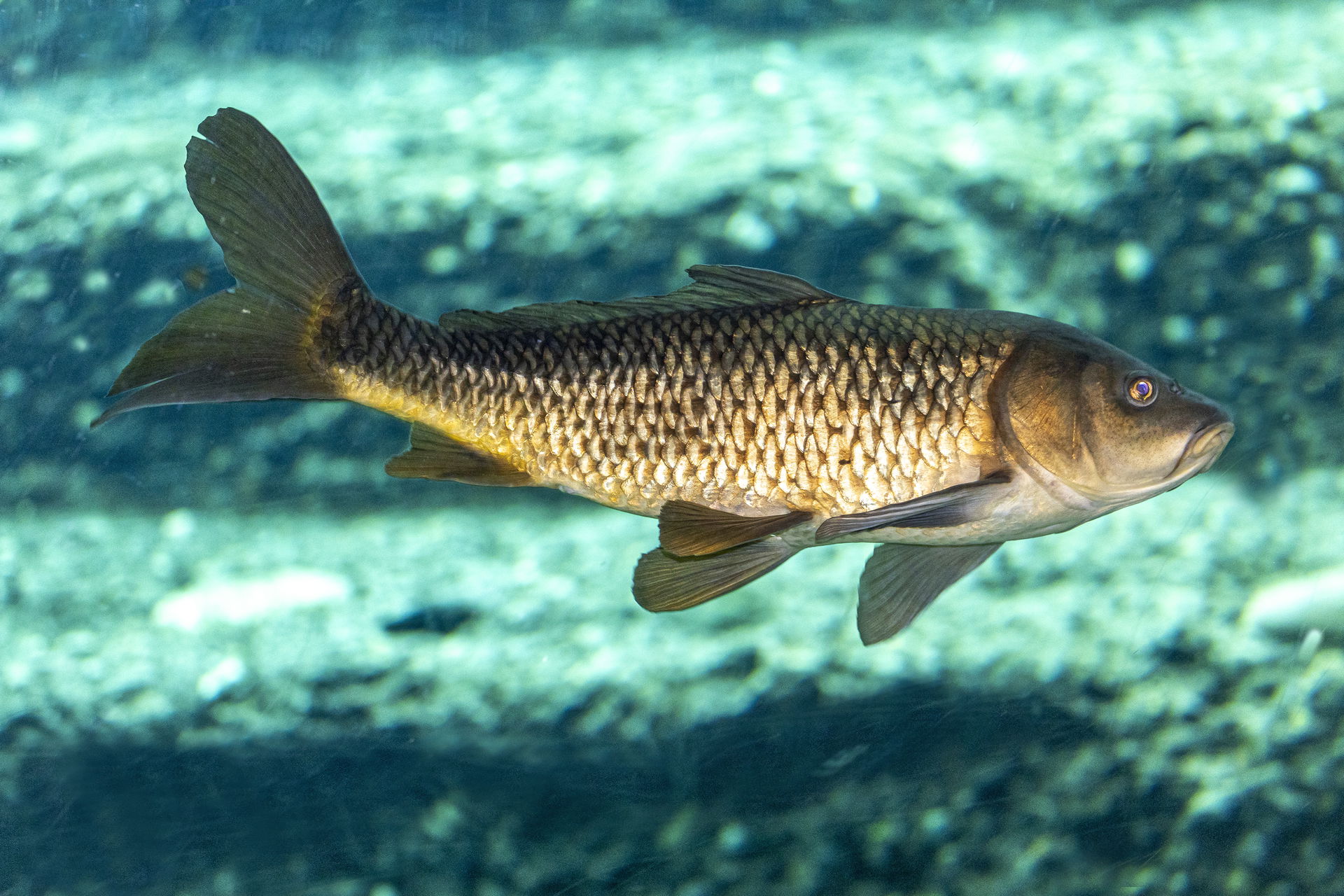
Common carp are freshwater fish that originate from Asia. They were brought to Europe by the Romans as far back as ancient times, and are now native to numerous rivers and lakes.
Although the Common carp is not native to Europe, the species is not classified as a neozoon, i.e. an introduced species. The classification of organisms as neozoons is based on Christopher Columbus’s discovery of the Americas in 1492, which serves as the chronological cut-off point. As common carp had already been brought to Europe before that time, they are classified as archaeobionts.
Due to their ability to survive even in waters with low oxygen levels, common carp are very well suited to farming, particularly in pond systems. There are many different farmed varieties, which differ from wild common carp mainly in the shape of their scales.
On average, common carp grow to a length of around 35 centimetres and weigh approximately one kilogram. However, depending on the breeding method, they can also grow considerably larger. The largest common carp ever caught weighed 42.6 kilograms.
Taxonomy
Cyprinidae, common carp (Cyprinus, over 20 species)
Habitat
Freshwater, lakes and slow-flowing watercourses
Behaviour and ecology
active at dusk and dawn; hides in deeper water during the day
Diet
omnivore (plants, algae, soil animals)