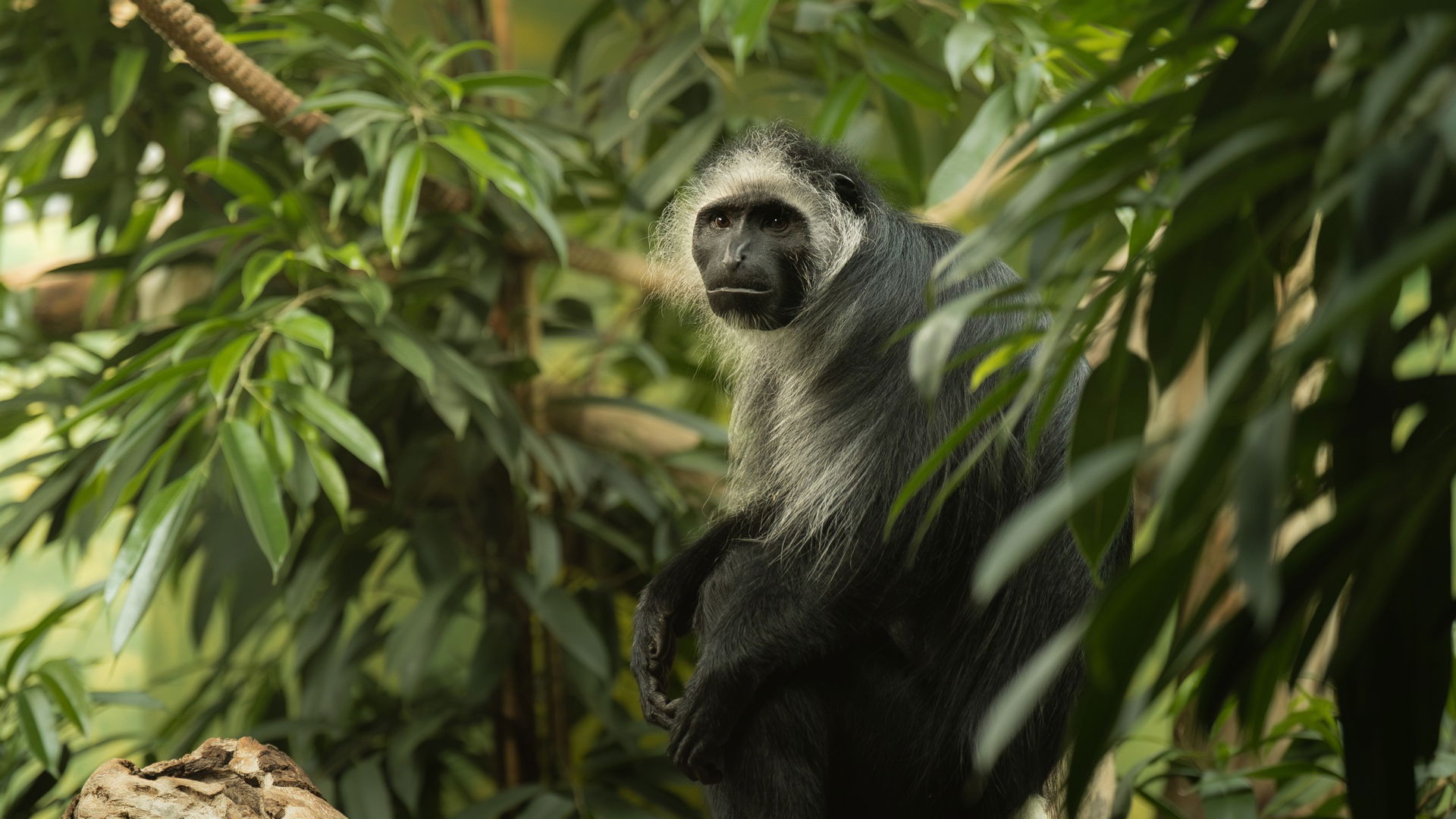
A characteristic feature of all colobus monkeys is their shortened thumb, which is shaped like a small stump. The name of the genus Colobus is derived from the Greek word ‘ekolobóse’, which means ‘mutilated’.
Unlike many other monkeys, the thumb is not opposable and cannot be brought opposite the fingers. This apparent limitation has, over thousands of years, proved to be an adaptive advantage for life in the treetops: when leaping from branch to branch, the animals use their hands like hooks. A flexible thumb would actually be more of a hindrance in this context. The long tail serves as a counterweight and steering aid, particularly during long leaps through the branches.
It is also striking that juveniles are white at birth and only develop their typical black-and-white colouring as they grow older.
The animals spend almost all their time in the uppermost tree canopies of the West African rainforest. Consequently, they have specialised in a diet of leaves, particularly those of lianas. To this end, they possess a multi-chambered stomach reminiscent of the forestomachs of ruminants. In an upstream fermentation chamber, bacteria break down the hard-to-digest cellulose. This complex digestive process requires a great deal of time and energy: King colobus spend more than half the day resting, sleeping or sunbathing.
King colobus live in groups, which usually consist of one or two males, four to six females and their offspring. Within the group, the females form closer social bonds with one another than with the males. In the first few weeks after birth, it is also common for juveniles to be carried not only by their mother but also by other females in the group.
The territories of neighbouring groups overlap to some extent. To mark their boundaries, the males use a distinctive morning ‘song’: a loud roar that echoes far through the forest, signalling their location to other groups. If encounters do occur, however, threatening gestures, loud roars and, occasionally, physical altercations involving both sexes may take place.
The ongoing deforestation of West African rainforests, as well as the hunting of animals for the bushmeat trade, has led to a drastic decline in the population of King colubuses. In many protected areas, the species has already disappeared or is now found only in very small numbers.