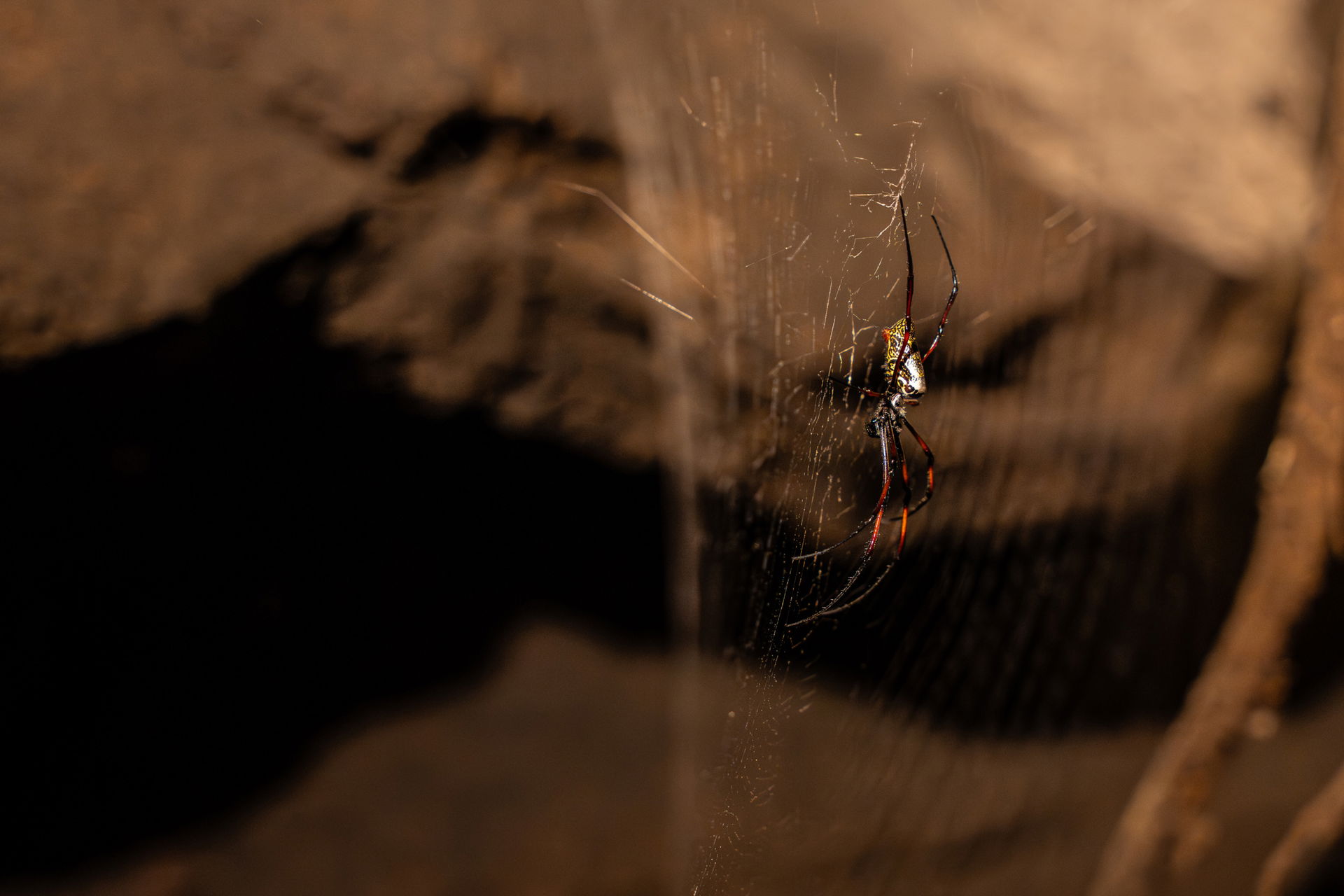
Madagascar golden orb-weavers weaves large, sturdy webs. These have a diameter of up to two metres and are a golden-yellow colour.
Scientists believe that the colour of the web may have an attractive effect on insects and that the web is also better camouflaged in the shade. This means, on the one hand, that the spider can attract more insects to eat. On the other hand, thanks to its camouflage, the spider itself is less likely to be spotted by predators such as birds or reptiles.
The webs are constantly being renewed. The females eat the parts that need replacing and use their spinnerets to weave the new section of web into place.
The Madagascar golden orb-weaver exhibits marked sexual dimorphism. This means that males and females differ greatly in appearance. Whilst the female’s body can grow to 3 centimetres in length and, including her legs, she is about the size of a human hand, the males are significantly smaller. Their body length ranges from 6 to 13 millimetres. The females also have striking colouring, with red and black striped legs and a yellow pattern on their bodies. This colouring presumably serves as a warning to predators.
Taxonomy
Nephilinae, genus Trichonephila (13 species)
Habitat
rainforest in Madagascar and other East African island nations
Behaviour and ecology
diurnal