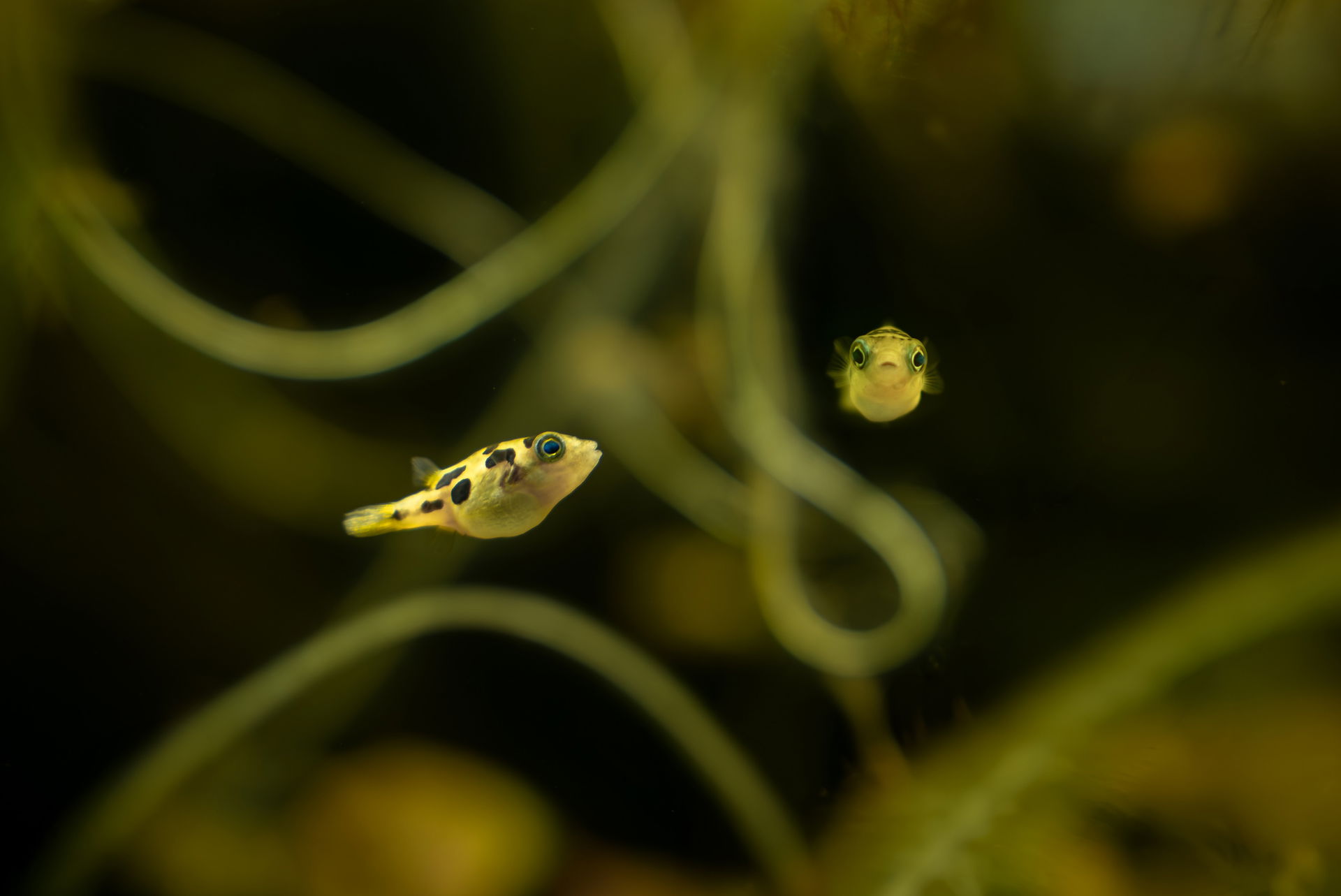
Der Zwergkugelfisch (Carinotetraodon travancoricus) im Zoo Zürich

Malabar pufferfish

Carinotetraodon travancoricus

The Malabar pufferfish, also known as the pea puffer, is one of the smallest pufferfish in the world. It can inflate itself with water in a matter of seconds, increasing its volume three- to four-fold.

VU

Red List
Vulnerable

The Malabar pufferfish is a slow swimmer. It often hides amongst the vegetation or near the bottom. In pufferfish, swimming is primarily driven by the dorsal and anal fins, whilst the caudal fin is only responsible for changing direction. As a result, the Malabar pufferfish’s swimming behaviour is reminiscent of a helicopter.

All pufferfish can inflate their bodies by rapidly taking in water into their highly elastic stomachs. Strong ring muscles at the entrance to the stomach prevent the water from flowing back out. By inflating itself, the fish increases its body volume, making it more difficult for a predator to swallow it.

The female Malabar pufferfish lays a total of around 100 eggs; however, she does not lay them all at once, but in small batches of 1 to 5 eggs per day. Once the female has laid the eggs on delicate plants, the male fertilises them. Just under a week later, the fry hatch. They reach sexual maturity after just five months.

Taxonomy

Pufferfish (Tetraodontidae), genus Carinotetraodon (6 species)

Habitat

India’s slow-flowing rivers with dense vegetation

Behaviour and ecology

living in small groups, active during the day

Diet

snails, mosquito larvae and small crustaceans

Taxonomy

Pufferfish (Tetraodontidae), genus Carinotetraodon (6 species)

Habitat

India’s slow-flowing rivers with dense vegetation

Behaviour and ecology

living in small groups, active during the day

Diet

snails, mosquito larvae and small crustaceans

Back to overview