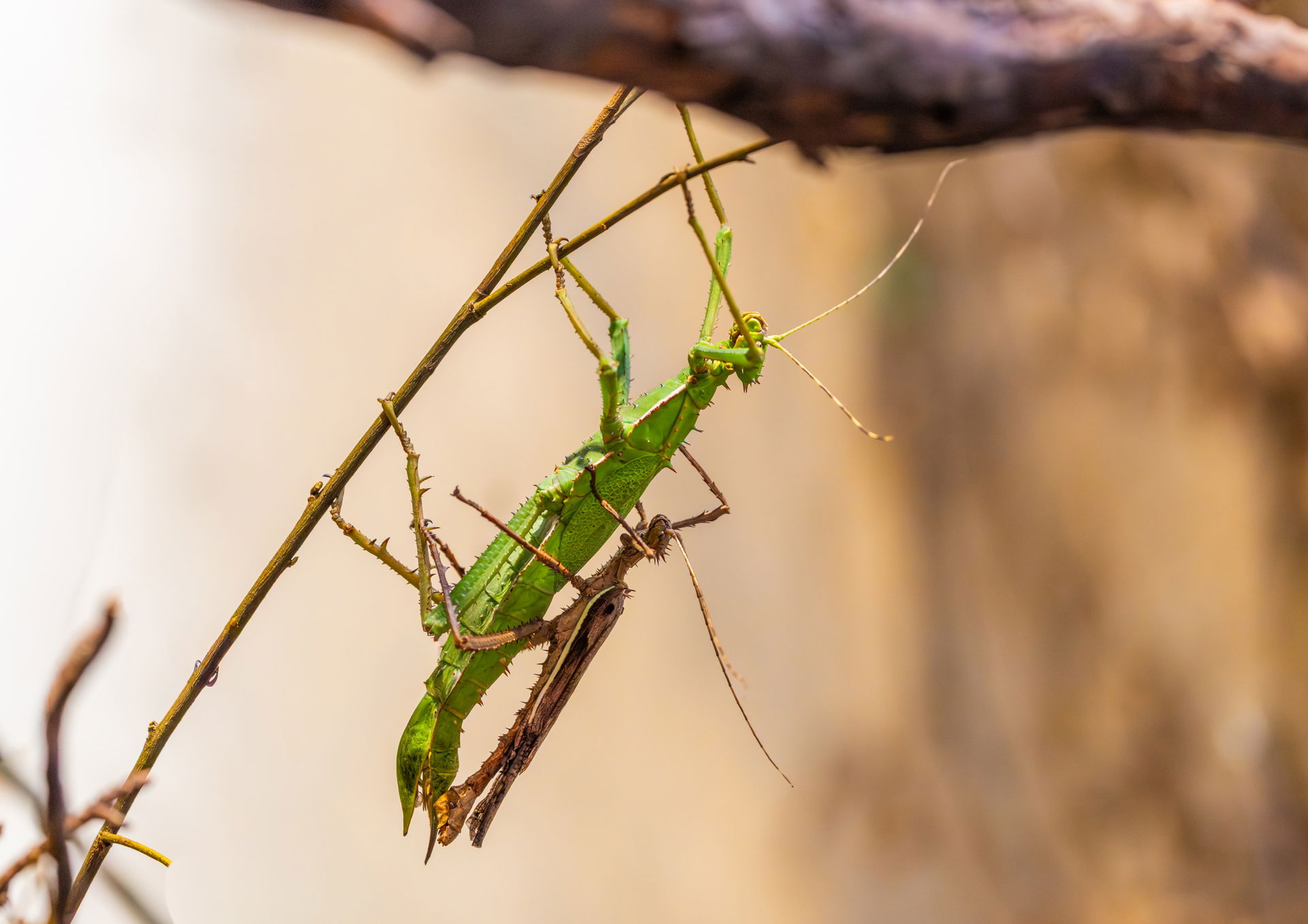
Despite its considerable size of up to 17 centimetres, the female Malayan jungle nymph possesses exceptional camouflage abilities. Its yellow-green colouring and leaf-like body structure enable it to blend in perfectly with the vegetation of tropical forests.
The species exhibits pronounced sexual dimorphism: whilst the females are larger and greenish in colour, the males remain significantly smaller, slimmer and brown in colour. Both sexes have two pairs of wings, but only the males are capable of flight.
A distinctive biological characteristic of this species is the occasional occurrence of gynandromorphism – individuals whose bodies consist of female cells on one half and male cells on the other. This rare phenomenon results in gynanders having a two-tone colouration.
A single female can lay up to 150 eggs during her lifetime. These are laid directly into the ground using the ovipositor (egg-laying tube).
The species can reproduce both sexually and by parthenogenesis (virgin birth). However, the latter only occurs in the absence of males.
The eggs are up to 7 mm long, and the juveniles do not hatch until approximately 7 to 12 months later, which is a long time compared with other phasmid mantises. The newly hatched nymphs are about 2 centimetres long, and it is already possible to distinguish between the sexes.
As they grow, the animals undergo several moults, with females moulting a total of six times and males five times. After about a year, they reach the adult stage. At this stage, they have a lifespan of 6 to 12 months.
When faced with threats, Malayan jungle nymphs display a defensive threatening posture: they raise their abdomen and stretch their spiny hind legs upwards to deter attackers. Their bodies are covered in sharp spines. They also have climbing claws on their legs. These not only make it easier for them to climb branches, but can also be used to defend themselves against predators in an emergency.
Taxonomy
Heteropterygidae, genus Heteropteryx (only 1 species)
Habitat
tropical rainforest and bushland
Behaviour and ecology
nocturnal