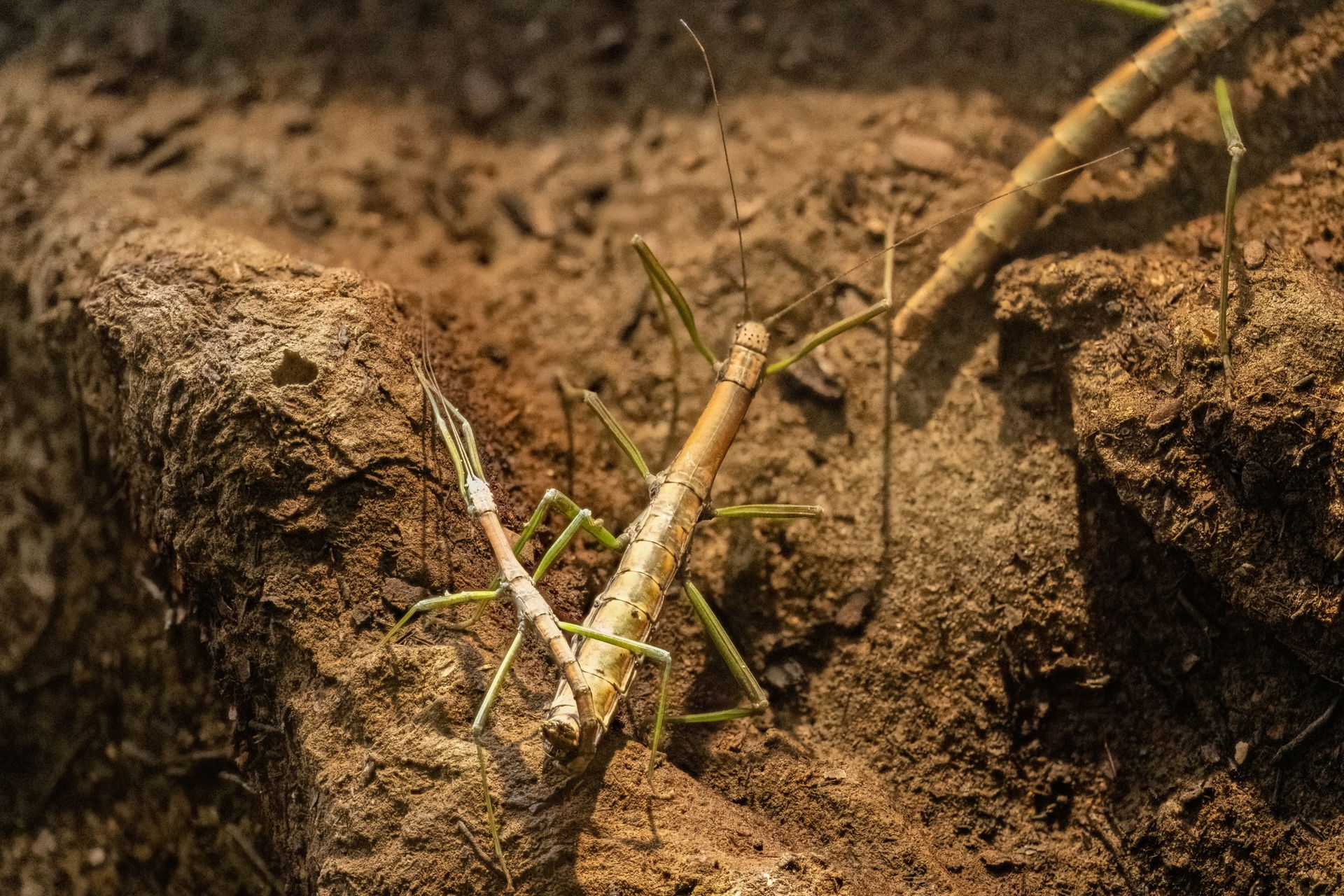
Vietnam is characterised by extraordinary biodiversity, encompassing a wide variety of animal and plant species. One species that has only recently been described is the Nui Chua stick insect, which was scientifically recorded in 2018. Its name is derived from Nui Chua National Park, which is currently the only known range of this species.
The species inhabits the region’s evergreen rainforests and possesses remarkable camouflage abilities: thanks to its branch-like appearance, it is superbly adapted to its surroundings and thus evades potential predators.
As is typical of many members of the stick-insect order (Phasmatodea), the Nui Chua stick insect exhibits pronounced sexual dimorphism. Females reach a body length of up to 13 cm, whilst males remain significantly smaller at around 6 cm.
A remarkable feature of this species is its social reproductive behaviour: as soon as a male reaches sexual maturity, he clings to a female nymph (juvenile) and remains there for the rest of his life. Even during the female’s final moult, as she transitions from the nymphal to the adult stage, the male remains attached to her.
Furthermore, it has been observed that males display defensive behaviour towards other males in order to secure a mate. The nymphs react differently to stress, depending on their stage of development: younger individuals display frantic movements, whilst older nymphs enter a state of thanatosis (freezing response).
The exact population size of the Nui Chua stick insect has not yet been recorded. However, given its very limited range, it is thought that the population is small overall.
As the species lives in the tree canopy, it is dependent on intact forest areas. Increasing deforestation therefore poses potential threats to its survival.
To safeguard the species, zoos have begun breeding the Nui Chua stick insect in a controlled environment, with the aim of establishing a stable reserve population and ensuring the long-term survival of this remarkable insect species.