Pantherchamäleon (Furcifer pardalis) im Masoala Regenwald des Zoo Zürich

Panther chameleon

Furcifer pardalis

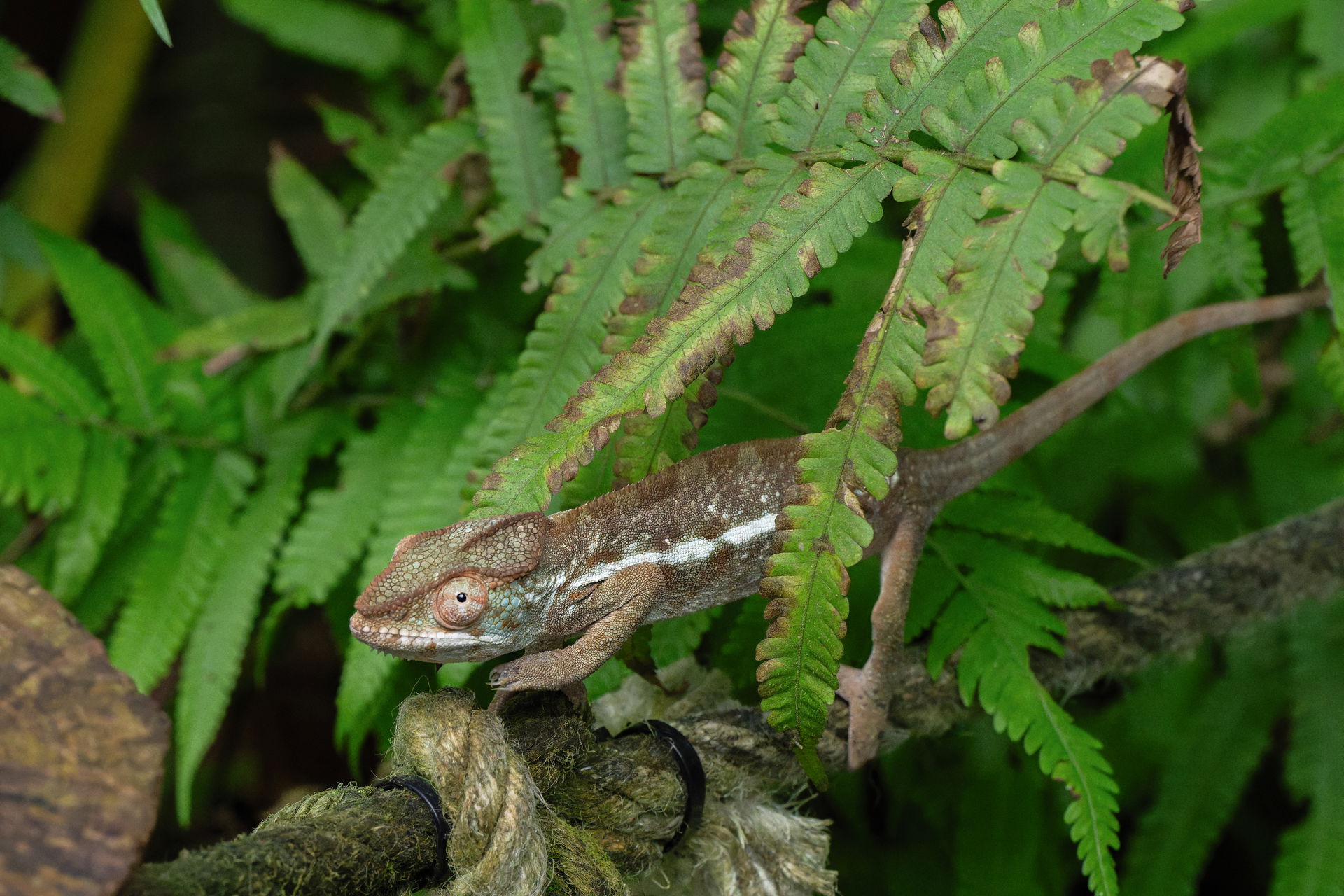
The panther chameleon fascinates with its remarkable abilities: it can change the colour of its body and move its two eyes independently of one another. When hunting, it shoots out its long, sticky tongue at lightning speed to catch its prey.

LC

Red List
Least Concern

Chameleons have very capable eyes. They can move them independently of one another. Their eyes protrude, giving the animal a field of vision of 342 degrees.

The chameleon’s flicking tongue can reach one and a half times the length of its body. It is not coiled up inside the mouth, but lies limp and contracted, much like a rubber band. The muscles attached to the hyoid bone tense the tongue, enabling it to be shot out of the mouth towards its prey within a tenth of a second.

When the tongue strikes its target, a muscle at the thickened tip contracts in a flash, creating a cone-shaped cavity. This generates a vacuum, drawing the prey towards it. In addition, the tongue is coated with a secretion, which increases the prey’s adhesion to the tongue.

The chameleon’s feet are perfectly adapted for gripping branches. Although each foot has five toes in total, two and three toes respectively have fused together. The fused toes face each other like the jaws of a pair of pliers.

Taxonomy

Chamaeleonidae, genus Furcifer (24 species)

Habitat

shrubs and trees, as well as agricultural and built-up areas up to 700 metres above sea level

Behaviour and ecology

diurnal, territorial

Diet

insects, other invertebrates

Habitat at the zoo:

Masoala Rainforest
Young animals
03.03.2026
01.03.2026
26.02.2026
25.02.2026
Taxonomy

Chamaeleonidae, genus Furcifer (24 species)

Habitat

shrubs and trees, as well as agricultural and built-up areas up to 700 metres above sea level

Behaviour and ecology

diurnal, territorial

Diet

insects, other invertebrates

Habitat at the zoo:

Masoala Rainforest

Godparent

Support the animals of Zoo Zurich with your annual godparent sponsorship

Panther chameleon for CHF 500.–

Become a godparent

Godparent

Support the animals of Zoo Zurich with your annual godparent sponsorship

Panther chameleon for CHF 500.–

Become a godparent
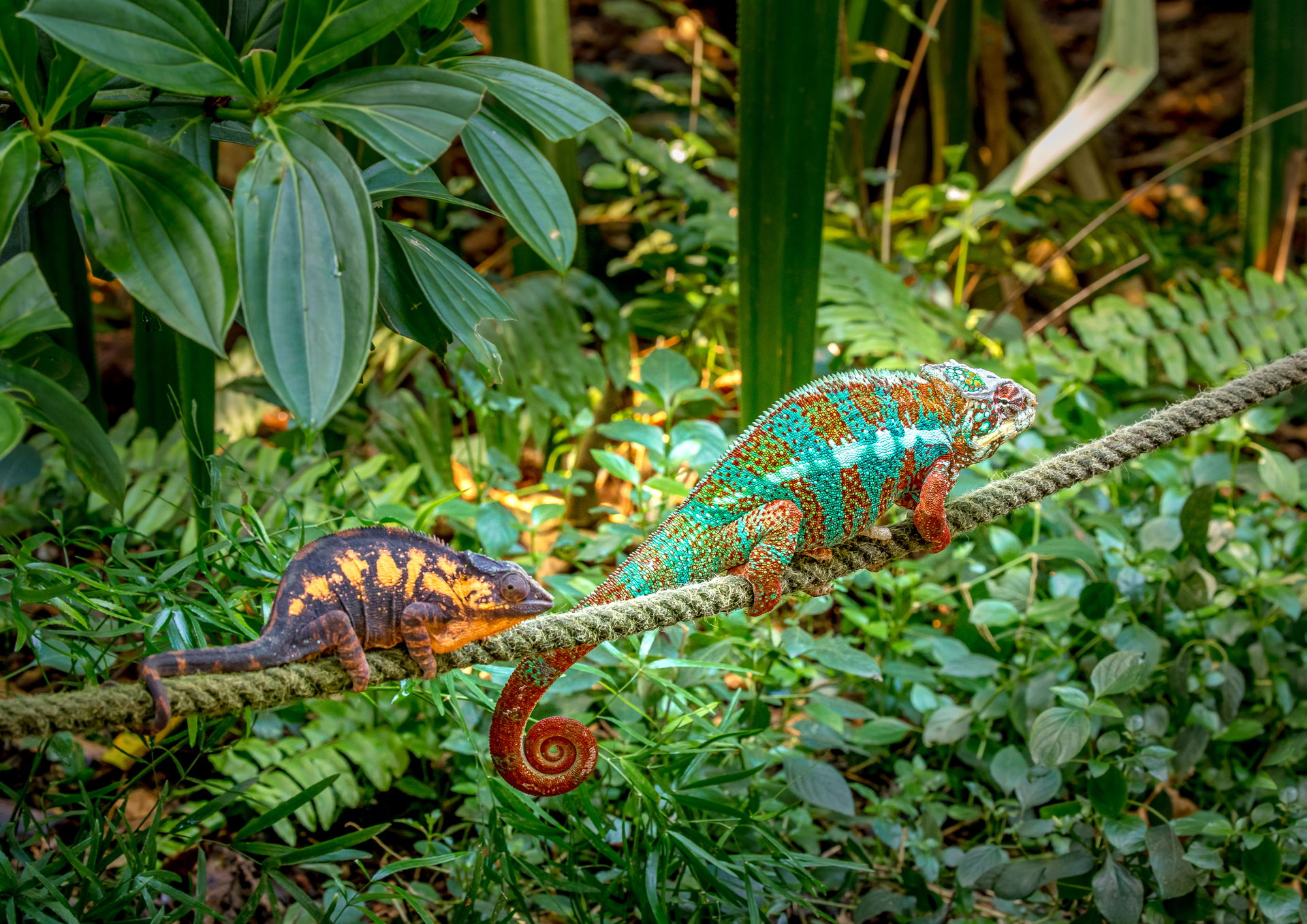
Pantherchamäleons (Furcifer pardalis) im Masoala Regenwald des Zoo Zürich.

Mit seinen Farben zeigt das Pantherchamäleon unter anderem an, ob es paarungsbereit ist. Foto: Zoo Zürich, Albert Schmidmeister

Wie das Chamäleon seine Farbe wechselt

Der Farbwechsel dient dem Pantherchamäleon hauptsächlich zur Kommunikation mit Artgenossen. Es zeigt Paarungs- und Kampfbereitschaft so unmissverständlich an.

Für die Hautfärbung spielen aber auch die Luftfeuchtigkeit, Temperatur, Sonneneinstrahlung, Tageszeit und Gesundheitszustand eine Rolle. Bei niedrigen Temperaturen nehmen die Chamäleons eine dunklere Hautfarbe an.

Die farbliche Veränderung entsteht durch die Ausdehnung und das Zusammenziehen von Pigmentzellen und deren Konzentration in den Farbzellen. Für den Wechsel sind drei Hautzellentypen verantwortlich, die in drei Schichten übereinander liegen.

Die oberste Schicht ermöglicht rote und gelbe Farben. Die mittlere Lage erzeugt braune und schwarze Farbtöne. Die unterste Lage bricht das einfallende Licht und erzeugt die Farbe Blau. Ein komplexes Zusammenspiel der drei Zellschichten erzeugt schliesslich die ganze Vielfalt an Farbvariationen.
Back to overview