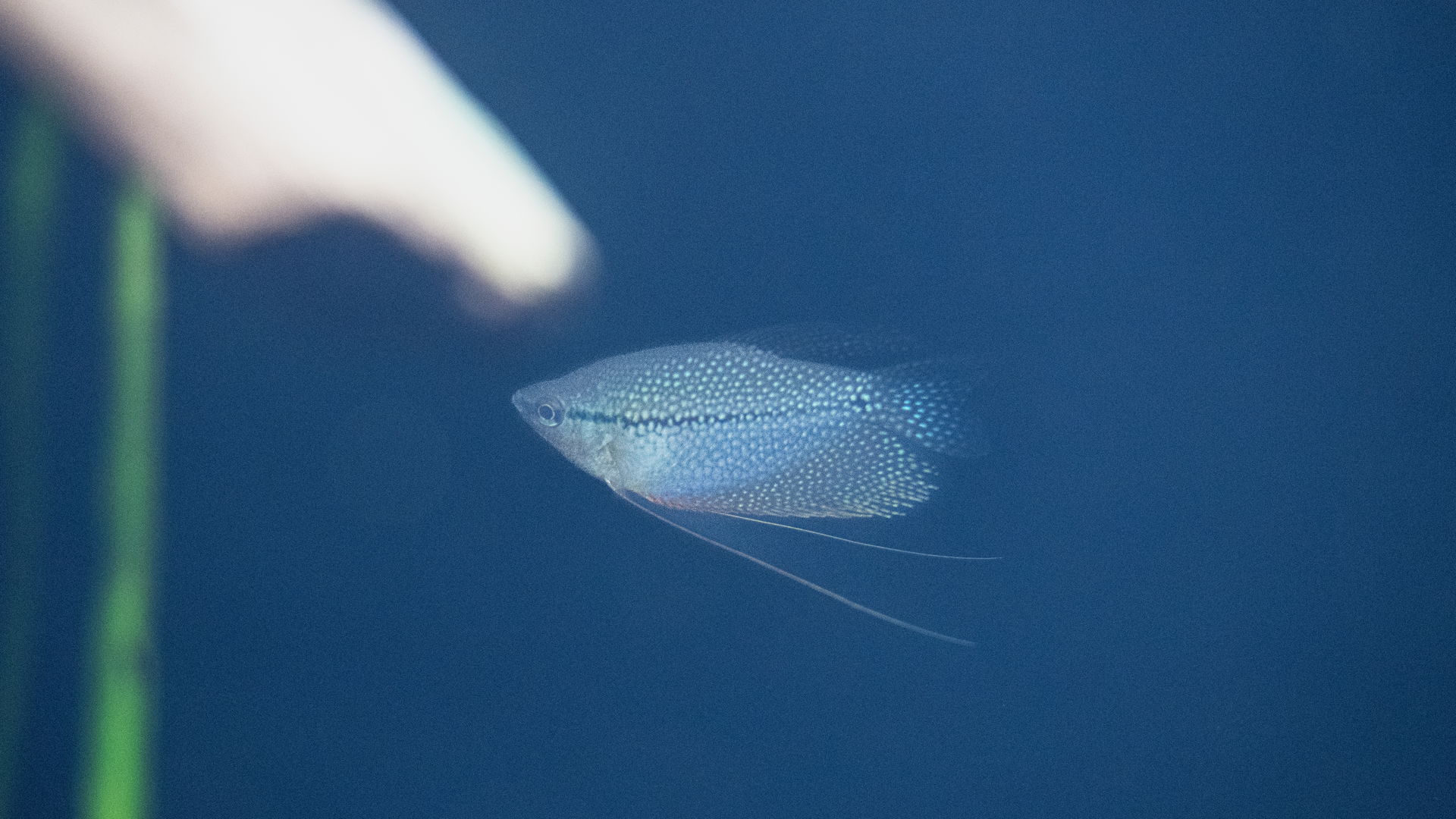
The pearl gourami not only stands out for its shimmering scale pattern, which is reminiscent of an intricate mosaic, but also for its extraordinary adaptability. Native to the dark, low-oxygen blackwater rivers of South-East Asia, it possesses a specialised respiratory organ – the labyrinth organ.
This organ enables it to breathe atmospheric air, thereby making it independent of well-oxygenated water. This distinctive feature gives it an evolutionary advantage in extreme habitats.
The pelvic fin rays, from which the fish takes its name, are also striking. These sensory organs help the fish to perceive tactile and taste stimuli and to navigate.
Another remarkable feature is its unique breeding behaviour. The male builds an elaborate foam nest on the water’s surface, consisting of hundreds of tiny air bubbles, which he stabilises with a secretion from his mouth. Following an intense courtship ritual, the female lays her eggs. The male carefully carries them into the nest and guards them.
During the breeding season, the male displays surprisingly aggressive territorial behaviour – a stark contrast to his otherwise peaceful nature.
It is easy to tell the sexes apart: males have longer fins and a bright reddish-orange colouration on their chest. This vibrant colouring becomes even more pronounced during the mating season, creating a spectacular display.
From an ecological perspective, the pearl gourami is an indicator of healthy tropical freshwater habitats. However, habitat loss and water pollution are increasingly taking their toll on the species. Despite its popularity in the aquarium hobby, it faces threats in parts of its natural range. However, its ability to survive in artificial habitats offers hope for the species’ conservation through controlled breeding programmes.
Taxonomy
Osphronemidae, genus Trichopodus (5 species)
Habitat
stagnant and slow-flowing freshwater bodies with dense, shade-casting riparian vegetation and/or weedy substrate
Behaviour and ecology
territorial; they defend their territory
Diet
plankton, insects, larvae, small crustaceans, snails and worms