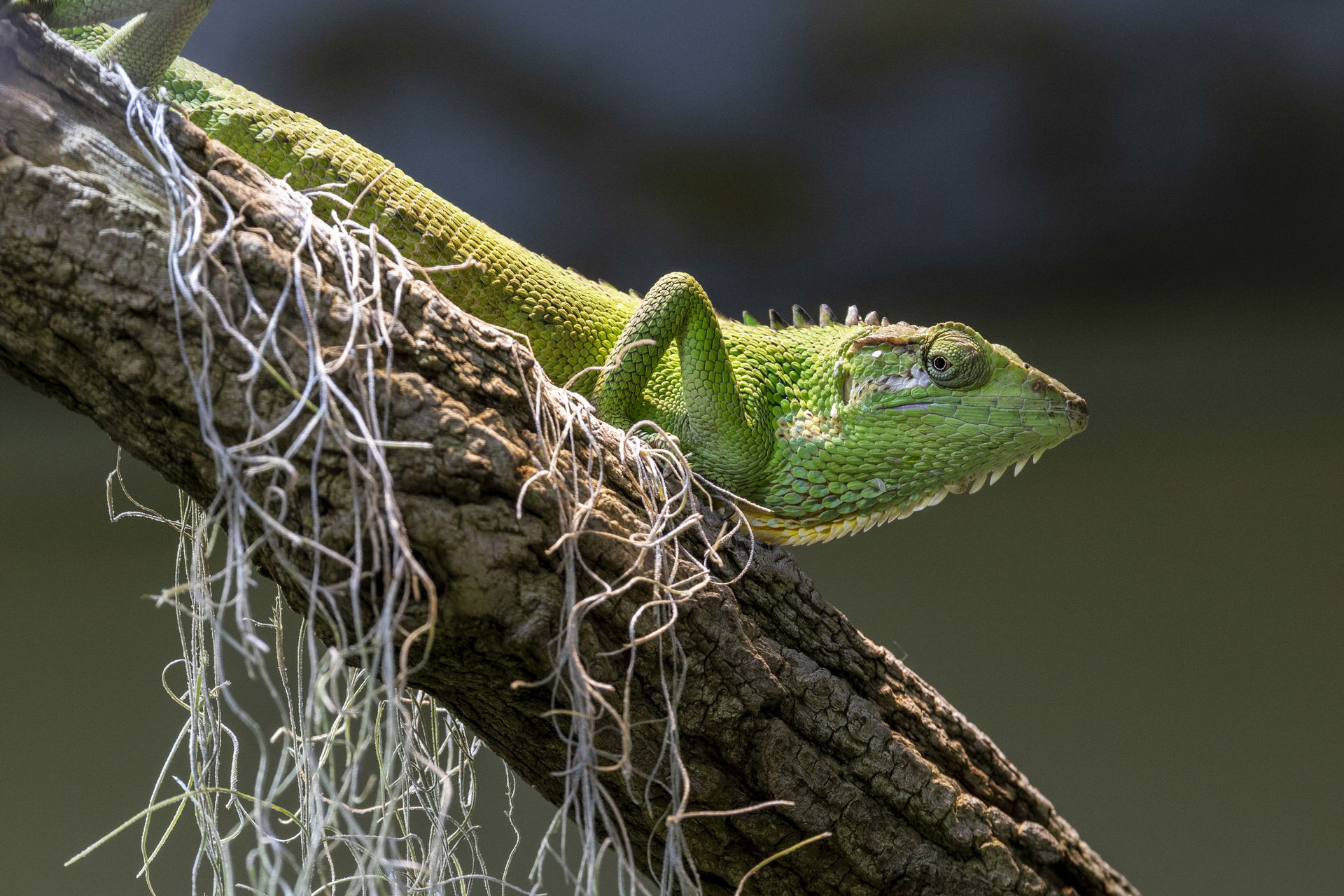
Peruanischer Buntleguan (Polychrus peruvianus) im Zoo Zürich

Peruvian bush anole

Polychrus peruvianus

The Peruvian bush anole moves like a swaying twig in the wind. Its extremely slow movements and camouflaged colouring make it very difficult to spot amongst the leaves and branches.

VU

Red List
Vulnerable

The lizard displays distinct sex-specific colouration: females have lime-green heads and a white lateral stripe on their bodies. Males have a brownish head and no lateral stripe. In addition, the males have a more pronounced dorsal crest and a sizeable throat flap.

When the animals are under stress, the colouring of the body, limbs and tail changes to a dark brown in both sexes. If the animal has white patches, these become more distinct. In females, the head also turns dark brown, whilst the head colour in males remains unchanged.

Taxonomy

Iguanidae, genus Polychrus (7 species)

Habitat

western South America, in lowland dry forests, rarely in moist forests

Behaviour and ecology

diurnal, arboreal, ambush hunter

Social structure

solitary

Taxonomy

Iguanidae, genus Polychrus (7 species)

Habitat

western South America, in lowland dry forests, rarely in moist forests

Behaviour and ecology

diurnal, arboreal, ambush hunter

Social structure

solitary

Back to overview