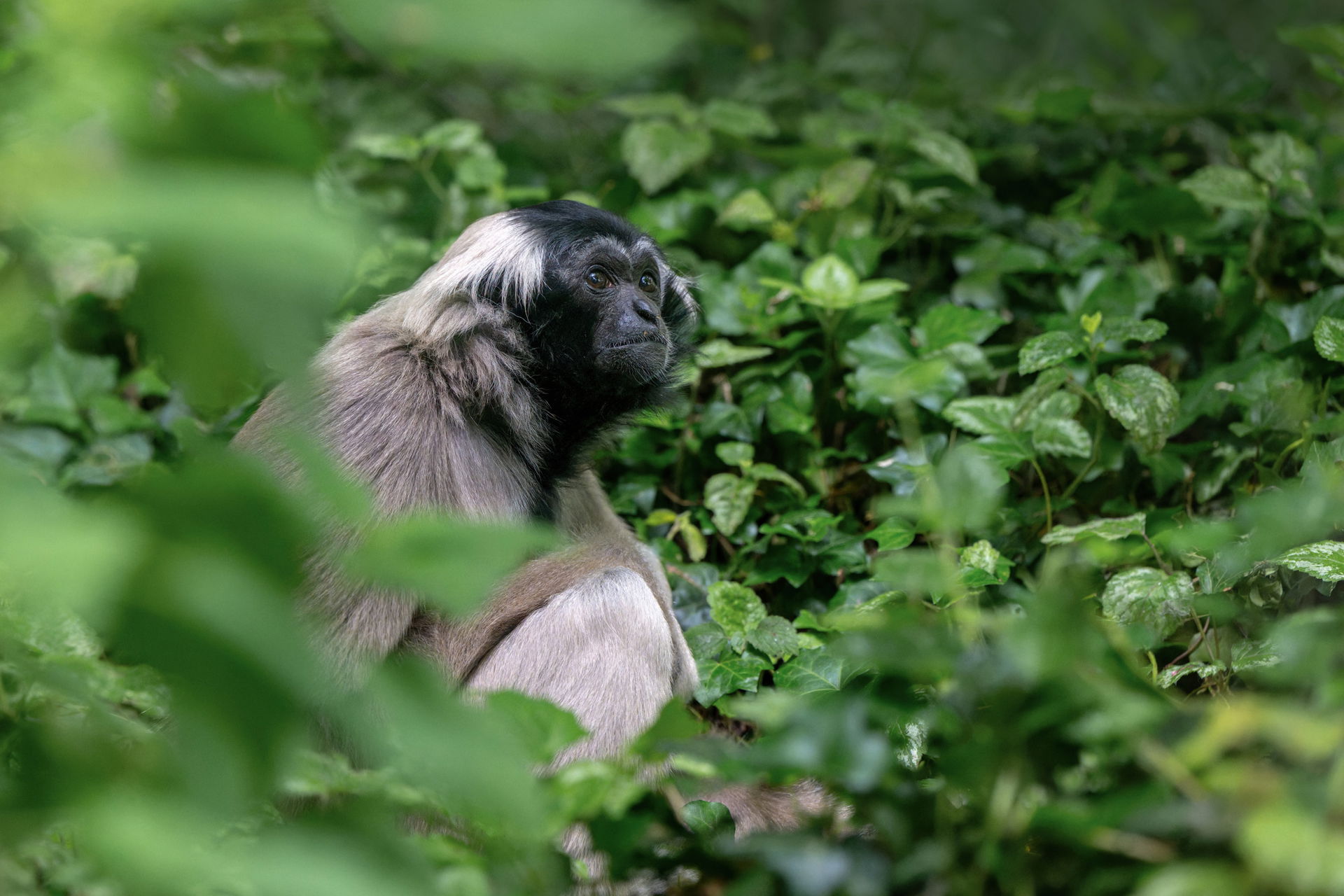
Kappengibbon (Hylobates pileatus) im Zoo Zürich

Pileated gibbon

Hylobates pileatus

Gibbons have developed their own method of locomotion – swinging from branch to branch – which is highly efficient in the treetops. Another distinctive feature is their calls, which they use to mark their territories and can be heard from a great distance.

EN

Red List
Endangered
Breeding programme

The infants of the pileated gibbons are initially cream-coloured. At the age of one year, their coat colour changes to a mixture of silvery and yellow-brown patches. Adult females retain this juvenile colouring. Males, however, change their coat colour during puberty, between the ages of six and eight, to an almost entirely black coat.

Gibbon families are very peaceful amongst themselves. There are hardly ever any squabbles. For example, two gibbons can eat from the same fruit without any trouble. Young gibbons never climb onto their mother’s back. They hold on to her belly, even when she is swinging about wildly.

Taxonomy

Hylobatidae, genus Hylobates (6 to 9 species)

Habitat

rainforest, evergreen dry forest up to 1,500 metres above sea level.

Behaviour and ecology

tree-dwelling; sleep in a sitting position without a nest

Social structure

in family groups; young adults are driven out of the group; very territorial

Godparent

Support the animals of Zoo Zurich with your annual godparent sponsorship

Pileated gibbon for CHF 1'200.–

Become a godparent

Godparent

Support the animals of Zoo Zurich with your annual godparent sponsorship

Pileated gibbon for CHF 1'200.–

Become a godparent

Tierstimme

Back to overview