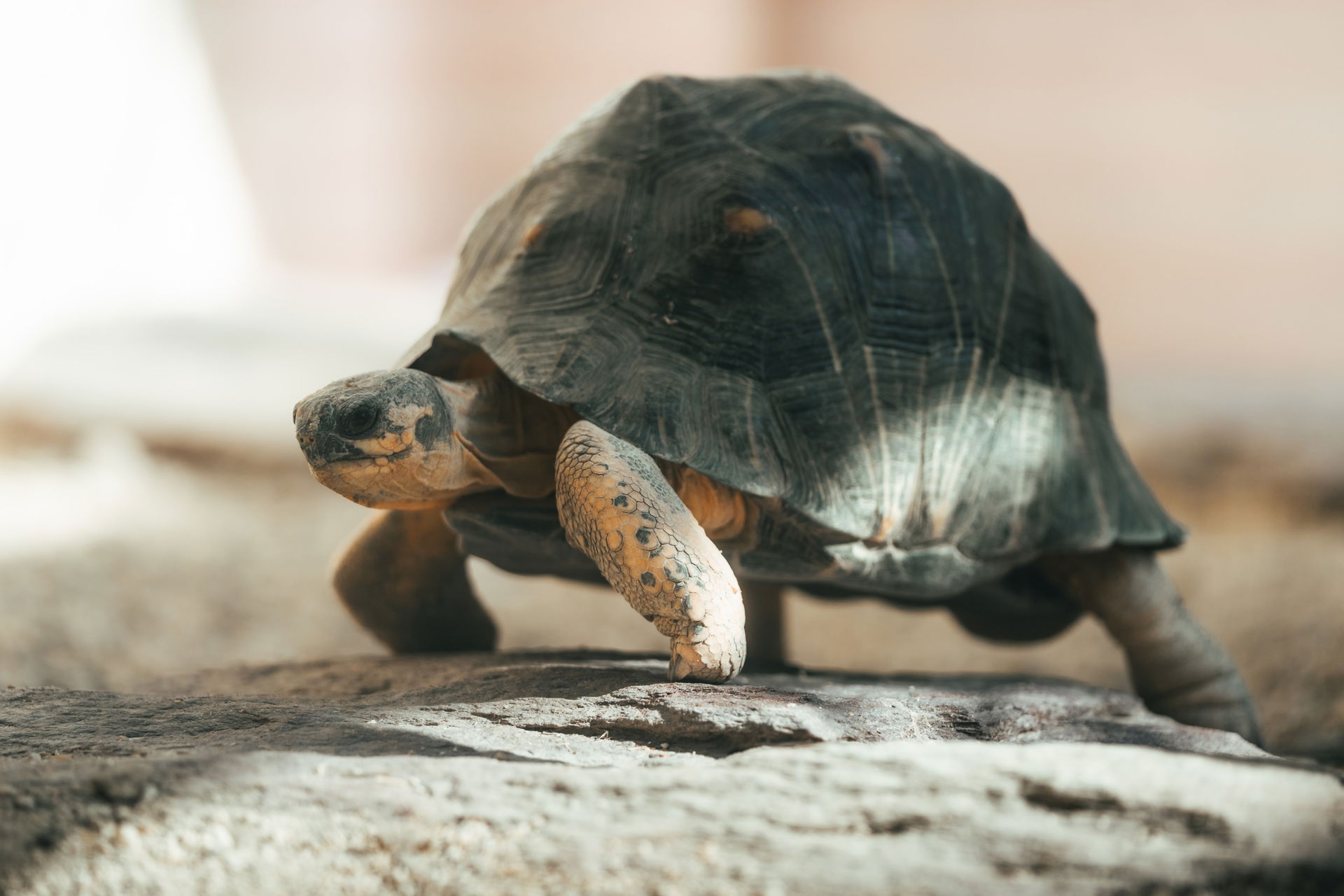
The tortoise’s radiating armour pattern gives this species its name. As each individual has a unique pattern, the animals can be distinguished relatively easily.
The radiated tortoise is endemic, meaning it is found only in Madagascar. It faces serious threats to its natural population and its habitat is disappearing due to human-caused slash-and-burn farming, deforestation and overgrazing. However, the tortoises are also collected and sold for food or as pets, despite being protected under international species conservation conventions.
During the hot dry season, the radiated tortoise can only be found in the early morning or late afternoon. During the rainy season, it is active throughout the day. Juveniles survive the dry season by hiding in foliage or burrowing into the sand.
Only once the males have reached a length of around 30 centimetres do they begin to court and mate. Loud hissing and grunting during mating is common. The females lay between 2 and 12 eggs in a hole they have previously dug and then leave the clutch.
The juveniles emerge after 215 to 240 days. Radiated tortoises exhibit temperature-dependent sex determination. At temperatures up to 29 °C, males hatch; at temperatures of around 29 or 30 °C and above, females hatch.
Taxonomy
Testudinidae, Astrochelys (2 species)
Behaviour and ecology
activity times vary depending on the season
Social structure
mostly solitary