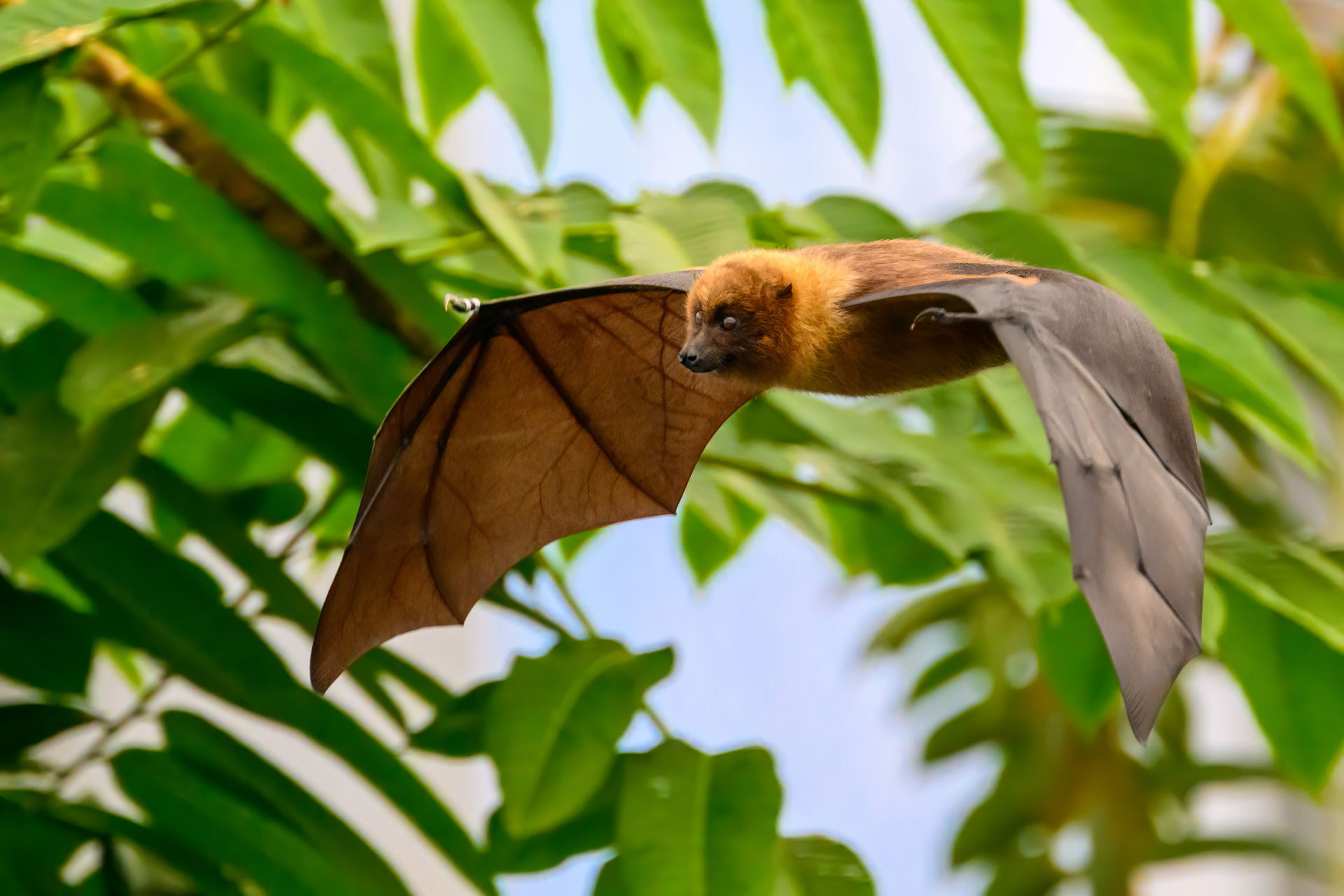
Rodrigues-Flughund (Pteropus rodricensis)  im Masoala Regenwald des Zoo Zürich

Rodrigues flying fox

Pteropus rodricensis

The Rodrigues flying fox is found only on the island of Rodrigues. In the 1970s, with fewer than 100 individuals remaining, it was on the verge of being extinct. Thanks to decades of conservation and breeding programmes, its population has grown significantly once again.

EN

Red List
Endangered
Breeding programme

Unlike bats, flying foxes do not usually navigate using echolocation, but rather by sight and smell.

Flying foxes like the juice of ripe fruit. To do this, they mash the fruit pulp in their mouths and expel the fibres. Whilst searching for nectar and ripe fruit, they brush against nearby flowers, thereby carrying pollen on their fur from flower to flower. As well as providing this pollination service, they carry undigested plant seeds, which they excrete in their droppings, thereby helping to achieve the distribution of plants.

Rodrigues flying foxes live on the island of Rodrigues, which covers an area of just 110 square kilometres. Their distribution is limited to a single valley there.

In 1916, the Rodrigues flying fox was described as common in sailors’ accounts. By 1965, there were fewer than 500 left.

In 1979, a cyclone struck the island of Rodrigues, decimating the already small population to just 70 animals. Following this, the Durrell Wildlife Park on Jersey launched an international breeding programme involving around 30 zoos, including Zoo Zurich. Thanks to reintroduction projects, the population on Rodrigues has since grown back to over 4,000 animals. 

Taxonomy

Pteropodidae, Pteropus (approx. 60 species)

Habitat

rainforest, coastal forest

Behaviour and ecology

active at dusk and at night, living in trees and clambering, travels by flying

Social structure

during the mating season, in harems; females in large colonies, males tending to be solitary and territorial

Habitat at the zoo:

Masoala Rainforest

Godparent

Support the animals of Zoo Zurich with your annual godparent sponsorship

Rodrigues flying fox for CHF 300.–

Become a godparent

Godparent

Support the animals of Zoo Zurich with your annual godparent sponsorship

Rodrigues flying fox for CHF 300.–

Become a godparent
Back to overview