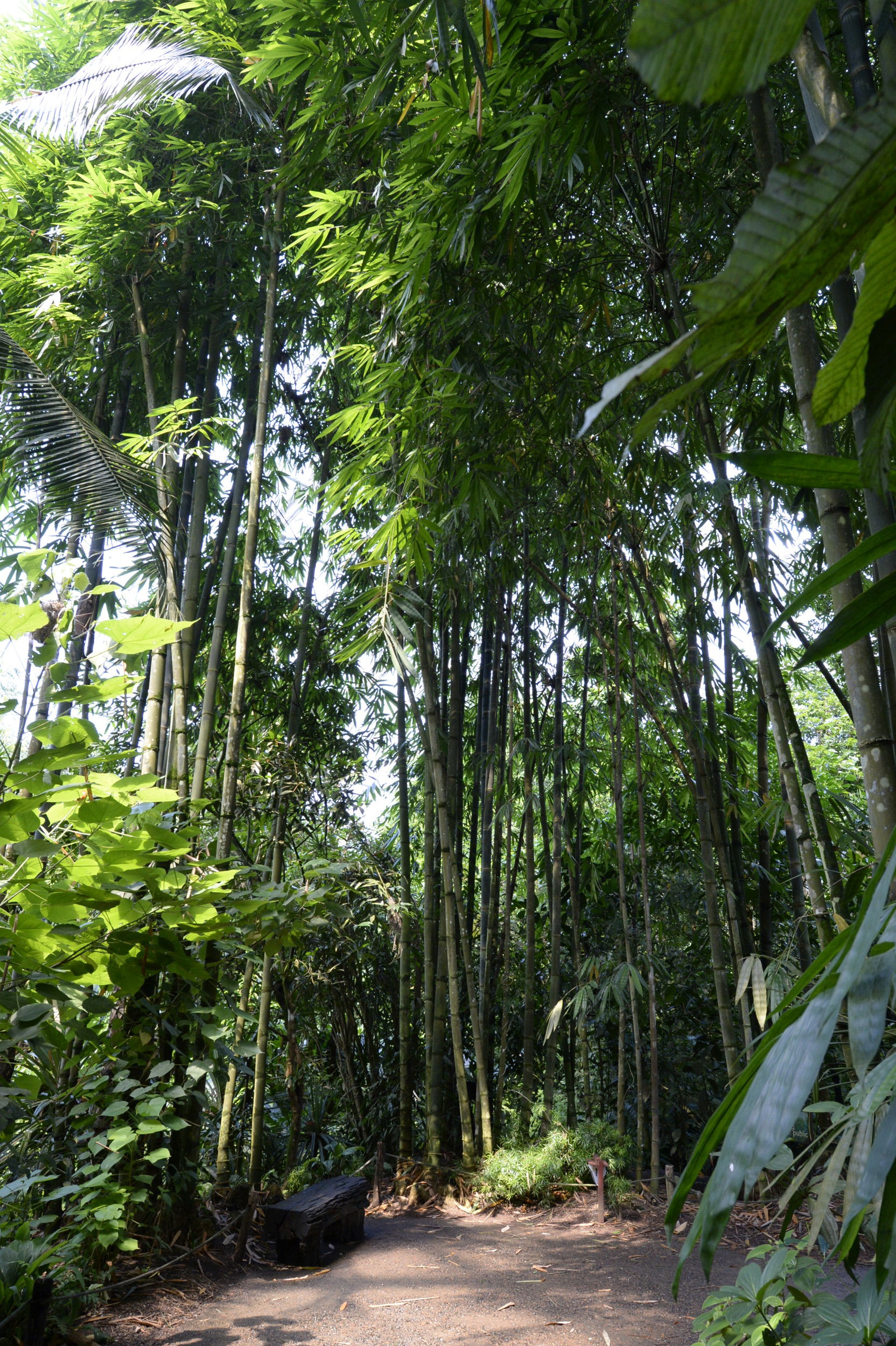
Gelber Bambus (Schizostachyum brachycladum) im Masoala Regenwald des Zoo Zürich

Sacred bamboo

Schizostachyum brachycladum

Most species of bamboo flower only at very long intervals, ranging from 12 to 120 years depending on the species.

Because of this often very long period without flowers, it is difficult for botanists to identify bamboo species, as the flowers serve as an important characteristic for species identification.

Once the fruit has set, the stalks die off. Bamboo does not normally reproduce via seeds, but produces new shoots from its roots. These shoots can grow by up to 120 centimetres a day!

Within a few months, a bamboo stalk reaches its final length and stops growing. Bamboo does not increase in thickness; the stalk remains the same thickness from the very beginning. As they mature, the stalks become drier and tougher over time.

The root mass of bamboo is enormous and can have a weight that is four times greater than the weight of the above-ground bamboo culms. The longest culms of giant bamboo can reach a height of 40 metres. However, there are also dwarf bamboo species that do not grow taller than 30 centimetres.

Bamboo has enormous economic value and, together with wheat, rice and maize, is regarded as one of the foundations of civilisation.

Distribution

tropical and subtropical regions around the world

Species

100 genera; exact number of species unknown

Use

building materials, scaffolding, roofs, light bridges, fences, furniture, buckets, eating and drinking vessels, food (bamboo shoots), fabrics for clothing, materials for weaving, shoe soles, paper, musical instruments (for example, the Madagascan valiha), tools (bamboo knives), hunting implements (blowpipes, spearheads, fishing rods, traps, fish traps), medicines (tabaschir), leaves as animal feed, ornamental plant

Habitat at the zoo:

Masoala Rainforest

Godparent

Support the plants of Zoo Zurich with your annual godparent sponsorship

Sacred bamboo for CHF 300.–

Become a godparent

Godparent

Support the plants of Zoo Zurich with your annual godparent sponsorship

Sacred bamboo for CHF 300.–

Become a godparent

Zeitraffer: Bambus-Wachstum

Godparents

I. Gebhard, Dielsdorf

Back to overview