Lorikeets feed primarily on nectar, pollen, and fruit, thereby playing an important ecological role as pollinators. Another characteristic feature of lorikeets is their specialized tongue, which has brush-like papillae for collecting nectar: When a lorikeet extends its tongue into a flower, the papillae stand upright, and the nectar sticks to them. As the tongue is withdrawn, it is pressed against the palate, and the liquid nectar is collected in skin folds. This process is repeated rapidly while the bird is feeding.
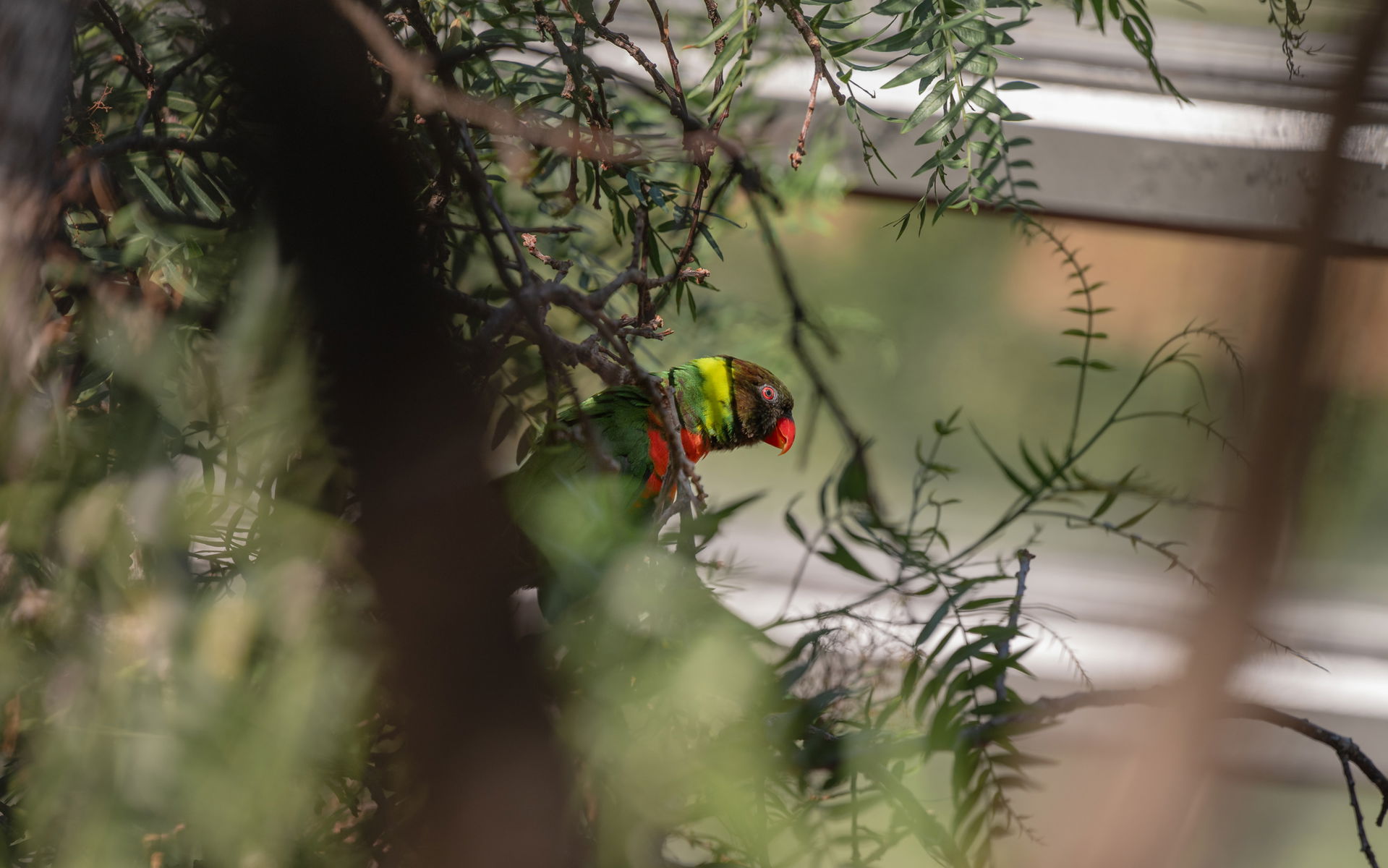
The scarlet-breasted lorikeet (Trichoglossus forsteni) stands out because of its bright red breast. The species was first scientifically described in 1850 by Prince Charles Lucien Bonaparte. However, it was later long considered a subspecies of the common lorikeet (Trichoglossus haematodus) before more detailed studies confirmed it as a distinct species.
The scarlet-breasted lorikeet is now critically endangered. The main cause is capture for the international bird trade. In addition, the loss of its habitat due to deforestation for plantations and agriculture is having a negative impact. The species was once widespread across several Indonesian islands, including Bali, Lombok, Sumbawa, as well as Tanahjampea and Kalaotoa. Today, populations have declined sharply throughout its range and, in many places, consist only of small, isolated groups. The species now occurs only in parts of Bali (with occurrences extending as far as Java), in northern Lombok, and in some regions of Sumbawa, where it inhabits primarily forest edges, open woodlands, and landscapes shaped by human activity.
The Zurich Zoo houses one of the four subspecies of the scarlet-breasted lorikeet: Trichoglossus forsteni mitchellii, which is primarily found on Bali and Lombok. It is slightly smaller and exhibits subtle differences in plumage pattern, such as a darker head with greenish streaking. However, these characteristics are not always clear-cut. What is clear is that these birds are very rare. Furthermore, given the small number of individuals observed, it is unclear whether they actually originate from wild populations or are partly descended from captive birds that have escaped.
Taxonomy
family of Psittaculidae, genus Trichoglossus (about 10 species)
Habitat
lowlands with forest and shrub vegetation; also mountainous areas above 1,000 m above sea level, provided suitable foraging trees (e.g., coral trees) are present; landscapes shaped by human activity
Behaviour and ecology
in flocks, form monogamous pairs, nest in tree hollows
Diet
pollen, nectar, fruits, seeds, and insects