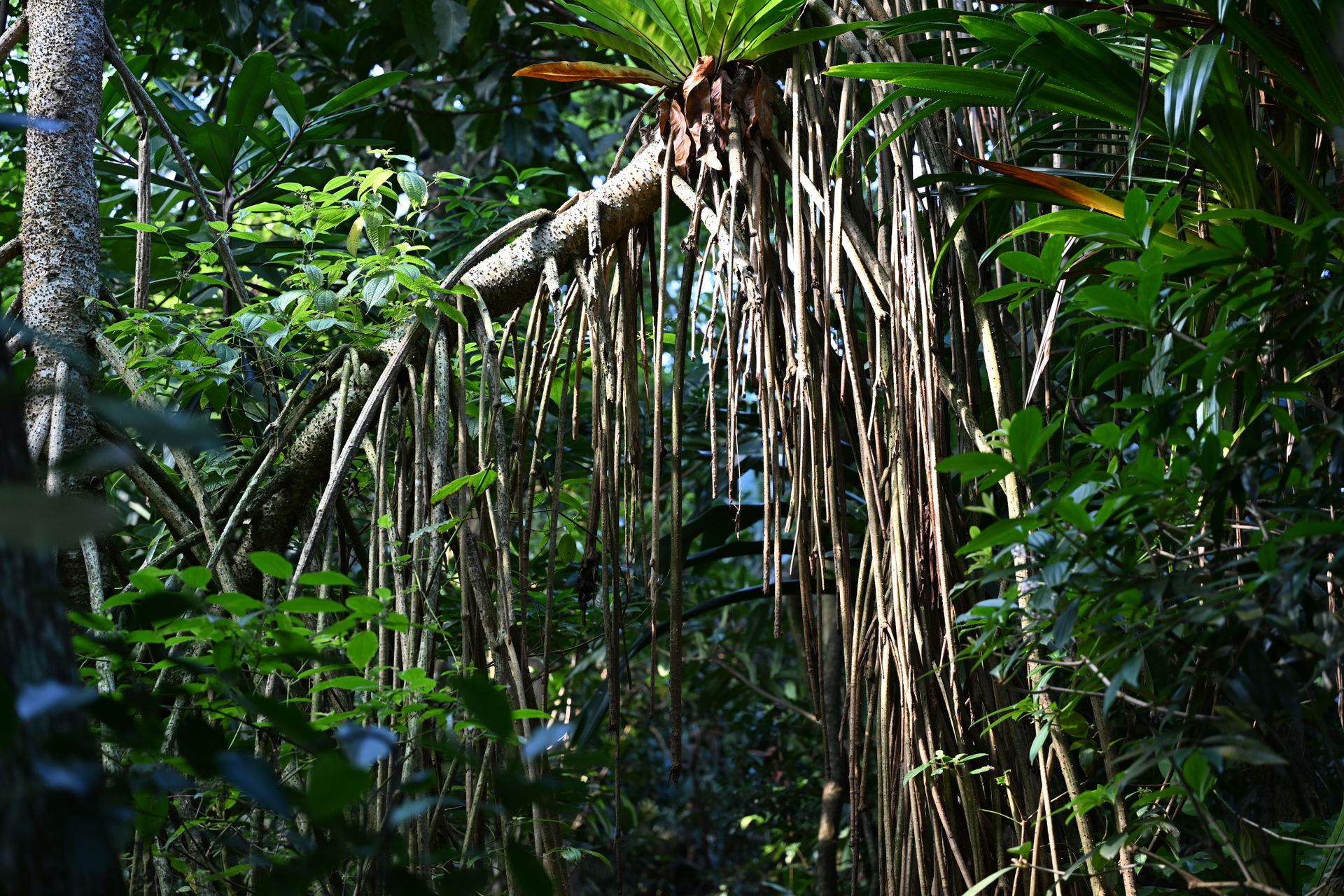
Schraubenbaum im Masoala Regenwald des Zoo Zürich

Screw pine

Pandanus baptistii

A distinctive feature of screw pines is their stilt roots, which develop near the shoots and grow down to the ground. The stilt roots support the relatively narrow tree trunks and prevent them from toppling over.

The approximately 700 species of screw pines inhabit swampy areas in rainforests and coastal regions near the sea. They are also commonly referred to as pandanus or screw palms. The term “Pandanus” is derived from their scientific name, Pandanaceae, whereas the term “screw palm” is misleading, as the plant is not related to palms.

Some species of the tree-like screw pine family form tuft-like clusters of leaves at the upper and outer parts of their branches. The leathery, spiny leaves of larger species can grow up to nine meters long. The leaves are arranged in three spirally twisted rows, which is how this plant family got its name, “screw pine.”

Screw pines are generally unisexual, meaning there are male and female plants. At the base of the inflorescences, sugar-rich, fleshy leaves develop, which serve as a food source for birds, bats, and flying foxes. These animals are responsible for pollination in many species. Some species are pollinated by the wind, while others reproduce vegetatively. Small lateral branches fall to the ground, take root, and grow into independent plants.

Screw pines are used for commercial purposes. For example, the Malagasy species screw pine utilis is cultivated in the Caribbean and Central America to produce weaving material. The leaves are used to make coffee sacks, baskets, household items, and roofs. A starchy food is obtained by boiling the fruits of the female plant. The pleasant scent of the male spikes serves as an aphrodisiac. The tips of the stilt roots are made into brushes, and a decoction prepared from the roots is said to cure sexually transmitted diseases.

Distribution

West Africa, Madagascar, South and Southeast Asia, Australia, and Polynesia

Species

700 (worldwide)

Use

leaves as material for weaving and construction, vegetables, and spices; leaf fibers as fabric for clothing; male cobs as perfume, spice, and syrup; fruits as flour for bread-making, starch-based dishes, cooking oil, and medicine; tuberous roots as paintbrushes; roots as medicine; wood as floats for fishing nets; the entire plant as an ornamental plant

Habitat at the zoo:

Masoala Rainforest
Back to overview