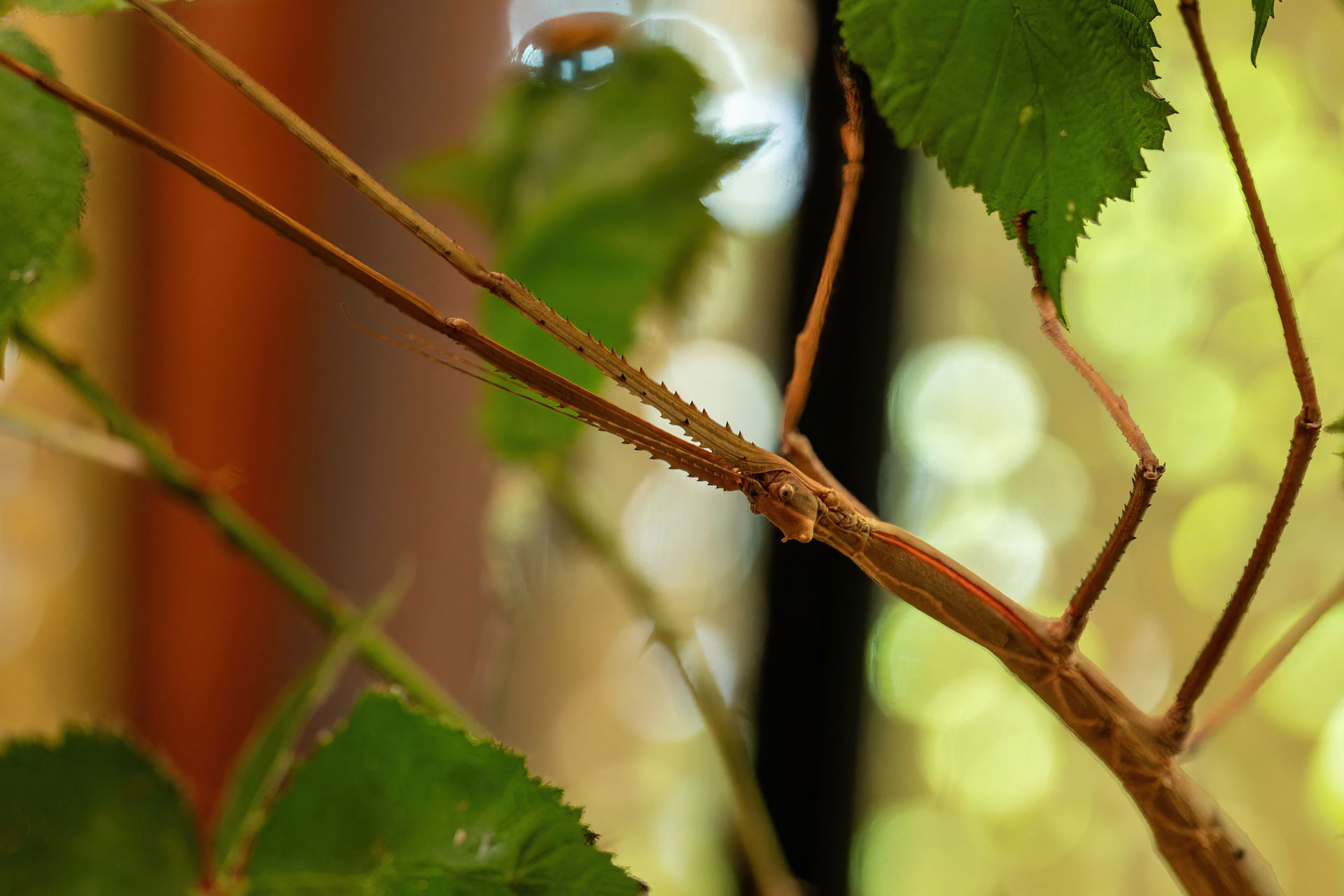
The two-humped stick insect is quite large for an insect. Despite its impressive body length of up to 20 centimetres, however, it is difficult to spot in its natural habitat. Its brownish-reddish colouring and twig-like body structure provide almost perfect camouflage amongst the vegetation, allowing it to hide inconspicuously amongst twigs and leaves.
There is a striking sexual dimorphism in body size and wing development. The females are larger and remain wingless. The males are smaller, but have fully developed wings and are able to fly.
Reproduction normally takes place sexually, but in the absence of a male, it can also occur via parthenogenesis (virgin birth). A female lays between 30 and 40 eggs per week, each measuring around 4 millimetres.
One remarkable strategy involves flinging individual eggs away with a powerful swing of the abdomen. This seemingly random distribution may serve an adaptive purpose, protecting the offspring from predators and parasites.
After an incubation period of 4 to 6 months, the nymphs hatch. They develop into adults over a period of 6 to 7 months, undergoing several moults.
Taxonomy
Phasmatidae, genus Tirachoidea (8 species)
Habitat
tropical rainforest on the island of Java (endemic)
Behaviour and ecology
on trees and bushes