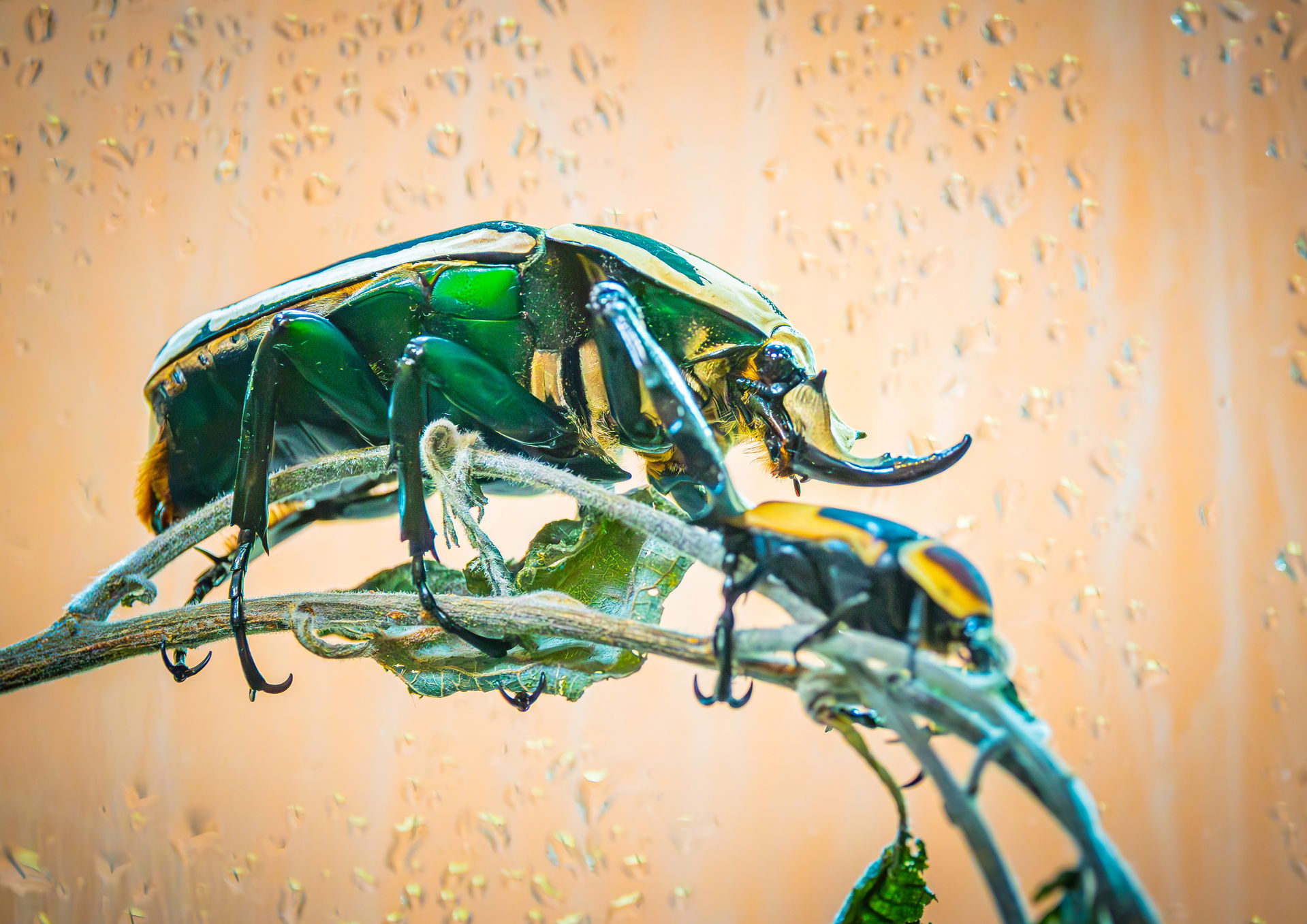
The Uganda flower beetle stands out due to its size and colourful plumage. Adult beetles can reach a body length of up to 8.5 centimetres and display a wide range of colours – from reddish-brown to shades of blue-green, purple or black. They are also usually adorned with white patterns, which vary from individual to individual.
However, Uganda flower beetles spend most of their lives not as beetles, but as larvae. The larval stage lasts up to two years, during which they play an important ecological role as decomposers. They feed mainly on dead wood and decaying plant material, thereby contributing to the decomposition of organic matter.
The fully-grown larvae pupate inside a cocoon made of soil and saliva. After a further two to three months, the adult beetle (imago) emerges from the cocoon. As adults, they live for only a few months, during which time they devote themselves mainly to reproduction. Males can be observed engaging in so-called pushing contests, in which they use their horns.
The Uganda flower beetle is used in research to study muscle activity during flight. Rose beetles fly with their wing covers (elytra) closed by extending their forewings and flapping them. This means that small computers can be attached to their backs without hindering their flight. The Uganda flower beetle is also suitable for the experiment because, thanks to its size, it can carry a heavier weight.
Taxonomy
leaf-horn beetles (Scarabaeidae), Mecynorrhinella (approx. 4 species)
Habitat
leaf litter of the tropical rainforest surrounding Lake Albert
Behaviour and ecology
diurnal
Diet
larvae: decaying leaves and dead wood; adult beetles: flowers and fruit