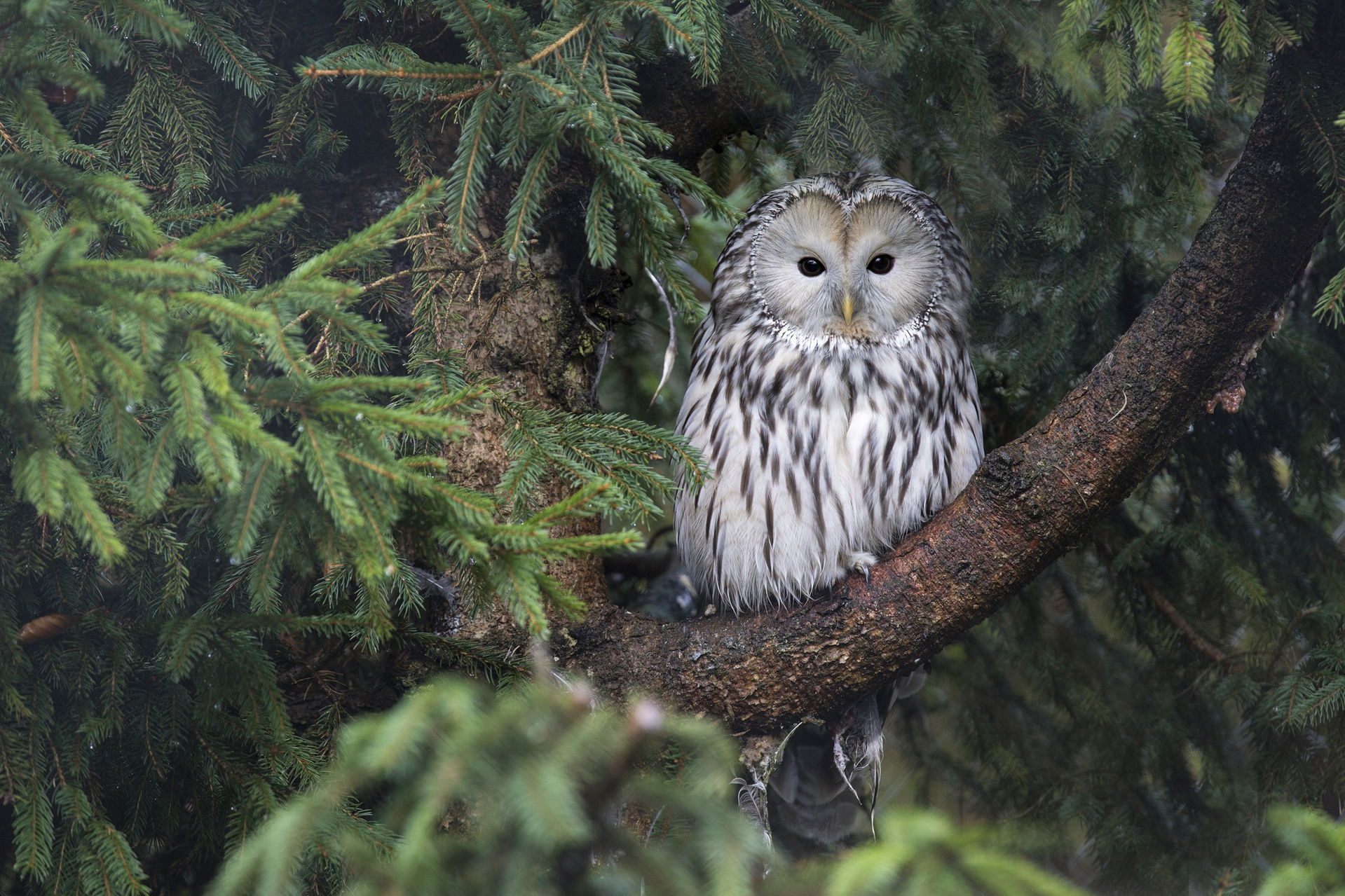
Habichtskauz im Zoo Zürich

Ural owl

Strix uralensis

Compared with many other owls, the Ural owl has relatively small eyes. It is not exclusively nocturnal, but can also be active at dusk and during the day.

LC

Red List
Least Concern
Breeding programme

Owls’ eyes are fixed and face forwards. As a result, the fields of vision of the two eyes overlap over a large area. It is only within this area that distances can be accurately judged, which is of great importance to these predators.

Release of an Ural owl into the wild

In the mid-20th century, the Ural owl disappeared from Austria’s forests. This was primarily due to habitat loss and hunting by humans.

Since 2009, Ural owls hatched in zoos have been released into the wild in eastern Austria. Zoo Zurich supports this project by providing young birds to help ensure the survival of the species in the wild.

Taxonomy

Strigidae, genus Strix (17 species)

Habitat

boreal coniferous forest

Behaviour and ecology

active at dusk and at night

Migratory behaviour

loyal to the location

Taxonomy

Strigidae, genus Strix (17 species)

Habitat

boreal coniferous forest

Behaviour and ecology

active at dusk and at night

Migratory behaviour

loyal to the location

Godparent

Support the animals of Zoo Zurich with your annual godparent sponsorship

Ural owl for CHF 200.–

Become a godparent

Godparent

Support the animals of Zoo Zurich with your annual godparent sponsorship

Ural owl for CHF 200.–

Become a godparent

Tierstimme

Back to overview