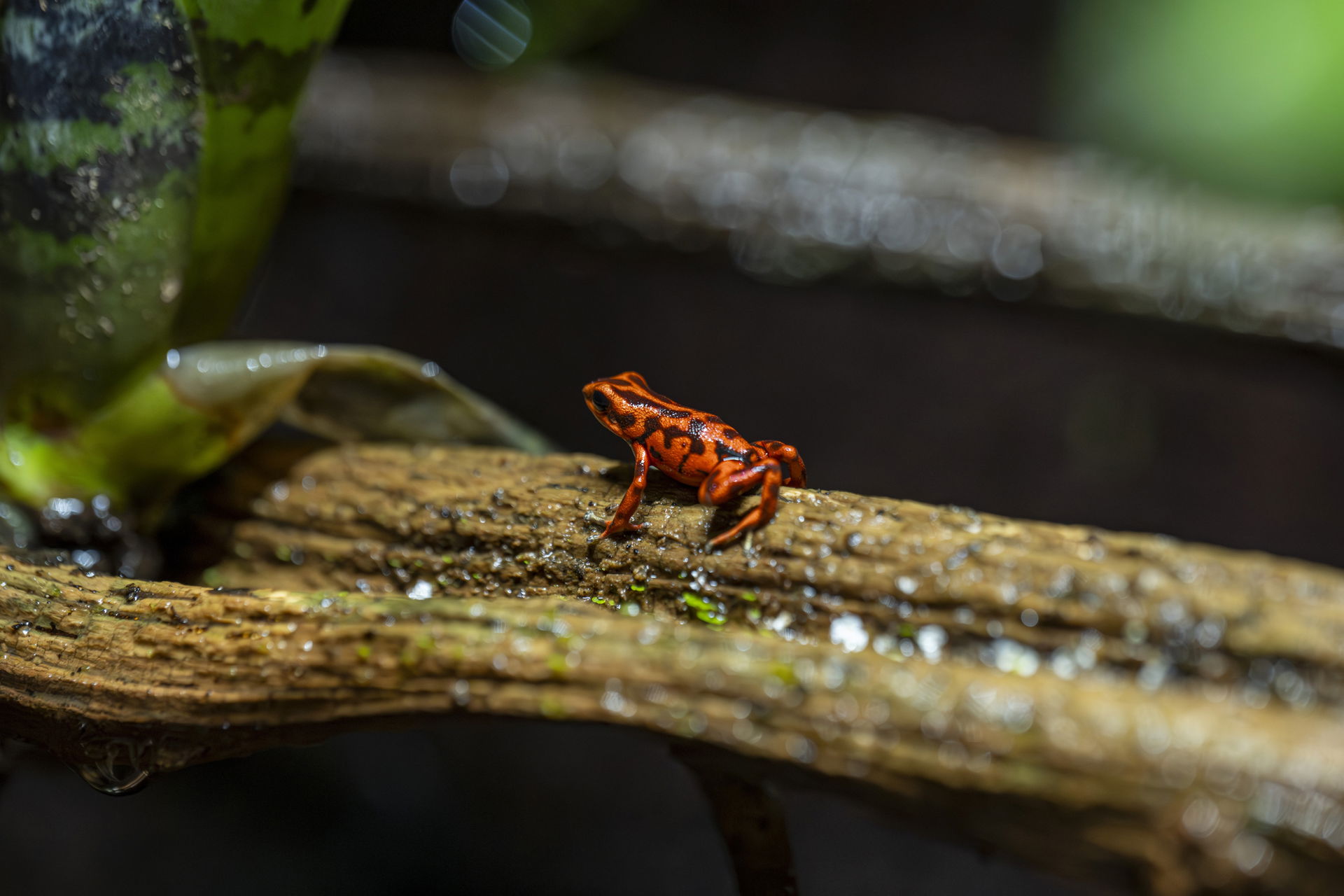
Like some members of the genus Oophaga , Vicente’s poison frog is remarkable for its wide variety of colour variations and patterns, which range from red and black to green and blue-black.
Vicente’s poison frog also displays typical behaviour of the genus Oophaga during courtship. The male attracts females ready to mate with his calls. As soon as he spots a female, he switches to a different type of call.
As with other Oophaga species, the male then leads the female to the egg-laying site – usually the smooth base of a bromeliad leaf – whilst intermittently calling. At the laying site, it begins to sweep its hind legs across the leaf. The female mimics this movement by pressing her abdomen against the leaf and making circular movements, thereby moistening the leaf. This process can take more than thirty minutes. The male usually remains passive during this time, until he finally climbs over to the female.
Once both have made contact with their cloacas, sperm transfer presumably takes place. The male then leaves the laying site and often begins calling again from neighbouring leaves. Only then does the female lay her eggs.
After hatching, the female carries the larvae one by one on her back to the leaf axils filled with water. Every two to eight days, she returns to each larva to lay nourishing eggs. As soon as the female appears at the edge of the leaf axil, the larva begins to wriggle. The female then climbs backwards into the axil and lays two to six unfertilised clutches. During this feeding phase, the female does not lay any further fertilised clutches.
Vicente’s poison frog is classified as endangered. The main threats are deforestation and forest clearance for large-scale opencast mining, cattle farming, the clearing of new agricultural land, and the development of housing estates.
Vicente’s poison frog is extremely attractive and, due to its colour variations, is in high demand in the pet trade. However, excessive harvesting for the pet trade could also pose threats in the future.
Taxonomy
Dendrobatidae, genus Oophaga (9 species)
Habitat
caribbean coastal lowlands of Panama
Behaviour and ecology
lives high up in the trees at a height of 5 to 15 metres; only rarely on the ground
Diet
insects and other invertebrates